Andrea McKenna • May 17, 2026

Walk of the Cosmos in Borrego Springs

Share
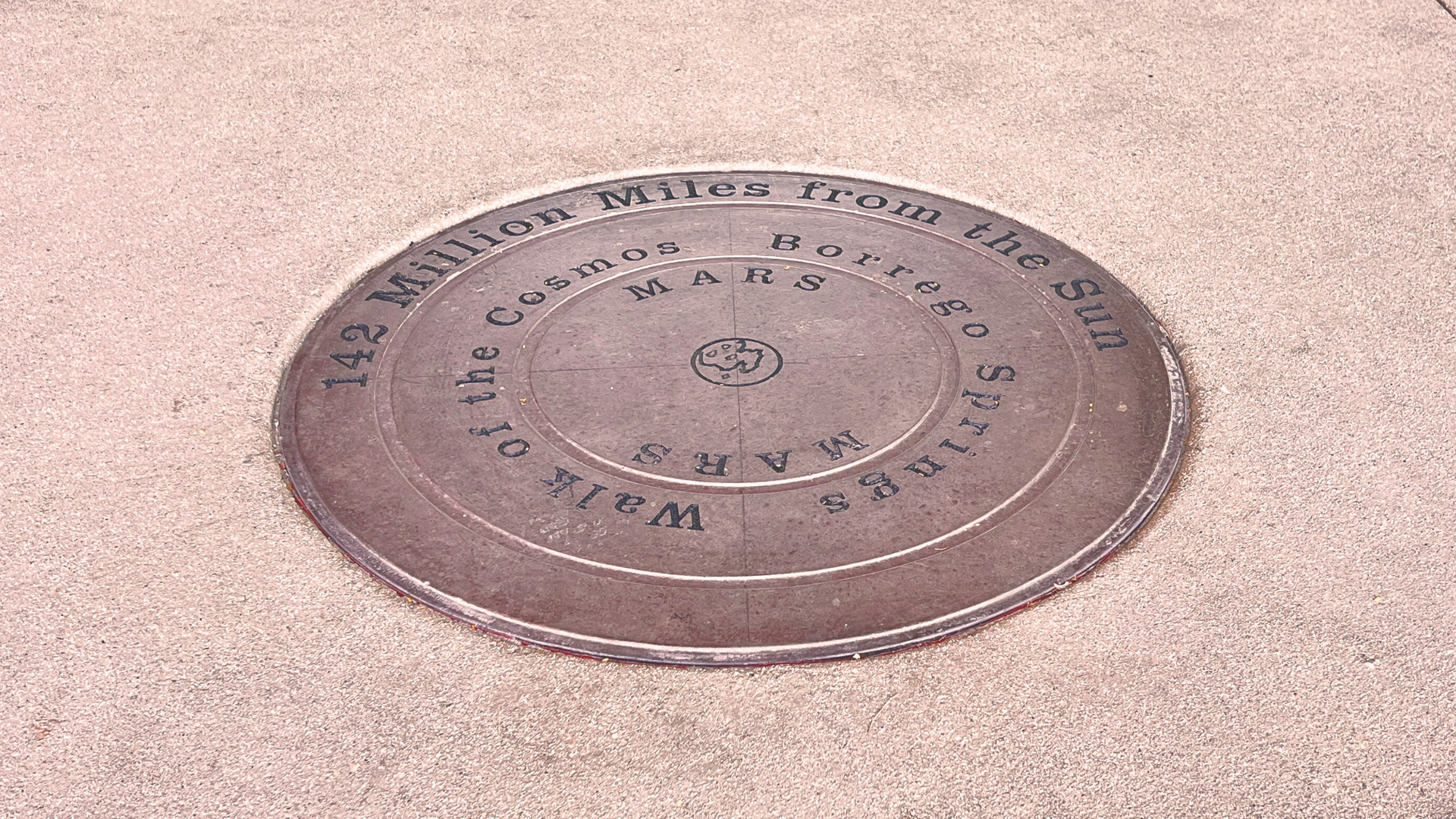
Walk of Cosmos in Borrego Springs

Visit the Walk of the Cosmos in Borrego Springs

Borrego Springs is home to a unique attraction that offers visitors an immersive experience combining the vastness of space with the serene beauty of the desert. The Walk of the Cosmos, located within the Borrego Springs Park and Library complex, invites you to take a journey through our solar system while enjoying a variety of outdoor amenities.


2580 Country Club Road

Borrego Springs, California 92004

Get Directions


Journey Through the Solar System


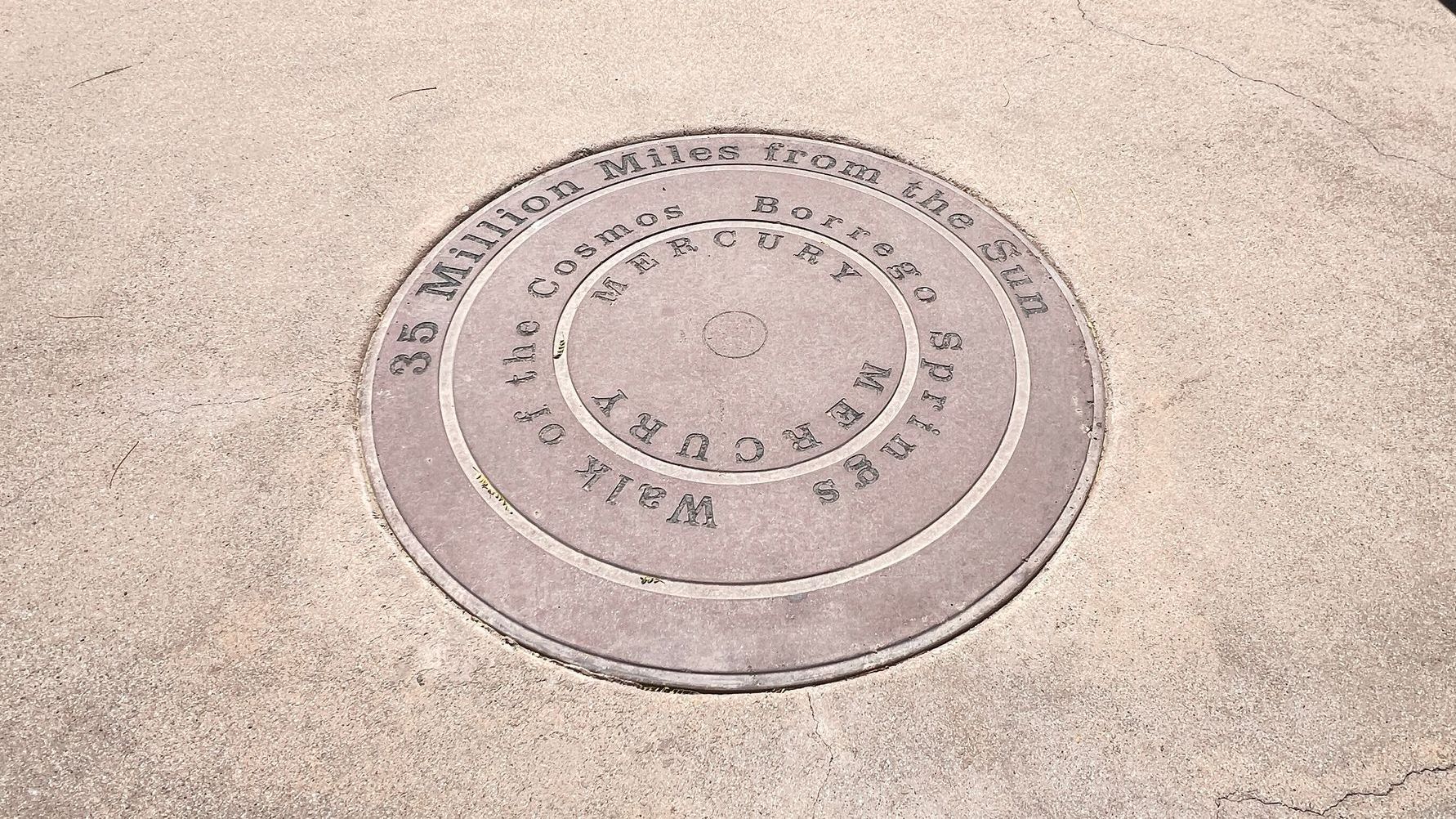
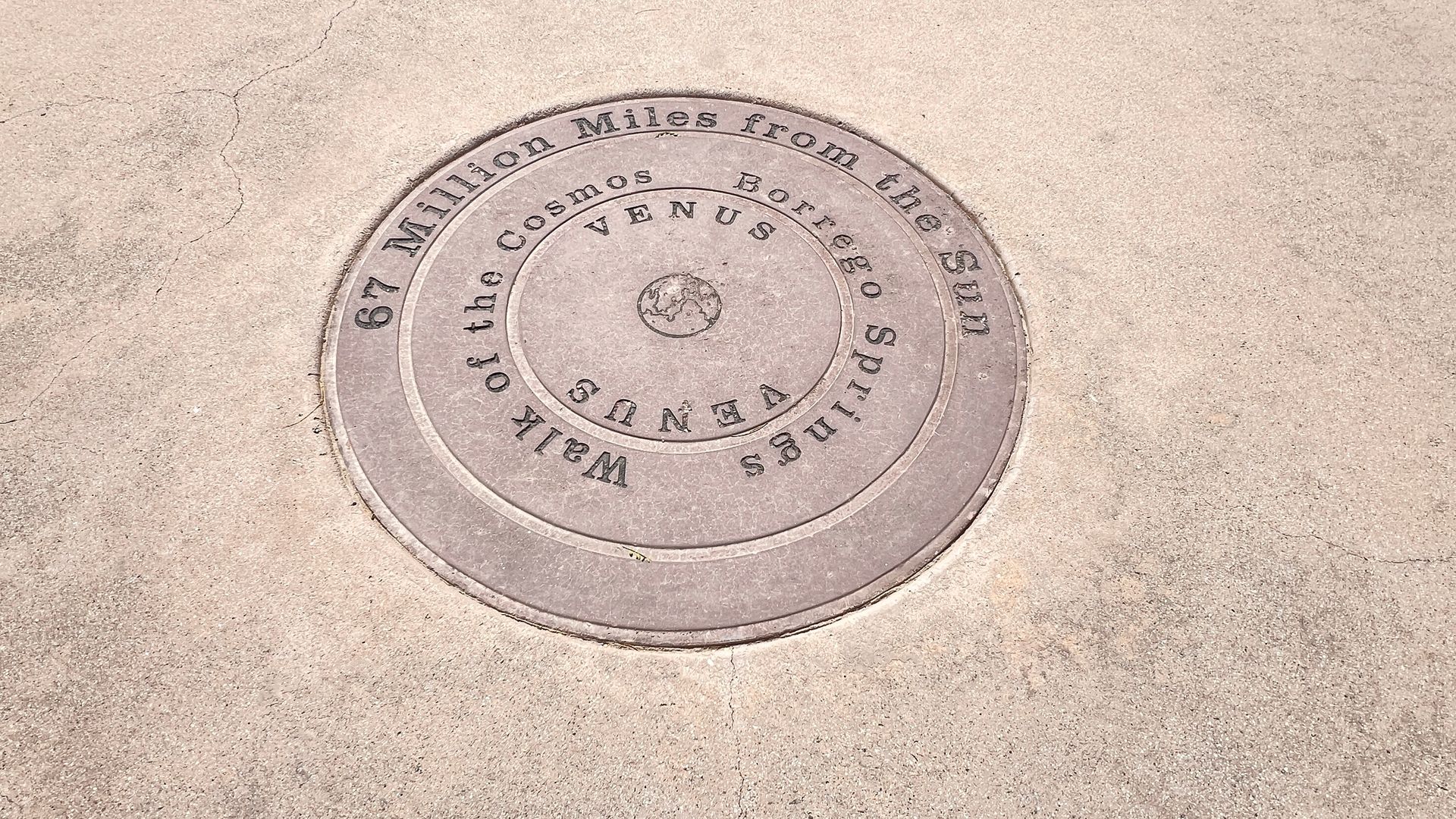
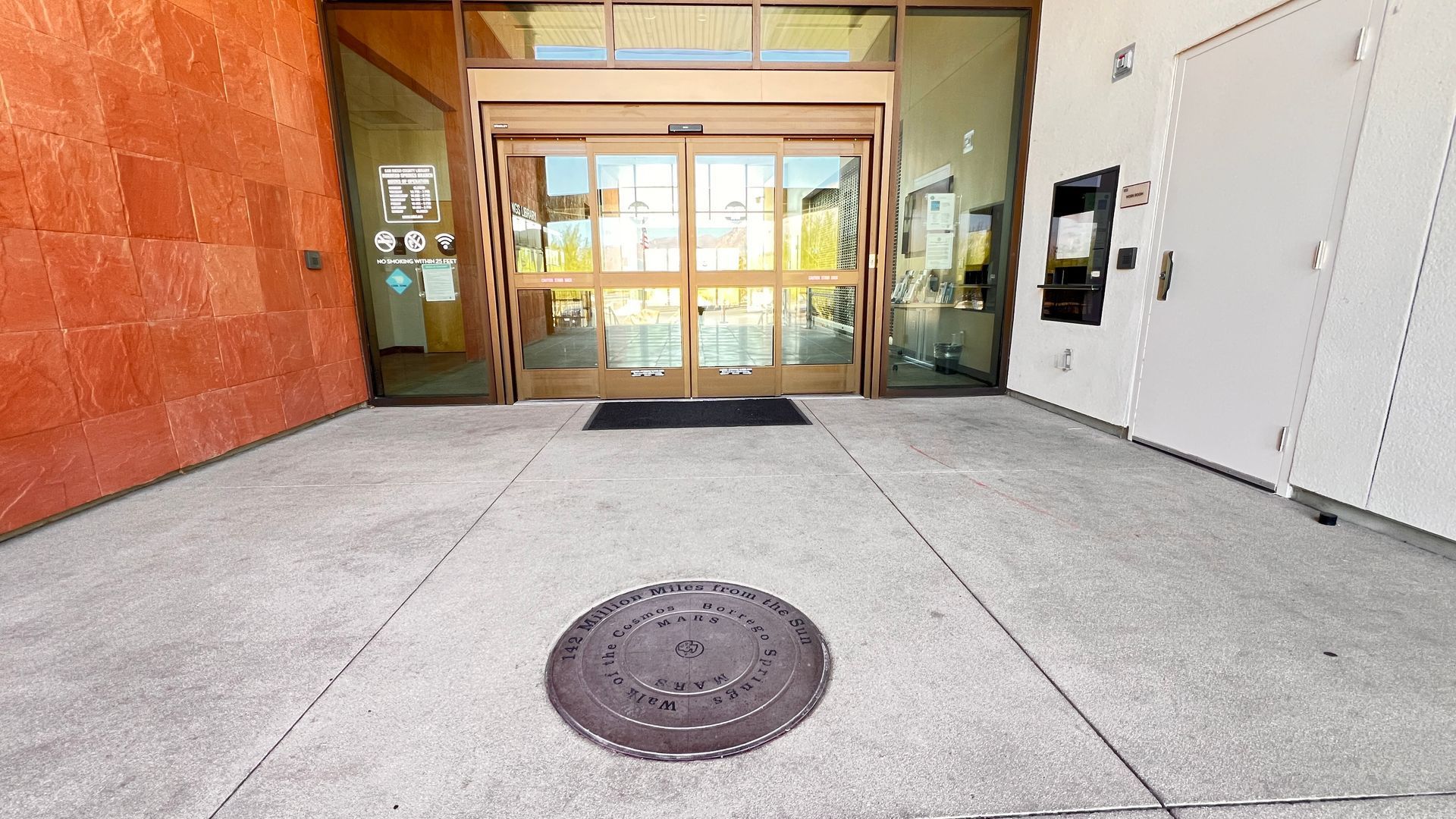
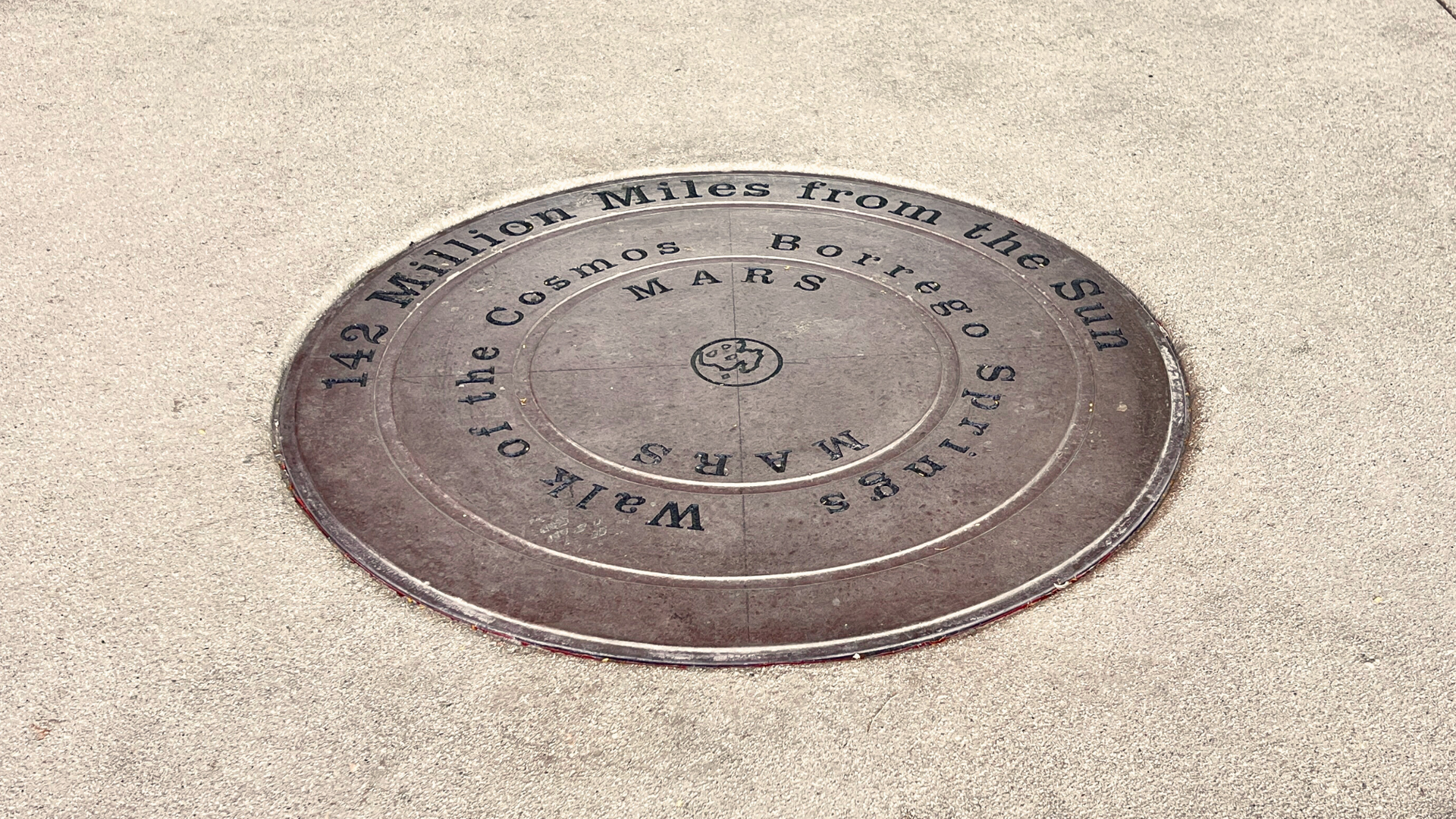
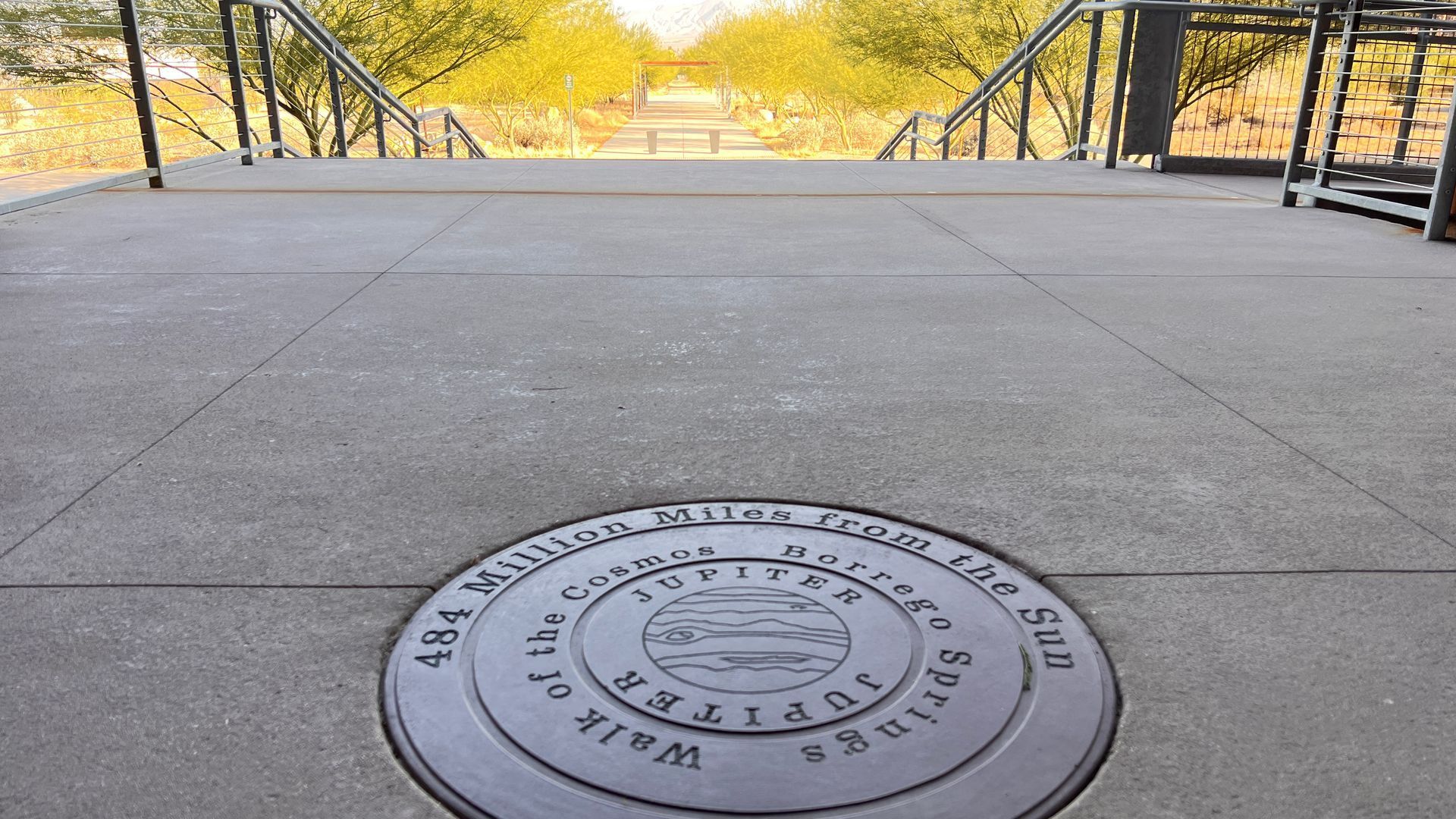
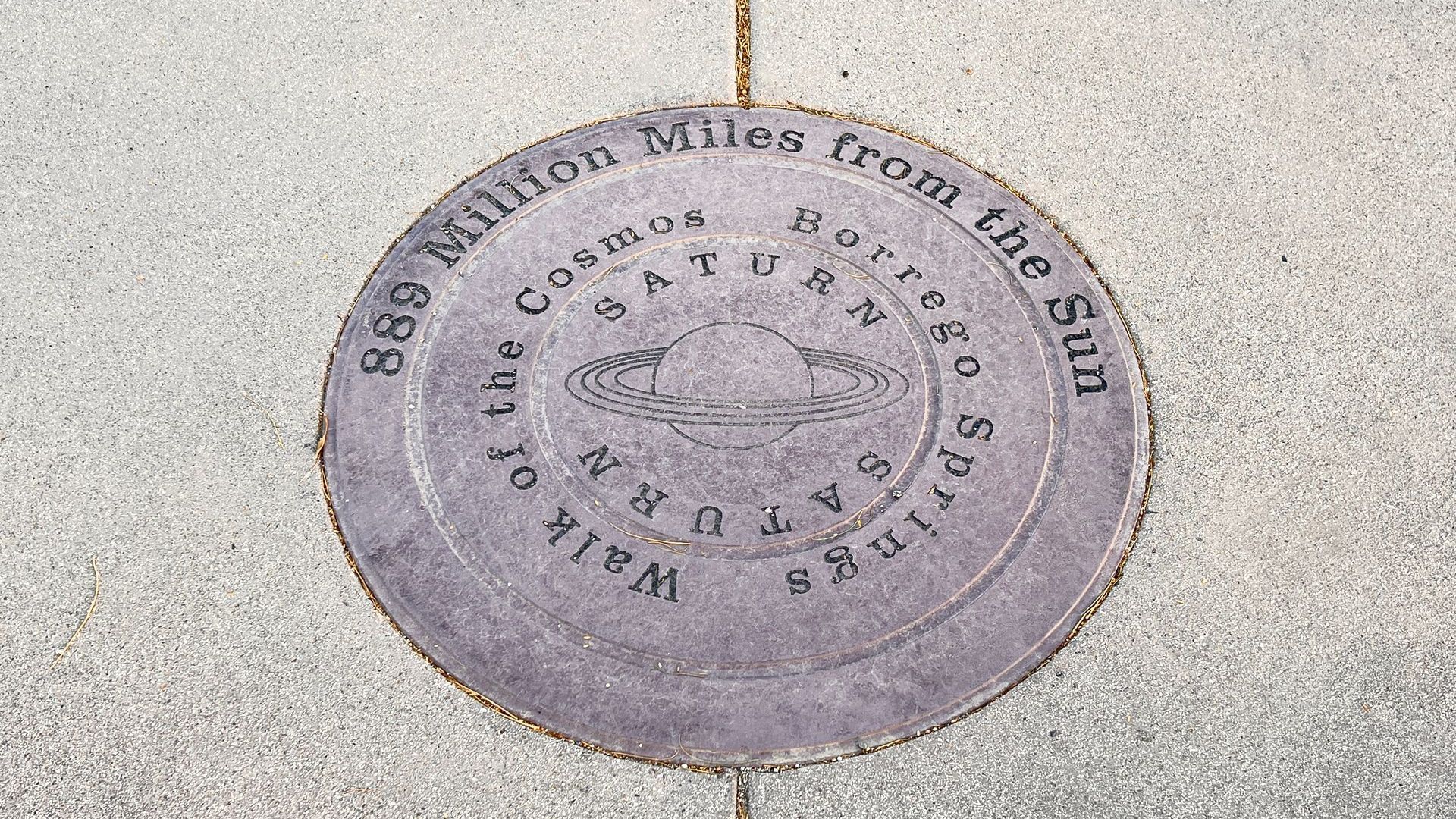
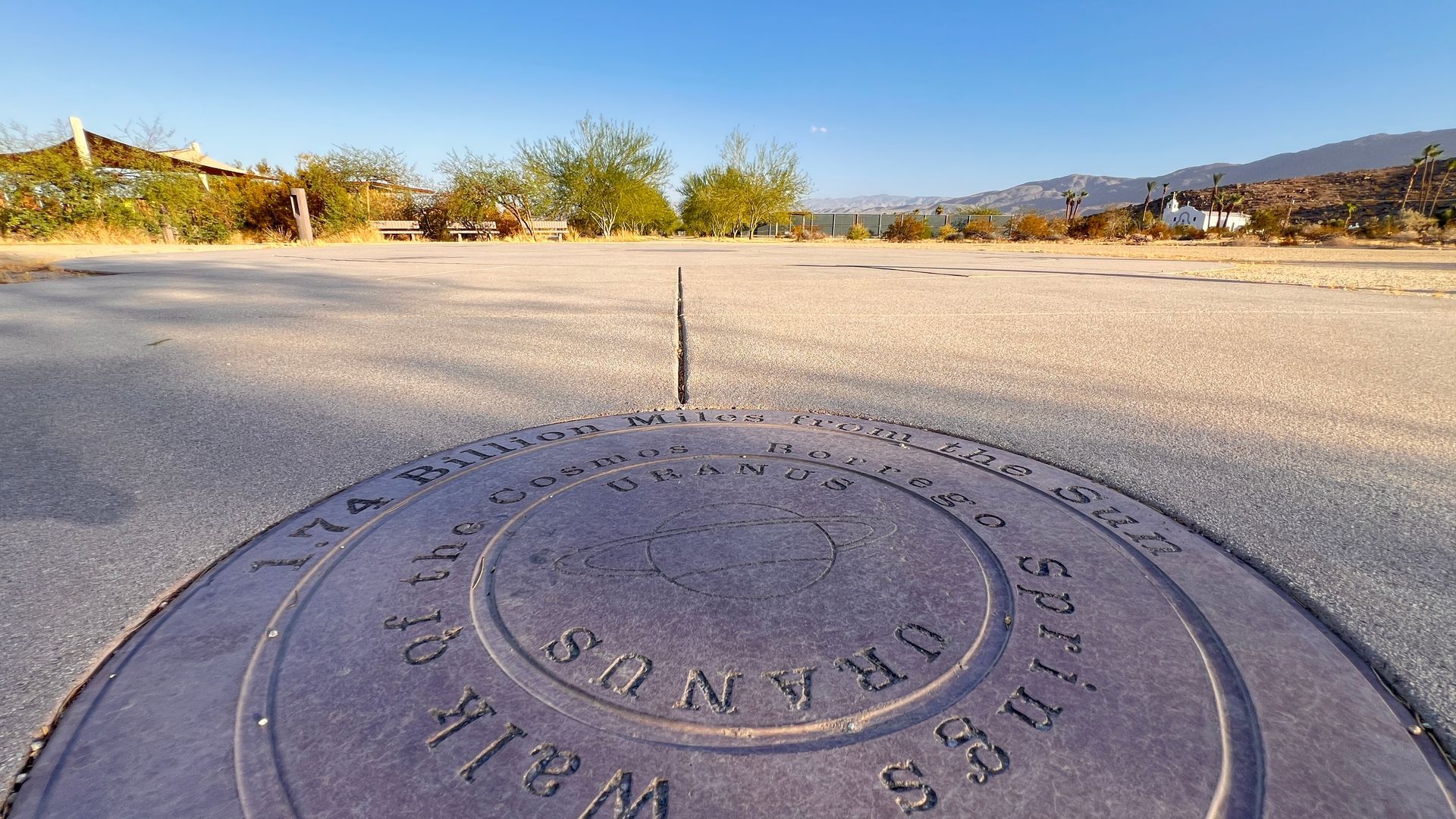
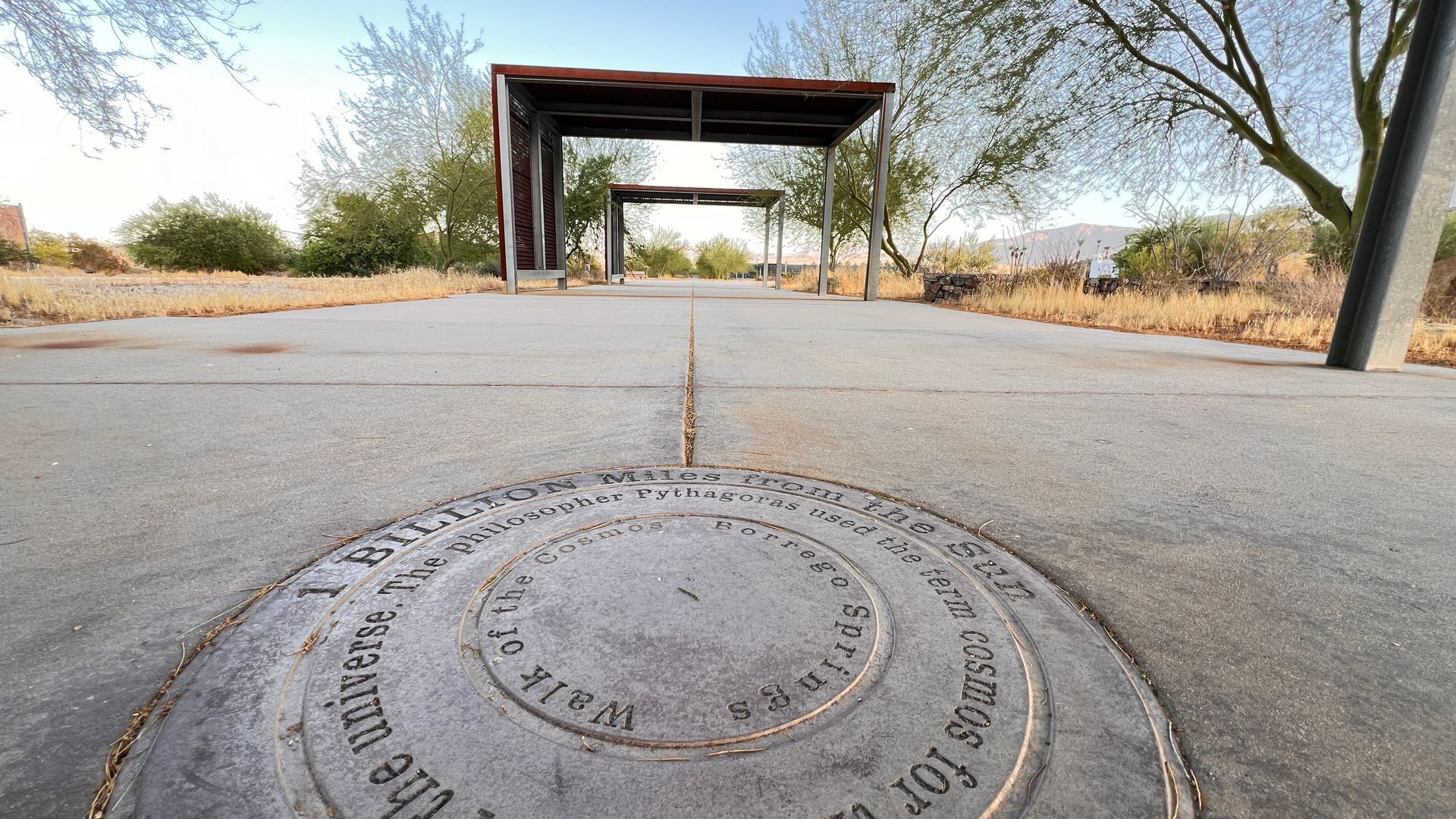
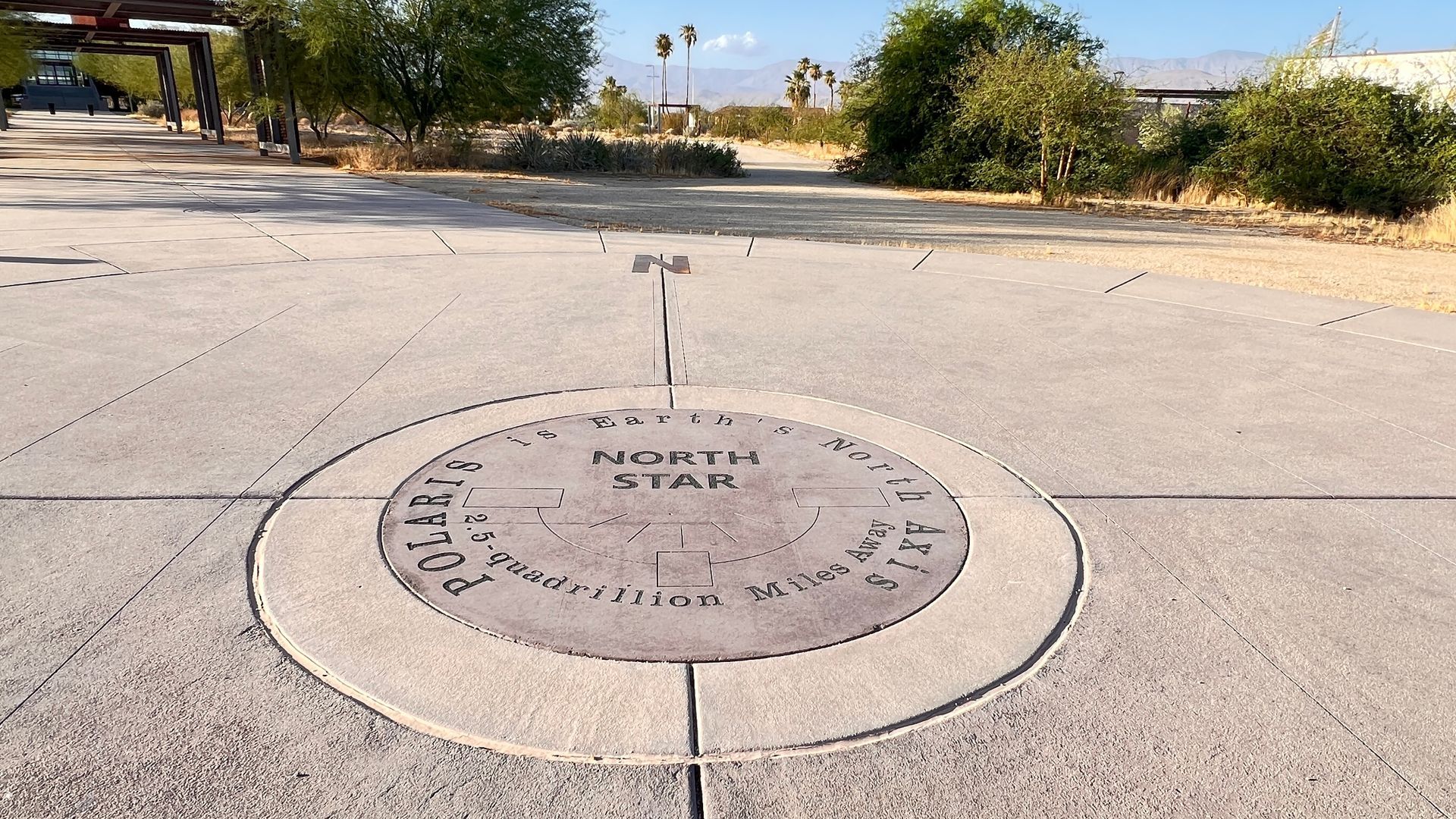
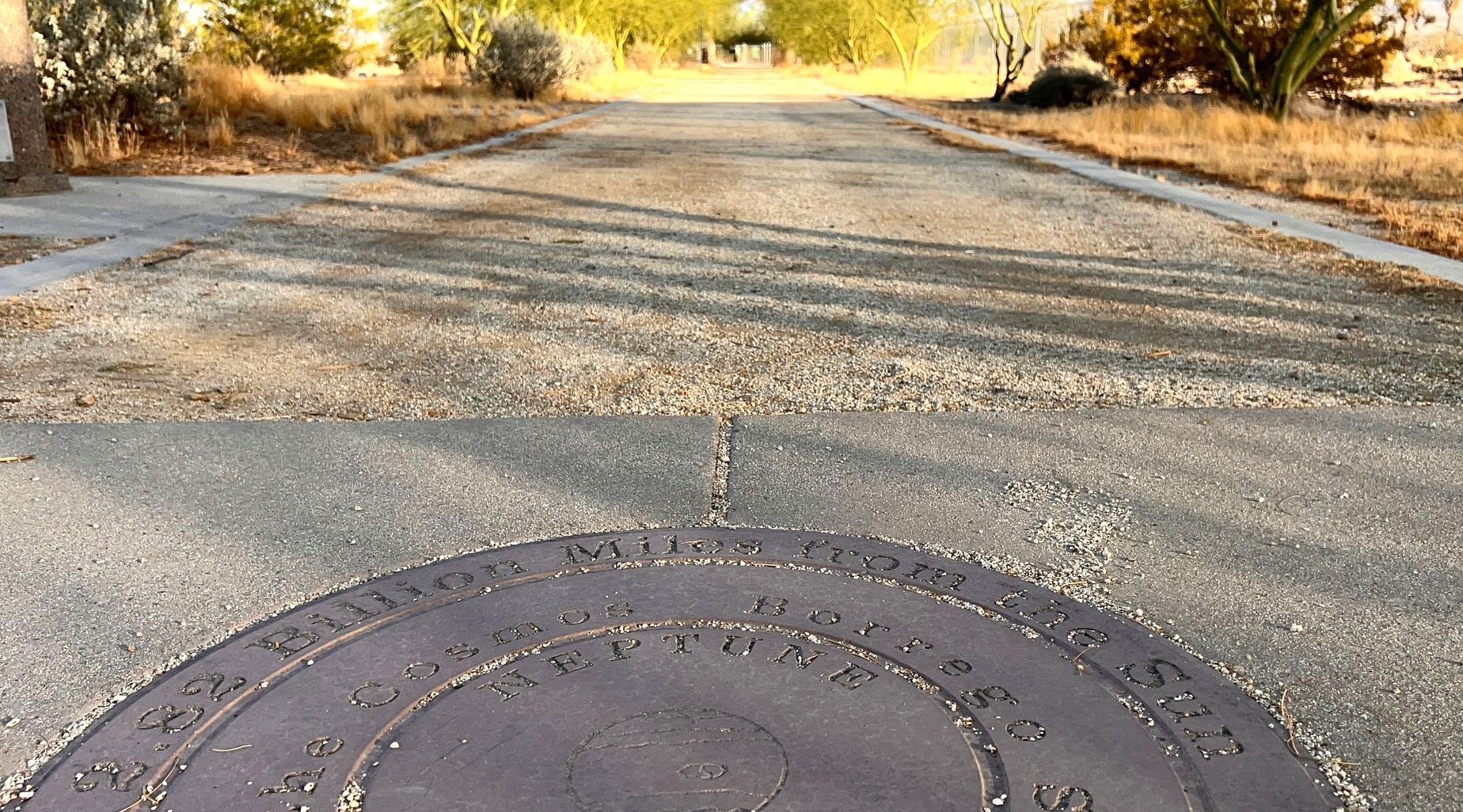
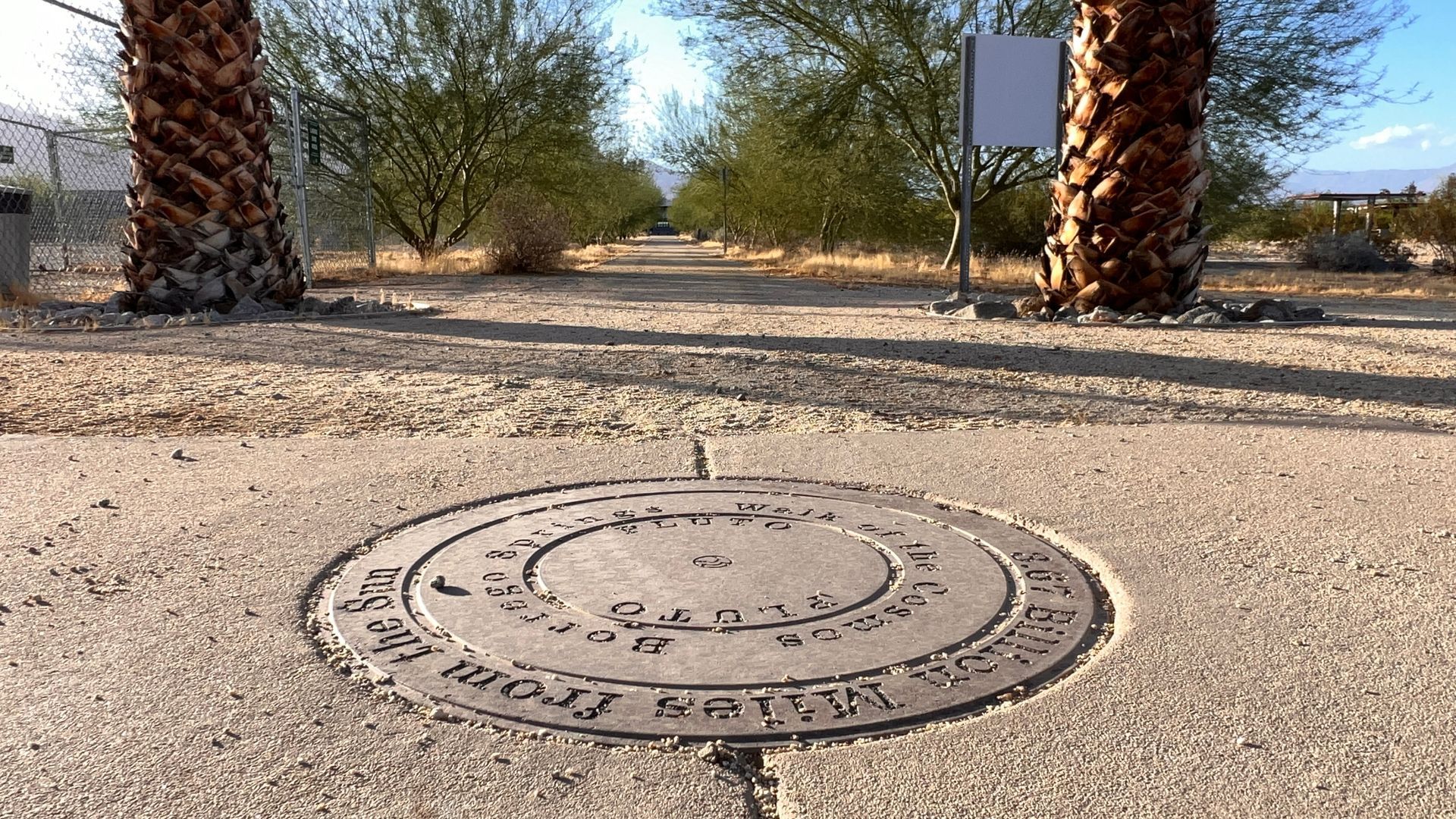
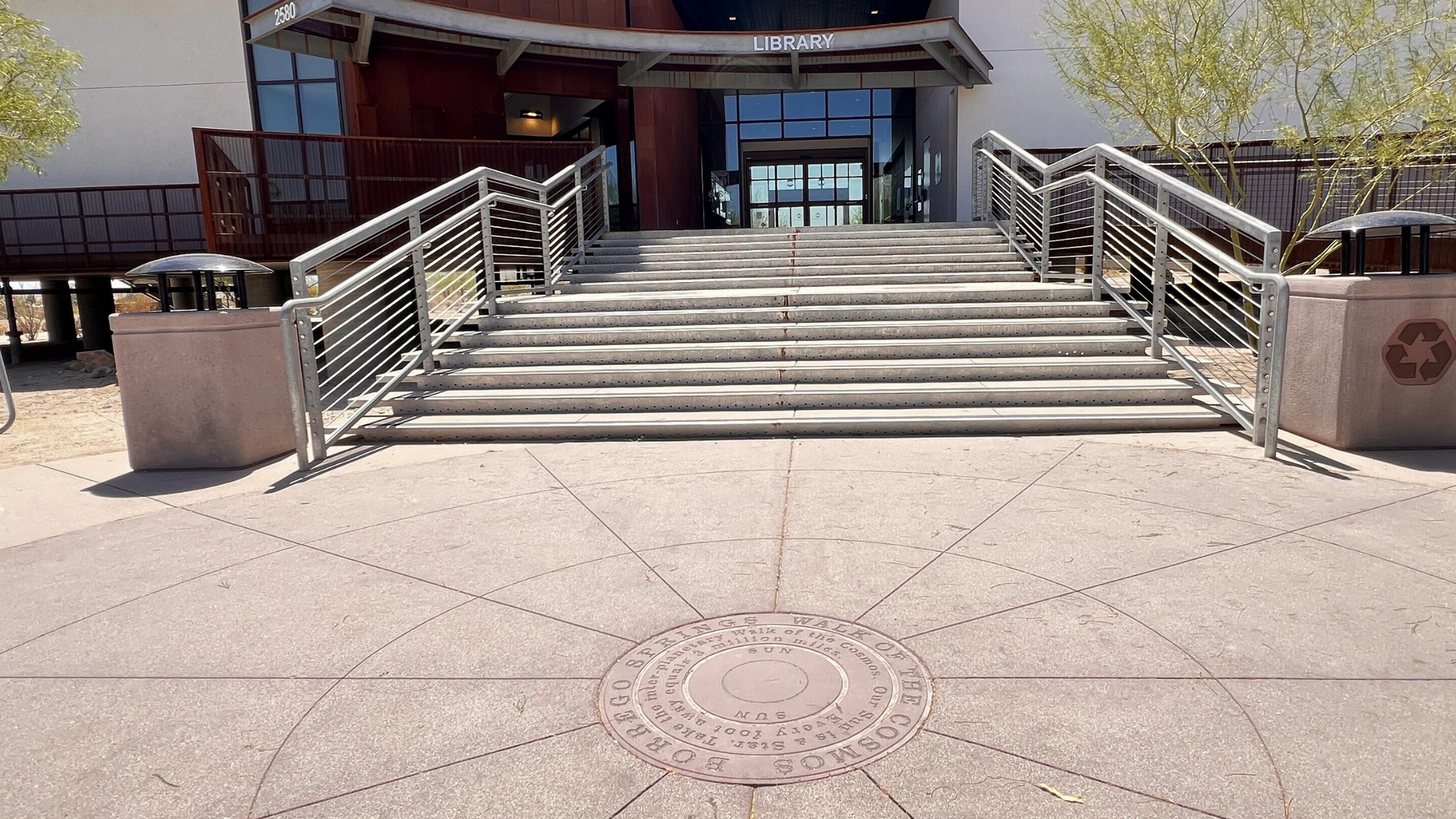
The Walk of the Cosmos begins at the entrance of the Borrego Springs Library and leads you on a fascinating journey through our solar system. The path is lined with engraved markers that represent each planet, positioned at scaled distances from the Sun. As you walk along this trail, you'll gain a deeper understanding of the immense distances between the planets while taking in the tranquil desert surroundings.


Each marker along the path provides educational information about the planets, making the walk both informative and engaging for visitors of all ages.


Whether you're a space enthusiast or simply looking for a peaceful walk, the Walk of the Cosmos offers a unique way to connect with the universe.


Follow the Path to Pluto at Borrego Springs Library


Begin your journey at the Sun near the front entrance of the Borrego Springs Library. Step inside, then exit through the back door to follow the path that guides you all the way to Pluto at the end.


Scroll Through The Images
  • Walk of the Cosmos

    Slide title

    Write your caption here
    Button
  • Slide title

    Write your caption here
    Button
  • Slide title

    Write your caption here
    Button
  • Walk of the Cosmos

    Slide title

    Write your caption here
    Button
  • Slide title

    Write your caption here
    Button
  • Slide title

    Write your caption here
    Button
  • Slide title

    Write your caption here
    Button
  • Slide title

    Write your caption here
    Button
  • Walk of the Cosmos in Borrego Springs

    Slide title

    Write your caption here
    Button
  • Walk of the Cosmos in Borrego Springs

    Slide title

    Write your caption here
    Button
  • Walk of the Cosmos in Borrego Springs - Neptune

    Slide title

    Write your caption here
    Button
  • Walk of the Cosmos in Borrego Springs

    Slide title

    Write your caption here
    Button
  • Walk of the Cosmos in Borrego Springs - Play Area

    Slide title

    Write your caption here
    Button

Explore Borrego Springs Public Park


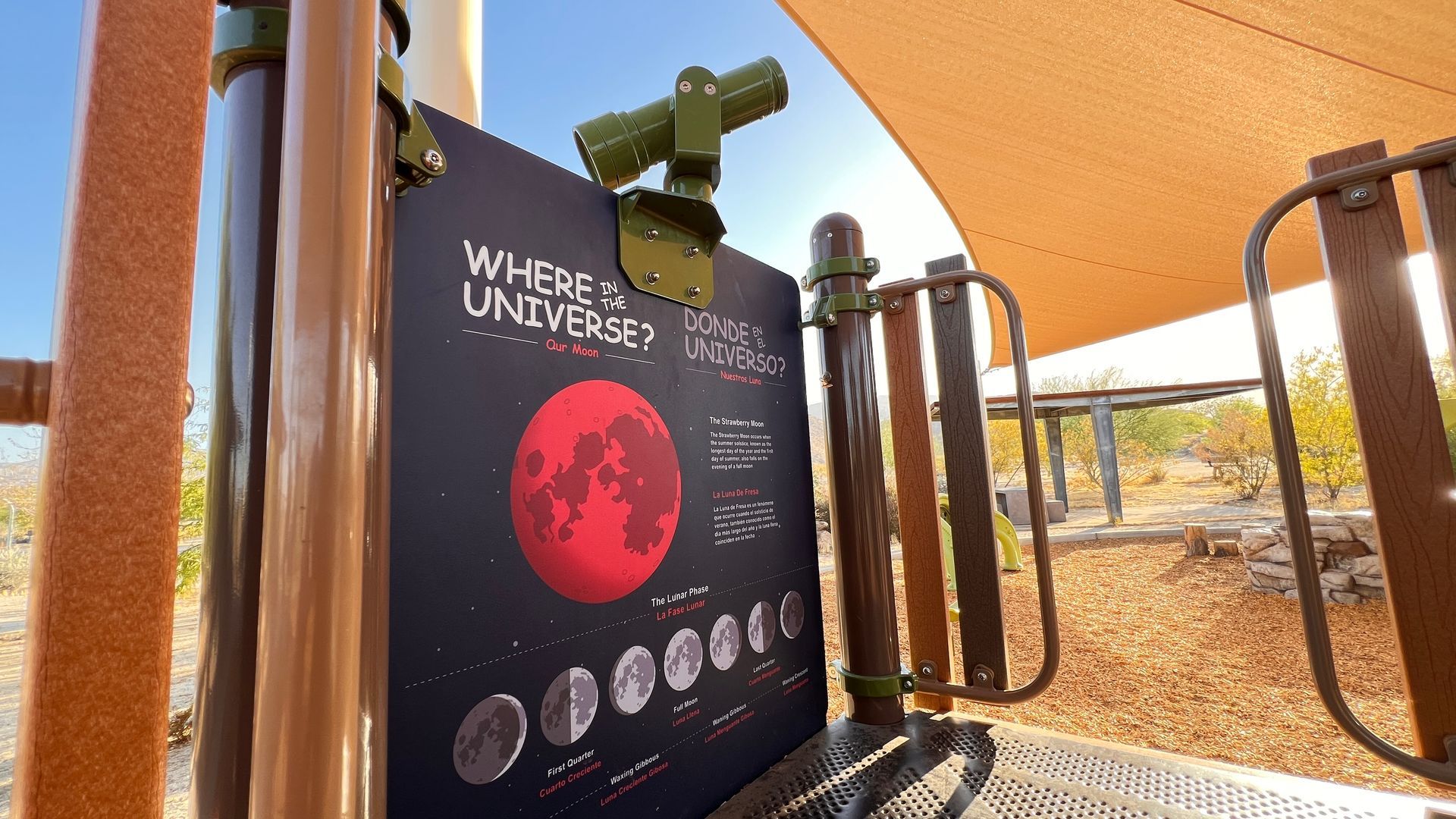
The Walk of the Cosmos is just one part of the Borrego Springs County Park, a well-equipped recreational area that offers something for everyone. The park features a spacious play area, perfect for families with children. Here, kids can enjoy various playground structures, all while surrounded by the natural beauty of the desert.


For those looking to stay active, the park includes tennis and basketball courts, providing a great opportunity for some friendly competition or a casual game under the clear Borrego Springs skies. The park's off-leash dog area is another highlight, offering a safe and enjoyable space for your furry friends to run and play.


In the evening, the park’s amphitheater becomes a prime spot for stargazing. Borrego Springs is designated as a Dark Sky Community, making it one of the best places in Southern California to observe the night sky. The amphitheater provides a comfortable setting for visitors to sit back and marvel at the stars, planets, and constellations visible in the desert sky.


A Must-Visit Destination in Borrego Springs


The Walk of the Cosmos and Borrego Springs County Park offer an enriching and enjoyable experience for visitors. Whether you're exploring the solar system on foot, enjoying the park's recreational facilities, or gazing at the stars in the amphitheater, this destination is a perfect addition to your Borrego Springs itinerary.


Located just minutes from the heart of Borrego Springs, the park is easily accessible and free to visit year-round. It’s a place where education, recreation, and natural beauty come together, offering a memorable experience for everyone who visits.


Learn More About Borrego Springs

By Matt Bosson, BSFI July 20, 2026
On Wednesday, July 29, at 7pm BSFI presents: A Simple Plan – 1998 – Rated R – 2h 1m A Simple Plan is a gripping neo-noir crime thriller that represents a striking departure from Sam Raimi's reputation as a master of horror and stylized genre filmmaking. Directed by Raimi and written by Scott B. Smith, adapting his own 1993 novel, the film stars Bill Paxton, Billy Bob Thornton, and Bridget Fonda, and is set in rural Minnesota. The story follows brothers Hank (Paxton) and Jacob Mitchell (Thornton), who, along with Jacob's friend Lou (Brent Briscoe), stumble upon a crashed plane in the woods containing $4.4 million in cash. The four — including Hank's wife Sarah (Fonda) — go to great lengths to keep the money secret, but begin to doubt each other's trust, resulting in lies, deceit, and murder. Roger Ebert, who ranked the film fourth on his list of the best films of 1998, praised how rarely a film is "this skillful at drawing us, step by step, into the consequences of criminal action," and Gene Siskel called it "an exceedingly well-directed genre picture" in which Raimi "does an excellent job of presaging the lethal violence that follows." A Simple Plan premiered at the 1998 Toronto International Film Festival to critical acclaim, before a limited US release in 1998. It underperformed at the box office, grossing $16.3 million, but was widely praised by critics. On the awards front, the film earned two Academy Award nominations: one for Best Supporting Actor for Thornton and one for Best Adapted Screenplay for Smith. After Paxton's death in 2017, critic Matt Zoller Seitz declared his performance as Hank the finest of Paxton's career — a fitting testament to a film that, despite its modest box office, has only grown in reputation as one of the most emotionally devastating thrillers of its era. This season’s BSFI movie screenings are being generously underwritten by the Borrego Valley Endowment Fund (BVEF). A Simple Plan — Free BSFI Movie Screening When: Wednesday, July 29 at 7 p.m. Doors open at 6:30 p.m. Where: Borrego Springs Performing Arts Center, 590 Palm Canyon Drive, Borrego Springs Rating/Runtime: Rated R | 2 hours, 1 minute
By Dennis Mammana July 18, 2026
By Dennis Mammana Week of July 19-25, 2026 We can spend our time under the stars trying to find constellation figures from mythological times, but we'll always have limited success. If we really want to see pictures among the stars, I'm afraid we need to create our own. You may remember from previous articles that constellations are simply areas of the sky, and do not resemble their namesakes. Corvus looks nothing like a crow. Trying to find a bear in Ursa Major? Fuhgetaboutit! And Scorpius, the scorpion ... well, OK, there will always be one exception. No, if you want to see pictures among the stars, you must invent your own. And that's where asterisms come in. An asterism is a group of stars that we connect in our imaginations to look like something. Some of the easiest of these to create are geometrical figures. If you ever took a geometry class, you may recall that a point is the simplest of these — a figure with no length, width or depth. In the sky, every star forms a point; connect any three of these, and you'll create a triangle. One in particular, though, is different. It's larger and brighter, and we can find it midway up in our eastern sky after dark. It's called the Summer Triangle. It's not a constellation but rather an asterism made of three stars from three separate constellations, but that doesn't mean that early storytellers overlooked this prominent star grouping. For example, an ancient Chinese love tale tells that the star Deneb represents a magpie bridge over the Milky Way, which allows the separated lovers Altair and Vega to be reunited on only one summer night each year.  The brightest of the stellar trio — and highest in the sky this week — is Vega, the most prominent star in the constellation of Lyra, the harp. It lies 150 trillion miles from us (about 25 lightyears); in other words, the light arriving tonight from Vega began its journey toward our eyes in 2001. The southeasternmost of the three stars is Altair, the brightest in the constellation of Aquila, the eagle. Its name comes from the Arabic Al Nasr al Tair, meaning in English "the flying eagle." Altair lies about 96 trillion miles (17 lightyears) from us. Not only is Altair one of the nearest stars, it's also one of the most rapidly spinning, completing one rotation in just 6.5 hours! Finally, farthest to the northeast lies Deneb, marking the tail of the great swan Cygnus, more easily recognized as the Northern Cross. It's not certain, but we think that Deneb could lie as far away as 2,600 lightyears from Earth. If it's truly that distant, this star could be one of the most brilliant in our entire galaxy, with a luminosity equivalent to 200,000 suns, and would generate more light in one day than our sun has produced since the days of Marco Polo at the end of the 13th century! With the overwhelmingly bright moonlight this week and next, the brightest stars are about all we'll be able to see, but you can still head outdoors to check out the brightest of the summer — the Summer Triangle. Visit Dennis Mammana at dennismammana.com. To read features by other Creators Syndicate writers and cartoonists, visit the Creators Syndicate website at www.creators.com . Learn More About Borrego Springs
By Matt Bosson BSFI July 15, 2026
Free Summer Movies Continue in Borrego Springs This July
By Andrea McKenna July 12, 2026
Reserve Your Spot for the Lunar Eclipse Spectacular
By Andrea McKenna July 12, 2026
Participants experienced Borrego Springs' dark skies through guided telescope viewing and expert commentary.
By Andrea McKenna July 7, 2026
Make a Night Sky Tour Part of Your July Getaway
By California Wolf Center July 6, 2026
Limited-time summer promotion encourages families to explore wolf conservation and education in Julian.
By Dennis Mammana July 5, 2026
By Dennis Mammana Week of July 5-11, 2026 There's a constellation in our night sky right now that is somewhat unknown to stargazers. Despite being huge — it's the 11th-largest in all the heavens — it has no stars brighter than the North Star, so you won't find it easily without a pretty dark sky. Its name is Ophiuchus (oh-fee-YOU-kuhs), and if you'd like to find it this month, you'll need to get away from the city lights and gaze midway up in the southeast shortly after dark. Ophiuchus (the serpent-bearer) represents Aesculapiu, the ancient Greco-Roman god of medicine, healing and physicians, and its brightest star is named Rasalhague, which is Arabic for "Head of the Snake Charmer." Draped from one side of Ophiuchus to the other lies Serpens — the only two-part constellation in the heavens — with its head on one side (Serpens Caput) and its tail on the other (Serpens Cauda). I admit that it requires quite an imagination to find these star groupings, but once you do, you'll know them forever. In fact, you may even recognize this shape, especially if you've ever searched online for the name of a physician. Quite often, you'll find the image of two serpents wrapped around a vertical staff that appears topped by a round knob and is flanked by wings. It's known as the "caduceus," and since 1902, when the U.S. Army adopted it as the insignia of its Medical Corps, it has been the familiar emblem of the American medical profession. Many medical associations — including the World Health Organization — use what some consider to be the "correct" and traditional symbol of medicine: the staff of Asclepius, with a single serpent encircling a staff. Either way, people have long associated the serpent with medicine. Once you find its stars, you'll see that Ophiuchus lies along some of the thickest star clouds of the Milky Way. If you've managed to get yourself to a rural location with a non-light-polluted sky, you'll have little trouble finding the hazy band of the Milky Way passing near this constellation, along with the bright reddish-orange star Antares (the heart of Scorpius, the scorpion) just to its lower right. Be sure to take binoculars with you so you can scan this celestial region. Here you'll find countless "faint fuzzies" (as amateur astronomers affectionately call deep-sky objects). Many of these are star clusters — collections of dozens, hundreds or even thousands of stars held together by gravitation — and interstellar nebulae, where stars and planetary systems are constantly forming. Now, while you're gazing at the stars of Ophiuchus, here's a little tidbit to wrap your head around: This constellation is not one of the official signs of the zodiac, but it should be. Why, you ask? Because the sun spends three times as many days in front of the stars of Ophiuchus as it does in Scorpius. So why, then, is this constellation missing from the official zodiacal signs in horoscope tables? Your guess is as good as mine. Just remember, if you were born between Nov. 29 and Dec. 17, you're not a "Scorpio" or "Sagittarius," as you might have thought. You're actually an Ophiuchan! Make of that what you will... Visit Dennis Mammana at dennismammana.com. To read features by other Creators Syndicate writers and cartoonists, visit the Creators Syndicate website at www.creators.com . Learn More About Borrego Springs

By Andrea McKenna July 1, 2026
Don't Miss These Summer Night Sky Events
By Andrea McKenna June 30, 2026
The historic farm offers fresh local products, farm tours, and a chance to experience sustainable agriculture in the heart of the desert. Riviera Farms continues to bring new life to one of Borrego Springs' historic properties. Originally established in 1975 by Knute and Gloria Quvale , the 22-acre farm has been revitalized with a focus on regenerative agriculture, sustainability, and caring for rescued animals. Visitors can stop by the farm to purchase fresh products, meet the animals, and take a tour of the property. For those who can't make it in person, many of the farm's products are also available through its online store. Riviera Farms offers a growing selection of organic eggs, seasonal produce, herbs, nopales, handcrafted seasonings, soaps, bath products, honey, apparel, and other farm-made goods . Inventory changes throughout the year based on what's in season and available. Supporting Riviera Farms means supporting a local Borrego Springs business that is helping preserve the community's agricultural heritage while producing fresh, locally grown products. To learn more, schedule a tour, or browse available products, visit rivierafarms.com . Riviera Farms 2021 Borrego Springs Rd. Borrego Springs, CA 92004
By East County Performing Arts June 30, 2026
East County Performing Arts Association unveils six shows for its fifth season in Julian.
By Dennis Mammana June 27, 2026
By Dennis Mammana Week of June 28 - July 4, 2026 It was bound to happen: The heat of summer has arrived at my desert home. As I write these words, it's 115 F outside, and it's just the beginning of the blistering heat we'll experience for months. This is no surprise, of course. We're all quite familiar with this seasonal pattern; in fact, most of us learned in grade school about the seasons and what causes them, but you'd be surprised how little some people remember of those basic lessons. I was stunned when I first heard of a 1987 video in which filmmakers Matthew H. Schneps and Philip Sadler of the Harvard-Smithsonian Center for Astrophysics interviewed recent Harvard University graduates, faculty members and alumni — some with science backgrounds — and asked them a simple question: What causes our seasons? Twenty-one of the 23 people interviewed did not know the answer. This is Harvard, people. Harvard! If you can't believe it, watch it online here. Oh, sure, they offered elaborate explanations and tried to be convincing, but it's obvious they had no clue. The most common reason they cited for the summertime heat was that the Earth lies closest to the sun at that time of year, and the cold of winter is caused by our greater distance from the sun. Sounds perfectly reasonable, doesn't it? But it's wrong. So very wrong. Now it is true that our planet orbits the sun not in a circular path but in an elliptical path, and that our distance from the sun varies throughout the year, but only by about 3%. What seems counterintuitive, however, is that we're closest to the sun not during our Northern Hemisphere summer but during our winter! In 2026, the Earth will reach its farthest point from the sun ("aphelion") on July 6, when we will lie 94,502,961 miles from our star. This occurs during the Northern Hemisphere summer. The Earth's nearest point ("perihelion") won't arrive until Jan. 2, 2027 (during our winter), when we'll be 91,406,556 miles from the sun. Of course, if you happen to live in the Southern Hemisphere, where seasons are reversed from those north of the equator, our planet's perihelion does occur during their summertime. But that's a story for another time. So, if our distance from the sun doesn't cause seasonal temperature changes throughout the year, what does? Well, as we all learned in third grade, it's the tilt of the Earth's axis. Our planet is tipped about 23.4 degrees to the plane of its orbit around the sun. From mid-March to mid-September, the Earth's Northern Hemisphere is tilted toward the sun, allowing solar rays to beat directly down upon us. During these longer days, heat accumulates in our atmosphere while having little time to escape into space during the much shorter nights. In other words, it's not our changing distance from the sun that causes the buildup of summer heat; it's the tilt of our planet that produces long days and short nights — just as it always has. Unfortunately, few still seem to understand this simple phenomenon, and I suspect if we did this same interview today, we'd see even less informed answers than four decades ago! Visit Dennis Mammana at dennismammana.com. To read features by other Creators Syndicate writers and cartoonists, visit the Creators Syndicate website at www.creators.com . Learn More About Borrego Springs
Show More

Share This Post