Dennis Mammana • May 12, 2026

Cosmic Trio Shines at Dusk

Share
By Dennis Mammana


Week of May 17-23, 2026


That brilliant light now glistening in the west at sunset is again the "star" of the show. It is, of course, the planet Venus, and this week it'll pair up with two other celestial wanderers: Jupiter and the moon.


Jupiter, another very bright planet, has been descending farther to the west as the spring months progress, and it is now approaching a close encounter with Venus by the end of the month. This occurs because these worlds, along with the Earth, orbit the sun, and our constantly changing viewpoint makes them appear to drift slowly against the more distant and "fixed" stars.


Over the next week, though, another solar system body will enter the scene: the moon. Since our celestial neighbor orbits the Earth once a month, we can see it change its position in the sky from night to night.


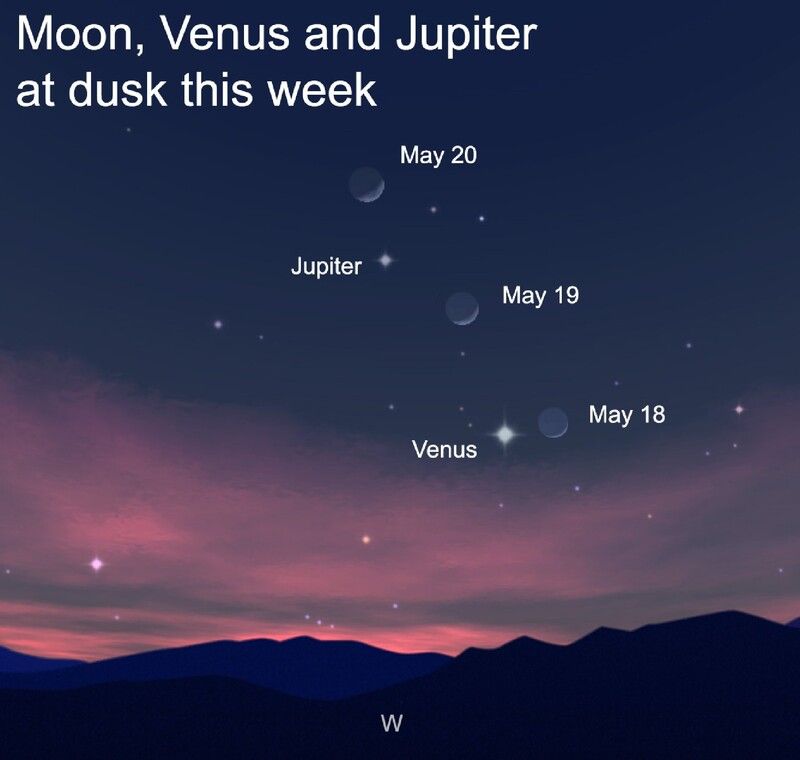
Shortly after sunset on May 17, you might try searching very low in the west for the tiny and delicate crescent moon, but to find it, you'll need a very clear sky and a low horizon, and possibly binoculars.


If you don't succeed, don't worry. It'll be pretty tough to spot, but if you wait until the next night, it'll be much easier to see. On the 18th, it will appear not far from Venus. Of course, the moon won't really be next to this planet; they will be separated by 124 million miles that evening, but since both lie roughly along the same line of sight, they'll appear together in the sky. For a really amazing view, check out the pair through binoculars!


The following night, May 19, the moon will have moved eastward along its orbit and will appear about midway between Jupiter and Venus. If your sky is clear on May 20, check out the western sky again, and you'll notice that the moon is not only a significantly thicker crescent but now lies above Jupiter.


Of course, this whole view is purely an illusion caused by our inability to see true depth in the cosmos, but it does result in a truly pretty picture. And speaking of pretty pictures, this week offers a good opportunity to try your hand at photographing the spectacle.


Since the trio appears low enough in the sky at dusk, you can frame the scene with a foreground subject — a dramatic tree, building, sculpture or person, for example. You don't need fancy or expensive equipment to do this; just a regular camera or smartphone will do fine. You may find, however, that zooming in a bit will produce a more compelling image.


If you shoot half an hour or so after sunset, you can probably trust the automatic settings of your camera or phone. Much later, though, you may need to adjust settings as you go because the light at dusk changes rapidly. Don't be afraid to experiment; if some photos turn out poorly, you can always hit "delete," and no one will ever know!

I hope your skies are clear this week so you can enjoy the planetary sky show. And if you get some nice photos, please email me. I'd love to share your success!


Visit Dennis Mammana at dennismammana.com. To read features by other Creators Syndicate writers and cartoonists, visit the Creators Syndicate website at www.creators.com.


Learn More About Borrego Springs
By Andrea McKenna June 27, 2026
Heatwave Pool Party Returns for an Evening of Music, Swimming, and Summer Fun Looking for a unique way to celebrate Independence Day in Borrego Springs? The Palms at Indian Head is hosting its annual Heatwave Pool Party on Saturday, July 4, from 6:00 to 9:00 p.m. , inviting guests to enjoy an evening of swimming, music, and poolside fun at one of the community's most iconic destinations. Known for its mid-century modern architecture and rich Hollywood history, The Palms at Indian Head has welcomed visitors to Borrego Springs for decades. Today, the boutique hotel continues to blend its historic charm with new experiences, including the recently opened Dive Bar, the award-winning Coyote Steakhouse, and special community events throughout the year. This year's adults-only celebration encourages guests to bring a swimsuit and towel and enjoy the Olympic-size pool under the desert evening sky. A no-host bar will be available, while Coyote Steakhouse will be serving food and beverages throughout the event. Outside food, drinks, and coolers are not permitted. The Heatwave Pool Party takes place at The Palms at Indian Head, 2220 Hoberg Road, Borrego Springs. For more information or to RSVP, call 760-767-7788.
By Dennis Mammana June 27, 2026
By Dennis Mammana Week of June 28 - July 4, 2026 It was bound to happen: The heat of summer has arrived at my desert home. As I write these words, it's 115 F outside, and it's just the beginning of the blistering heat we'll experience for months. This is no surprise, of course. We're all quite familiar with this seasonal pattern; in fact, most of us learned in grade school about the seasons and what causes them, but you'd be surprised how little some people remember of those basic lessons. I was stunned when I first heard of a 1987 video in which filmmakers Matthew H. Schneps and Philip Sadler of the Harvard-Smithsonian Center for Astrophysics interviewed recent Harvard University graduates, faculty members and alumni — some with science backgrounds — and asked them a simple question: What causes our seasons? Twenty-one of the 23 people interviewed did not know the answer. This is Harvard, people. Harvard! If you can't believe it, watch it online here. Oh, sure, they offered elaborate explanations and tried to be convincing, but it's obvious they had no clue. The most common reason they cited for the summertime heat was that the Earth lies closest to the sun at that time of year, and the cold of winter is caused by our greater distance from the sun. Sounds perfectly reasonable, doesn't it? But it's wrong. So very wrong. Now it is true that our planet orbits the sun not in a circular path but in an elliptical path, and that our distance from the sun varies throughout the year, but only by about 3%. What seems counterintuitive, however, is that we're closest to the sun not during our Northern Hemisphere summer but during our winter! In 2026, the Earth will reach its farthest point from the sun ("aphelion") on July 6, when we will lie 94,502,961 miles from our star. This occurs during the Northern Hemisphere summer. The Earth's nearest point ("perihelion") won't arrive until Jan. 2, 2027 (during our winter), when we'll be 91,406,556 miles from the sun. Of course, if you happen to live in the Southern Hemisphere, where seasons are reversed from those north of the equator, our planet's perihelion does occur during their summertime. But that's a story for another time. So, if our distance from the sun doesn't cause seasonal temperature changes throughout the year, what does? Well, as we all learned in third grade, it's the tilt of the Earth's axis. Our planet is tipped about 23.4 degrees to the plane of its orbit around the sun. From mid-March to mid-September, the Earth's Northern Hemisphere is tilted toward the sun, allowing solar rays to beat directly down upon us. During these longer days, heat accumulates in our atmosphere while having little time to escape into space during the much shorter nights. In other words, it's not our changing distance from the sun that causes the buildup of summer heat; it's the tilt of our planet that produces long days and short nights — just as it always has. Unfortunately, few still seem to understand this simple phenomenon, and I suspect if we did this same interview today, we'd see even less informed answers than four decades ago! Visit Dennis Mammana at dennismammana.com. To read features by other Creators Syndicate writers and cartoonists, visit the Creators Syndicate website at www.creators.com . Learn More About Borrego Springs

By Miriam Raftery June 27, 2026
By Miriam Raftery - www.eastcountymagazine.org June 26, 2026 (San Diego’s East County)— The Society of Professional Journalists’ San Diego Chapter last night presented four Excellence in Journalism awards to ECM editor Miriam Raftery and associate editor Karen Pearlman. The awards honored ECM’s coverage of issues involving the El Capitan Dam in Lakeside, aerial firefighting readiness, the impacts of mass deportations, and our guide to travel in San Diego County’s desert regions. Raftery received a first place award for an audio feature titled “ Who will be there when they come for you ?” Hear the interview with immigration attorney Nora Milner, which aired on East County Magazine’s radio show on KNSJ. You can also read a summary of that interview by Alex Schorr. In the interview, Milner voiced alarm over blatant denials of due process for immigrants under the Trump administration, warned that even citizens are not safe, and offered tips for those concerned about being visited by ICE or detained for potential deportation. Pearlman took second place for investigative/enterprise story in the daily reporting category for “ Proposed Lakeside sand mine owner sues city of San Diego for damages from water release at El Capitan Dam .” Her investigative reporting detailed the dangerous conditions of the old earthen dam and the potentially catastrophic loss of life if it were to rupture. He report spotlighted how the city’s failure to repair or rebuild the dam necessitated releasing water which raised the water table, resulting in a downstream property owner suing the city for destroying the site’s sand-mining potential. Third place for investigative/enterprise reporting went to Raftery for her article, “ Does the San Diego region have adequate aerial firefighting capability for the coming season? ” Raftery initiated the investigative report after learning that Cal Fire’s Ramona air base would be closed for nearly a year and that an SDG&E air crane on which fire authorities had relied for aerial firefighting support was no longer available to the manufacturer declining to renew the lease. Pearlman and Raftery shared a third place award for travel writing for their comprehensive piece titled “ Our Guide to San Diego’s desert destinations .” The article was written as part of a series of regional guides for East County Magazine’s newly launched “ Visit East County ” section highlighting travel and tourism destinations in San Diego’s inland region.
By Christmas Circle Board of Directors June 26, 2026
Written bids are due July 20 for ongoing landscape maintenance services beginning Aug. 1, 2026.
By Mia Garcia: Borrego Sun Youth Intern June 26, 2026
Borrego Sun youth intern Mia Garcia shares a poem about courage and her first live performance.
By San Diego County June 26, 2026
FY 26/27 application and instructions will be available on July 1, 2026.
By Andrea McKenna June 25, 2026
The Emmy Award-winning host called the sculptures "the most remarkable metal sculptures to be found anywhere in the world."
By Borrego Springs Soroptimist June 24, 2026

Circle of Art Continues a Tradition of Art and Giving in Borrego Springs

By Kathy Dice, Borrego Springs Soroptimist Club President June 24, 2026

Soroptimist International of Borrego Springs representatives Sally Theriault, Scholarship Committee Chair, and Jenny Huntley, Treasurer, present scholarships to Borrego Springs High School graduating seniors during Awards Night.


Show More

Share This Post