
Dennis Mammana • February 11, 2026
Dennis Mammana: Search for a Planetary Island Within the Celestial River
Share
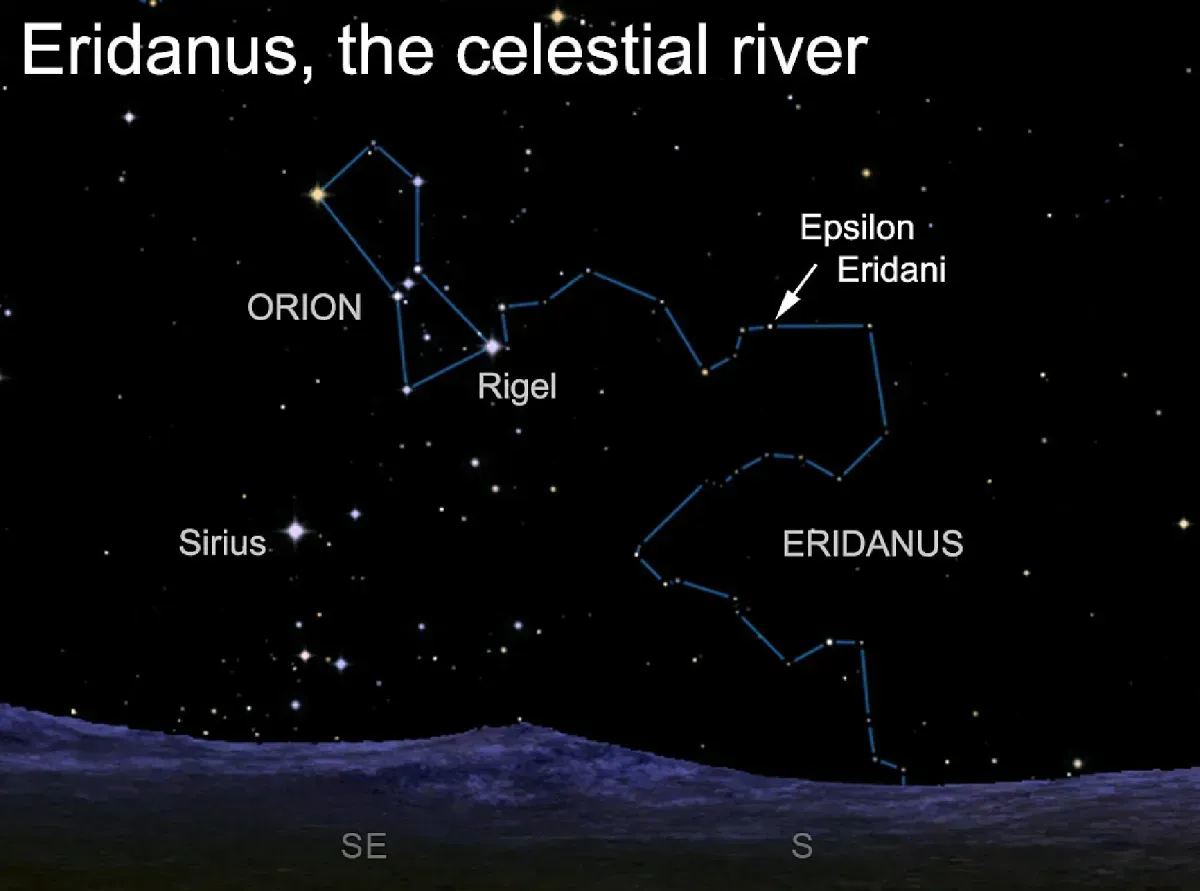
Among Eridanus’ prominent stars is Epsilon Eridani. Creators.com illustration
With much of North America shivering in a deep freeze, I’d be surprised if many folks are doing stargazing!
If you’re one of the intrepid few, you’ll find it hard to ignore the stars of Orion, standing stoically midway up in the southern sky.
Even folks who happen to glance upward accidentally as they race from their cars to their nice warm houses almost instantly spot its four bright stars that outline a rectangle, and three more that trace a straight line in its center.
Easily the most attention-grabbing star grouping, Orion is not the only one in that area of the sky.
In fact, one of the longest and faintest of all begins near the foot of the great hunter. Its name is Eridanus.
In ancient Greek mythology, Eridanus represents the river in which young Phaethon crashed after his failed attempt to fly the Chariot of the Sun, but no one knows exactly which river it is.
Homer called it an “ocean stream.” Others claim it’s the Tigris or the Euphrates; still others suggest it might be the river Po or maybe even the mighty Nile.
To see this sinuous string of relatively dim stars, first locate the southwestern-most star of Orion (Rigel), then look just above and to its right for the star that marks the beginning of the river.
If you have a night with no light pollution or moonlight and a low southern horizon, you should be able to trace much of the celestial river as it meanders to the west and south.
Because Eridanus lies so far south, skywatchers in the Earth’s Northern Hemisphere can see only a portion of it; if you live in middle or high latitudes, you might be able to see only one-third or half of it. Those living in more southerly locations, of course, will see much more.
Though the stars of Eridanus are rather faint and obscure, one of them has captured the imagination of astronomers and science fiction authors alike.
Its name is Epsilon Eridani, a slightly orange star appearing about midway down the constellation’s winding stellar string.
You might recognize its name from science fiction novels by Isaac Asimov and Frank Herbert, as well as from the 1990s TV series Babylon 5.
It was in 1960 that Cornell University astronomer Frank Drake aimed a radio telescope in this star’s direction to see if he might detect evidence of a technologically advanced civilization inhabiting a planet orbiting nearby.
Unfortunately, 6½ decades later, no such signals have ever been found.
Back then, the existence of planets orbiting the star was mere conjecture. Not so today. We now know that Epsilon Eridani, only 10½ light years away, is encircled by a disk of dusty debris — an asteroid belt, if you will.
In addition, astronomers have confirmed that orbiting nearby is a Jupiter-like planet they’ve named Aegir, and they suspect it may have at least two additional planets.
Might this nearby star be home to worlds harboring life? We don’t yet know, but if you step outdoors on any one of these frigid winter nights, you can gaze upon its light and wonder!
Visit Dennis Mammana at dennismammana.com. To read features by other Creators Syndicate writers and cartoonists, visit the Creators Syndicate website at www.creators.com.
Learn More About Borrego Springs