June 2, 2026

Approaching the Solar Apex

Share
By Dennis Mammana


Week of June 7-13, 2026


During one of my recent night sky tours, an elderly guest gazed into the sky and asked if the stars ever move. He said the constellations look the same now as when he was a child, and he was convinced that nothing in the heavens ever changes.


It was an excellent observation but one that didn't consider an important fact: Human time scales are considerably different than cosmic time scales.


Even the healthiest of humans will live at most about a century, and during our lives, we measure time in seconds, minutes, hours, days, weeks, months, years and decades. The cosmos, on the other hand, has been around for nearly 14 billion years, and everything takes much longer to occur.


To recognize changes in the universe, astronomers must think on a more cosmic scale. When we do, we find that the universe is remarkably active. Stars are forming, consuming their nuclear fuel, and dying, and all are racing through our galaxy at tremendous speeds. Expecting to see changes in any star's appearance or the shapes of constellations over even a full human lifespan just isn't possible.


To understand this, consider Barnard's Star, visible only through a telescope from the Earth's Southern Hemisphere. This star tears through our galaxy at a speed of some 88 miles per second, yet from our terrestrial vantage point six lightyears away, Barnard's Star requires three and a half centuries to cross a segment of the sky only the width of your outstretched little finger.


Of course, we can't watch this movement with our eyes — or even through powerful telescopes — but by using sophisticated earthbound and satellite technology, astronomers can precisely measure these stellar speeds and directions of motion.


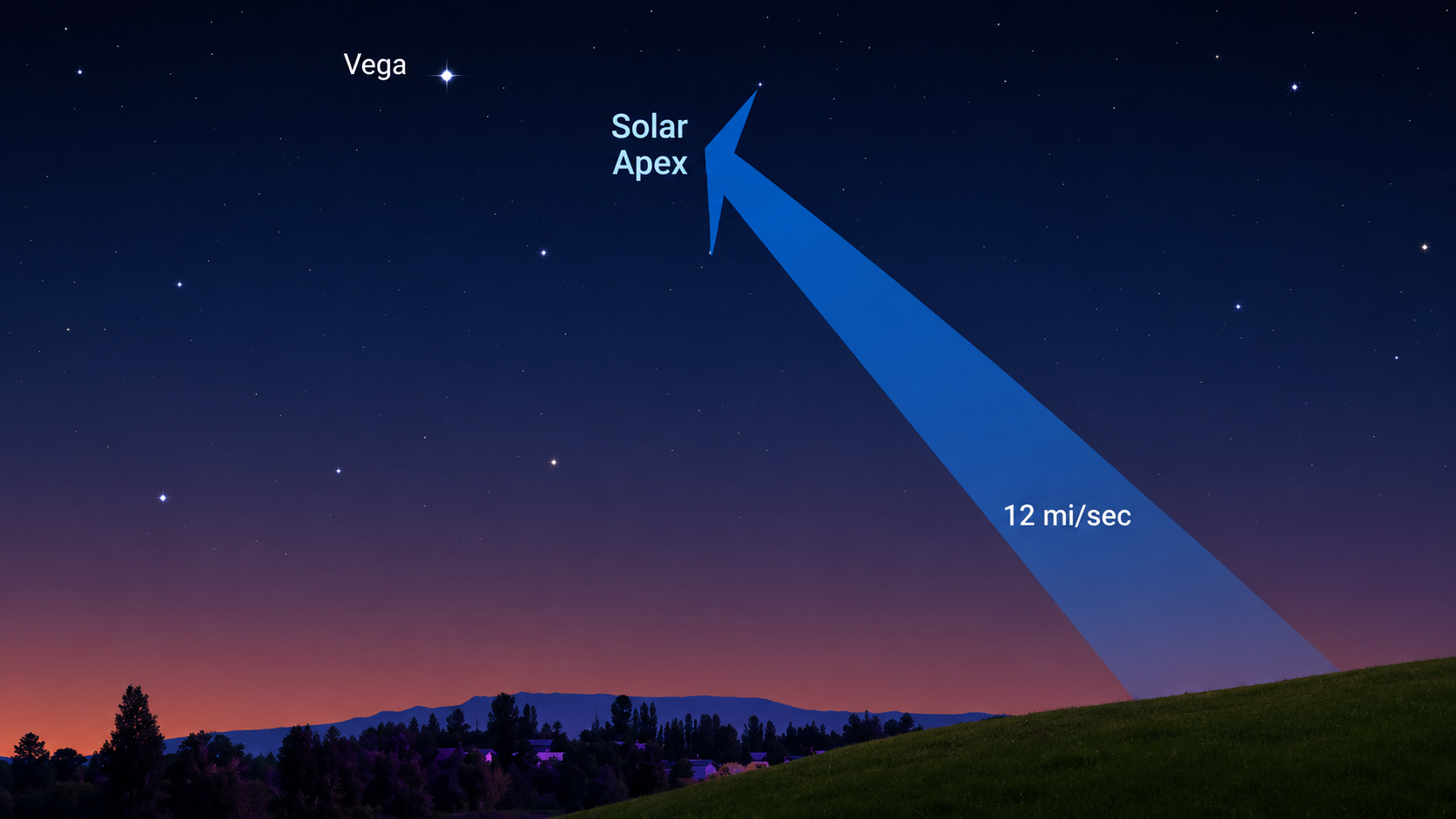
Measure the speeds and directions of enough stars, and we find some interesting patterns. For example, stars that appear roughly in the direction of the summer star Vega (now shining low in the northeastern sky after dark) seem to be spreading out from a central point, while those on the opposite side of the sky (near Sirius, setting in the southwest around sunset) appear to be converging on one another.


What this means is fascinating. Our sun's own motion is carrying it (along with the planets of our solar system) toward the stars near Vega — a point we know as the solar apex — and away from those near Sirius (known as the solar antapex).


This phenomenon isn't difficult to visualize. Imagine you're driving along a highway from one city to another. The buildings in front of you appear to become more widely separated as you approach, while those behind you appear to converge more tightly.


This is exactly what's happening in our section of the galaxy. Our sun is moving at some 12 miles per second toward a point in our sky not far from the bright star Vega. Of course, we can't see this movement, but it's fun to stand outdoors on a clear night and imagine our sun and Earth racing outward toward Vega.


Now, if you're worried about a collision with this star ... well, fuhgetaboutit. Even at this remarkable speed, we'd need some 5,300 human lifetimes to get there!


Visit Dennis Mammana at dennismammana.com. To read features by other Creators Syndicate writers and cartoonists, visit the Creators Syndicate website at www.creators.com.


Learn More About Borrego Springs

By Andrea McKenna June 2, 2026
New shade structure adds comfort to the Borrego Springs Community Dog Park.
By Andrea McKenna June 2, 2026
Long-running golf tournament supports Borrego Springs Children’s Center with funds and supplies

By Explore Always June 2, 2026
By: Explore Always on YouTube
By East County News Service June 1, 2026
East County News Service June 1, 2026 (San Diego County) — The San Diego Humane Society is clearing a path to make the road to a forever home less bumpy for hundreds of companion animals. The SDHS is waiving all adoption fees Saturday, June 6, as part of the third annual California Adopt-a-Pet Day .  As shelters across the state struggle with overcrowding, this statewide initiative — hosted by California Animal Welfare Association (CalAnimals) , the San Francisco Society for the Prevention of Cruelty to Animals and the American Society for the Prevention of Cruelty to Animals — aims to clear kennel space while connecting pets with new families. The San Diego Humane Society currently has more than 800 pets waiting for adoption across its campuses in El Cajon, San Diego, Escondido and Oceanside. On Saturday, all campuses will be open from 10 a.m. to 6 p.m. with no adoption fees. SDHS is encouraging prospective adopters to arrive early, as all adoptions will be processed on a first-come, first-served basis. The annual adoption event has seen consistent growth since its inception. In 2024, the initiative facilitated 3,609 adoptions across California, a figure that climbed to nearly 5,000 in 2025. Last year alone, the SDHS successfully placed 293 pets in a single day, and organizers are setting their sights on exceeding that number this weekend. “Waiving adoption fees for a day can transform hundreds of lives, both for the animals who find homes and the people who welcome them,” said Dr. Gary Weitzman, president and CEO of SDHS. “We’re proud to join shelters across California to spotlight the incredible pets in our care and help more families discover their perfect companion.” To ensure each pet gets off to a healthy start, the SDHS includes several services with every adoption. These include spay/neuter surgery, current vaccinations, permanent microchip identification, post-adoption training support and a complimentary veterinary exam at participating clinics. Prospective adopters can preview local animals currently awaiting homes by visiting sdhumane.org/adopt .
By Andrea McKenna June 1, 2026
By: Andrea McKenna
By East County News Service June 1, 2026
East County News Service May 31, 2026 (San Diego) – You’re invited to see James and Anne Hubbell’s acclaimed home and art studios near Julian, California. Docent-led tours are offered each Thursday through Saturday in June, starting at 10 a.m.An immersive art and nature experience, each 90-minute tour covers the art and architecture of famed architect and artist James Hubbell amid the surrounding unspoiled natural beauty of the Santa Ysabel landscape. Admission fees go entirely to support Ilan-Lael Foundation, a 501 (c) (3) non-profit dedicated to preserving the Hubbell property and its legacy of bringing art and nature to the community. Reservations are required. For tickets ($45) and details, visit https://ilanlaelfoundation.org/ .
By Karen Pearlman June 1, 2026
The closest federal protected land is the Sonny Bono Salton Sea National Wildlife Refuge , located about 60 to 75 miles northeast of Anza-Borrego Desert State Park in Calipatria, CA. This refuge serves as a vital stopover for the Pacific Flyway and features birdwatching trails and a multi-story observation tower. 
By Andrea McKenna May 31, 2026
How one Borrego Springs teen is using music, service, and storytelling to make a difference


By Andrea McKenna May 30, 2026
What a difference 10 days makes! May 20th to May 30th.
Show More

Share This Post