



March 18, 2026
The Dipper and the Lion By Dennis Mammana
Share
Week of March 22-28, 2026
Now that spring has sprung, I'm sure that those who have endured a long, cold and snowy winter are rejoicing.
Anyone who knows me knows that I'm no winter person. Sure, I used to enjoy the season when I was a kid, but that's only because I could spend entire days building snow forts with my friends and making a few bucks shoveling the white stuff for neighbors.
No longer. Today, warmer days of springtime can't come soon enough for me!
If we had no calendar, we would still know the seasons are changing. We see it happening all around us: Temperatures are rising, the first flower buds are beginning to appear, and many birds are returning to our part of planet Earth.
And, just as our daytime world gives us clues that spring is approaching, the darkness does as well. Nighttime hours are beginning to shorten, and the brilliant stars of winter are descending in the west to make way for those of springtime. And no star grouping heralds the arrival of springtime to our Northern Hemisphere more than Leo, the lion.
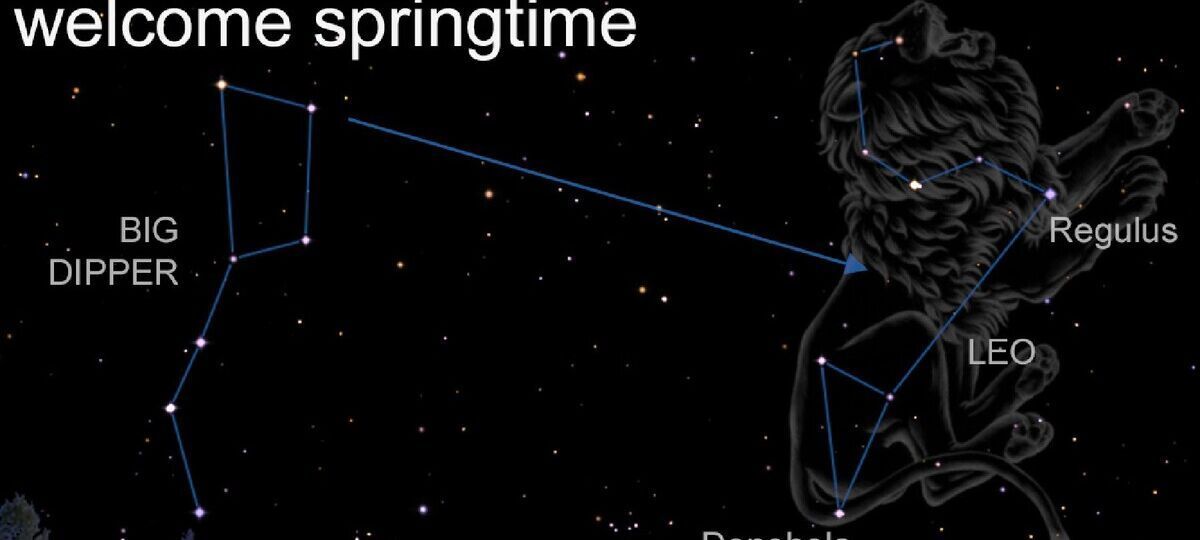
Head outdoors during early evening hours and cast your gaze midway up in the eastern sky. There, you'll see Leo, one of the few constellations that, with some imagination, actually can be made to look like its namesake — a lion crouching in a regal pose reminiscent of the enigmatic Egyptian Sphinx.
Most prominent in this constellation is the bright star Regulus, which shines brightly beneath the lion's majestic head and mane, outlined by a large sickle-shaped grouping of stars. More metropolitan stargazers may recognize this figure not as a sickle but as a backward question mark, with Regulus forming the dot at its base.
The star's very name, "Regulus," comes from the Latin word "Rex," meaning "king," and, interestingly, this star was revered throughout the ancient world as a "royal" star. According to astronomy author R.A. Allen, it was known in Arabia as "Malikiyy" (the Kingly One), while the ancient Greeks knew it as "the Star of the King."
At the other end of the lion, we find the bright star Denebola, whose name originates from the Arabic "Al Dhanab al Asad," meaning "The Lion's Tail."
You can find Leo more easily if you use the two pointer stars of the Big Dipper, farther to the northeast. These stars point toward Polaris (the north star) if you follow them from the bottom to the top of the Dipper's bowl, but if you follow them in the opposite direction, you can find your way toward the back of the lion.
If you have trouble tracing this animal's shape among the stars, don't worry. Just turn it around and you'll find it's much easier to find not the mighty king of the jungle but instead a mouse! Quite frankly, I think the figure of a mouse is much easier to trace. Here, the star Denebola forms its pointy nose, the nearby triangle forms his head, and the sickle now outlines its long, curving tail.
Either way you look at it — mouse or lion — nothing in the heavens announces springtime more loudly than Leo!
Visit Dennis Mammana at dennismammana.com. To read features by other Creators Syndicate writers and cartoonists, visit the Creators Syndicate website at www.creators.com.
Learn More About Borrego Springs