January 7, 2024

Yaqui Well Ghost Legend | Anza Borrego Mysteries

Share

Legends and Ghost Stories of the Anza-Borrego Desert


The Anza-Borrego Desert, a place of haunting beauty and mystery, has been the backdrop for numerous legends and ghost stories that have captivated imaginations for centuries. Among these tales are the ghost dancers at Yaqui Well and the enigmatic ghost lights near Oriflamme Mountain, each story weaving a fascinating tapestry of history and folklore.


Yaqui Well Ghost Dancers: A Haunting Legend


Nestled in the Anza-Borrego Desert near Route 78, Yaqui Well is the site of one of the desert's most intriguing ghost stories. It's said that during warm summer nights, particularly when the moon is full, ghostly figures can be seen dancing around the well. These apparitions are believed to be the spirits of three emigrants who were traveling from Yuma to California. In search of a shorter route through the harsh desert terrain, they arrived at Yaqui Well, desperately in need of water.


Tragically, one of the travelers drank too much water too quickly and died shortly thereafter. The two survivors, having also drunk from the well, are said to have lived. On those moonlit nights, one ghost is said to rise from the muddy waters of Yaqui Well, another emerges from the nearby brush, and the third arrives with a cool breeze from the wash. They join hands, dancing in a circle around the well, and as quickly as they appear, they vanish, leaving behind only the well's good water and a chill in the air.


The Ghost Lights of Borrego: An Enigmatic Phenomenon


In the heart of the Sonoran Desert, the Anza-Borrego Desert State Park and Borrego Springs area are shrouded in enigmas, one of which is the mysterious "Ghost Lights" of Oriflamme Mountain. First reported in 1858 by a Butterfield Stage driver, these unexplained phenomena have since been witnessed by soldiers, prospectors, and explorers. Sightings of these eerie lights, varying in each account but sharing a common mysterious quality, have been reported near Oriflamme Mountain and over Borrego Valley.


A notable encounter occurred in 1892, when prospector Charles Knowles and his companions, camping near Grapevine Canyon, observed what they described as "Fire Balls" – luminous orbs that ascended and exploded in a spectacular display reminiscent of fireworks. The lights then reappeared, forming an arch pattern before returning to their origin, a baffling display that defies easy explanation.


Scientists have theorized that these ghost lights could be a result of static electricity created by windblown sand striking quartz outcroppings, resulting in bright, spark-like appearances. Others have speculated more human-oriented explanations, suggesting the lights could have been signals used by bootleggers during Prohibition or for smuggling operations near the Mexican border, although these activities do not align with the historical timeline of the sightings.


Amidst these theories, a more captivating notion persists – that these "Fire Balls" might signify the presence of buried treasure. Supporting this idea are tales of discoveries in the Oriflamme area, like a young man finding gold nuggets in a gully and George Benton uncovering a gold-laden boulder. These stories, interwoven with the legend of the Ghost Lights, add a layer of intrigue and mystery to the already enigmatic and captivating landscape of the Anza-Borrego Desert.


A Legacy of Legends


These stories are just a small fraction of the many tales and legends that have been shared over the centuries. The Anza-Borrego desert, with its vast, silent expanses and starry nights, seems to be a natural canvas for such tales of lost treasures, mysterious sightings, and wanderers who met their fates in its unforgiving landscape. The legends of Yaqui Well and the Phantom Mine, with their ghostly dancers and lost prospectors, add a layer of mystery and allure to this already fascinating region.


Follow Oddly Explorer for More Stories


For those captivated by the enthralling tales and legends of the Anza-Borrego Desert, such as the ghost dancers at Yaqui Well and the mysterious happenings around the Phantom Mine, there's a wealth of stories waiting for you. One excellent source is the YouTube channel Oddly Explorer, which delves deep into the mysteries and legends that have been woven into the fabric of the desert over centuries.


Oddly Explorer offers a unique and captivating perspective on ghost stories, historical mysteries, and the exploration of the unknown. If you're a fan of untold tales and hidden secrets, this channel is a treasure trove of intriguing content.


Visit Anza-Borrego's Haunted Desert


For those who are fascinated by the intriguing tales and legends of the Anza-Borrego Desert, such as the mysterious "Ghost Lights" of Oriflamme Mountain and other unexplained phenomena, we highly recommend visiting DesertUSA's feature on the haunted aspects of the Anza-Borrego Desert. Their page offers a deep dive into the rich tapestry of ghost stories, historical mysteries, and folklore associated with this captivating region.

Learn More About Borrego Springs
March 2, 2026
Borrego Springs, CA The Anza-Borrego Desert Natural History Association (ABDNHA) will host the 2026 Borrego Home & Garden Tour on Saturday, March 14, 2026, from 9:00 a.m. to 3:00 p.m. The public is invited to explore four private homes and gardens at their own pace in Borrego Springs. This annual tour is a fundraiser benefiting ABDNHA, the educational 501(c)(3) nonprofit that supports interpretation, education, and stewardship connected to the Anza-Borrego Desert region. Event details Event: 2026 Borrego Home & Garden Tour Date: Saturday, March 14, 2026 Time: 9:00 a.m. to 3:00 p.m. Format: Self-guided tour of four private homes and gardens Tickets $30 General Public $24 ABDNHA Members $20 ABDNHA Volunteers Early purchase discount: Buy by March 8 and save $2 per ticket . How to purchase Tickets are available online at abdnha.org/gardentour and in person at the ABDNHA Desert Nature Center , 652 Palm Canyon Drive, Borrego Springs . Questions: (760) 767-3098 Important guidelines Tickets are non-refundable . For guest safety and property rules, no strollers or dogs are permitted. About ABDNHA The Anza-Borrego Desert Natural History Association (ABDNHA) is a nonprofit organization that supports education and interpretation in and around Anza-Borrego Desert State Park through programs, exhibits, and community engagement. Media Contact: ABDNHA Desert Nature Center 652 Palm Canyon Drive, Borrego Springs, CA (760) 767-3098 abdnha.org/gardentour
By Jake Hinton December 30, 2025
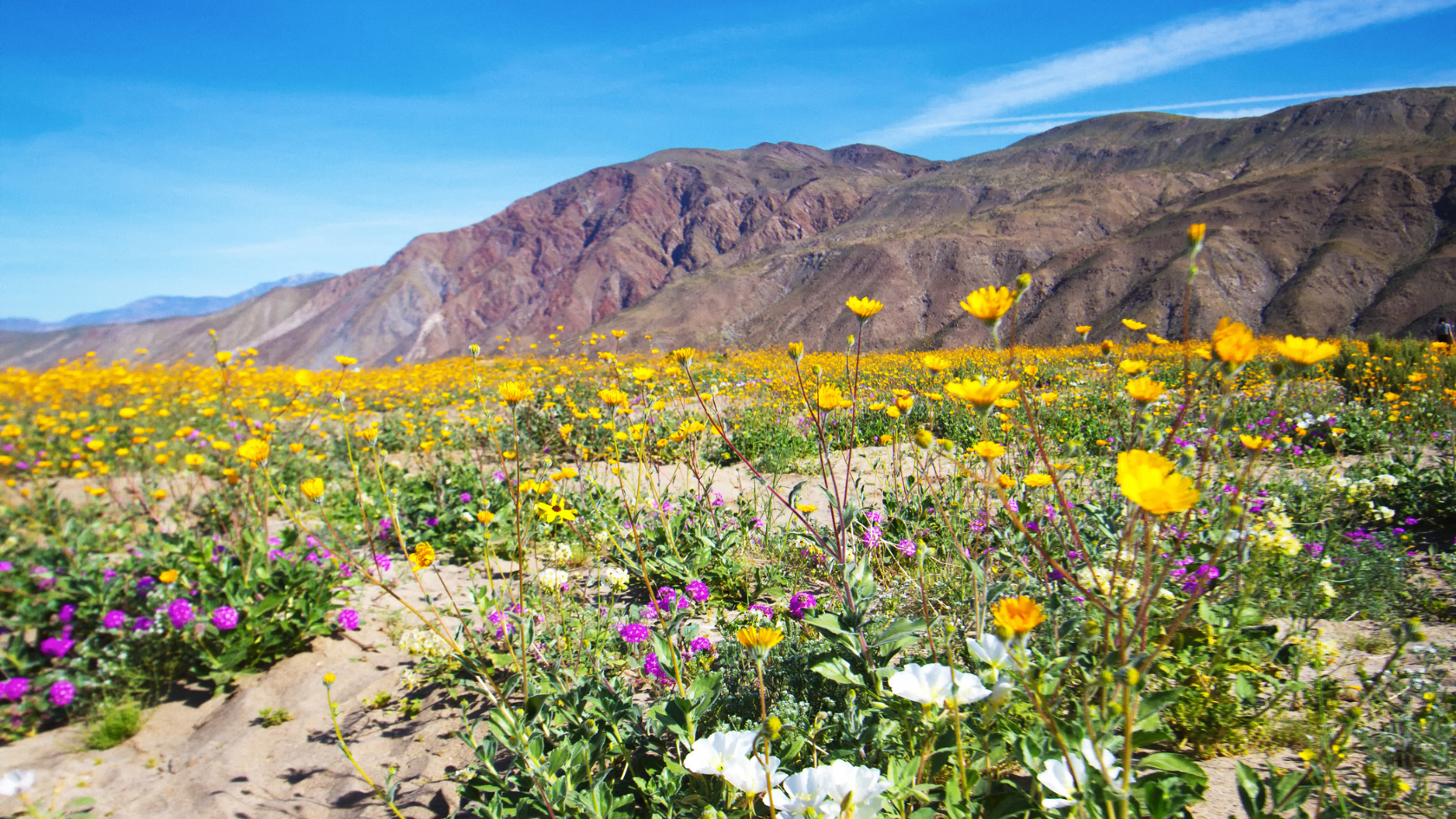
Borrego Springs, in San Diego County, is experiencing an unusual winter wildflower bloom. Henderson Canyon is already colorful—just about a 90-minute drive from San Diego. (ABDNHA)
By Jake Hinton October 19, 2025
Discover the exciting 2023-2024 activities offered by the Anza-Borrego Desert Natural History Association, including hikes, stargazing, conservation efforts, and educational programs. Join us to explore the wonders of the Anza-Borrego Desert.
By Jake Hinton August 13, 2025
Borrego Springs Groundwater Overview
By Jake Hinton April 17, 2025
Carlos Augusto Medina, a Borrego Springs resident for many years, passed away peacefully at his home here on April 13, 2025. He was 86.
By Jake Hinton March 24, 2025
Stay informed with the latest updates from the Borrego Springs Community Resource Center.
 ABDNHA Desert Garden and ArtPark Garden
By Jake Hinton January 13, 2025
Discover the ABDNHA Desert Garden and ArtPark Garden in Borrego Springs. These free, must-visit spots near Christmas Circle offer a unique blend of natural beauty and artistic expression. Perfect for nature and art lovers!
By Jake Hinton December 13, 2024
Discover the story behind the Hawkwatch documentary, showcasing the Swainson's Hawk migration, citizen science efforts in Borrego Springs, and the push for conservation.
By Jake Hinton November 2, 2024
Explore Borrego Valley Airport! Get pilot tips on parking, fuel, and local highlights in this detailed video guide.
Pizza in Borrego Springs: Top Local Spots
By Jake Hinton November 2, 2024
Discover freshly made pizza in Borrego Springs at Carlee’s and Calico’s, two family-run spots offering delicious options for both vegetarians and meat lovers in casual, welcoming settings.
By Jake Hinton September 17, 2024
Borrego Springs: A Hidden Desert Oasis for Nature, Art, and Adventure
By Jake Hinton September 11, 2024
Discover popular hiking trails in Anza-Borrego Desert State Park. Explore scenic routes, palm oases, and historic sites.
Show More
March 6, 2026
By Dennis Mammana Week of March 8-14, 2026 If you hear the word "superstar," what immediately comes to mind? Perhaps names like Tom Hanks, Taylor Swift or LeBron James? That's certainly understandable; they are all undisputed superstars who attract the attention of paparazzi and fans alike. If you're an astronomer, however, you may answer this question differently. For example, when I hear the word "superstar," I think of UY Scuti, WOH G64 or RSGC1-F01. Yes, these are superstars, but not quite how people may think. These are some of the largest stars known in our galaxy and, for that reason, are quite intriguing to us celestial paparazzi. Regular readers of this column know that our sun is also a star. It appears big and bright in our daytime sky because not only is it rather close (about 93 million miles away), it's also pretty large (nearly a million miles across). It sounds huge, but our star is rather small on a cosmic scale, and believe it or not, there are stars out there that would dwarf our sun and make it look tiny. These are the true superstars! Until recently, the largest star known was given the hopelessly poetic name of UY Scuti. At a distance of some 9,500 lightyears from Earth, UY Scuti is what is known as a red hypergiant star, with a diameter some 1,700 times that of the sun! All that changed recently, however, when astronomers found a gargantuan star some 2,150 times larger than our sun! It's named Stephenson 2-18, and if you'd like to get a peek at this stellar behemoth, you'll need more than your eyes. At a distance of some 18,900 lightyears, it appears 5,100 times fainter than we can see without a telescope. If you have no telescope but would still like to see a celestial superstar, you're in luck. There's one shining in our night sky right now; it's one of the brightest up there and is named Betelgeuse. Betelgeuse sparkles brightly in the northeastern corner of Orion, the hunter, and you can see its orange light midway up in the southern sky after dark this week. With about 15-20 times more mass than our sun, Betelgeuse is known as a red supergiant star for good reason. While we could align 109 Earths across the face of our sun, we would need at least 700 suns to cross the face of Betelgeuse! Indeed, this star is so immense that if it replaced our sun at the center of our planetary system, Betelgeuse would engulf the orbits of Mercury, Venus, Earth and Mars, and stretch part of the way to Jupiter! Yet it appears as a simple point of light in our night sky because of its tremendous distance from us — some 3,100 trillion miles, or about 520 lightyears. Betelgeuse is easily one of the largest known stars, though its size fluctuates by as much as 60% as the star shudders and pulsates on its way to an eventual supernova explosion, thousands or millions of years from now. Or tonight. We just don't know.  I hope you'll step out under the night sky soon to meet this remarkable superstar for yourself! Visit Dennis Mammana at dennismammana.com. To read features by other Creators Syndicate writers and cartoonists, visit the Creators Syndicate website at www.creators.com. Learn More About Borrego Springs
February 25, 2026
By Dennis Mammana Week of March 1-7, 2026 Attention, night owls and insomniacs! The sky show this week is just for you! Much of North America is about to see the moon experience one of nature's most beautiful sky shows: a total lunar eclipse. A lunar eclipse occurs when the full moon slips into the Earth's shadow far out in space, either partially or completely, and that's just what will happen during the wee hours of March 3. Skywatchers throughout North America will see the start of this eclipse (weather permitting, of course), but depending on where you live, you may see only a portion of the sky show. In general, the farther west you live, the more of the eclipse you will see before the moon sets behind the western horizon. The eclipse begins at 12:44 a.m. PST (3:44 a.m. EST), when the moon enters the Earth's light outer shadow (known as the penumbra), but this shadow is so thin that no one will notice a darkening of the moon's appearance. Within an hour or so, that will change significantly. As the moon approaches the dark inner shadow of the Earth (known as the umbra), skywatchers will notice the eastern side of the moon beginning to darken slightly. The real show begins at 1:50 a.m. PST (4:50 a.m. EST) when the moon officially enters the umbra. No one gazing skyward will have any doubt that a "bite" has been taken out of the moon — a bite that will grow larger with each passing minute. For the next hour or so, the moon will dim as it slips more deeply into our planet's umbra, until 3:04 a.m. PST (6:04 a.m. EST) when it's completely engulfed and the total eclipse begins. Unfortunately, those in the far eastern part of North America may miss this since the moon will lie quite close to (or even below) the western horizon. During the total phase, the moon will take on a dim coppery hue. This occurs because sunlight passing through our atmosphere is reddened and bent inward toward the darkened surface of the eclipsed moon, now suspended eerily against the stars of Leo, the lion. Only those viewing from the Midwest to the West Coast will see mid-eclipse, which occurs at 3:33 a.m. PST (5:33 a.m. CST). Those in the Midwest may miss the end of totality at 4:02 a.m. PST (6:02 a.m. CST), however, as the moon will be setting in the west. The entire event will end at 5:17 a.m. PST (4:17 a.m. MST) with the moon approaching the western horizon for viewers in western North America. Unlike an eclipse of the sun, a lunar eclipse is perfectly safe to view without protective filters. Your eyes are all you need to enjoy the show, but you'll have even more fun viewing through binoculars or a small telescope. If the sky is cloudy that morning, or if you live where the eclipse won't be visible, you can watch a livestream of the sky show online. Visit timeanddate.com and click on "Sun, Moon & Space" at the top to find details for your location, as well as links to view the eclipse live online. Visit Dennis Mammana at dennismammana.com. To read features by other Creators Syndicate writers and cartoonists, visit the Creators Syndicate website at www.creators.com.  Learn More About Borrego Springs

By Dennis Mammana February 11, 2026

Among Eridanus’ prominent stars is Epsilon Eridani. Creators.com illustration
By Dennis Mammana January 22, 2026
The Great Orion Nebula is visible with the unaided eye.
By Jake Hinton January 10, 2026
This segment aired on KTLA's Off the Clock on Jan. 7, 2026.
By Jake Hinton May 1, 2025
Follow Stories of Borrego updates from the desk. Learn about restoring 707 Christmas Circle, preserving local history, and how you can share your story.
Show More

Share This Post