Andrea McKenna • July 25, 2026
Alphonse Burnand: The Vision Behind Borrego Springs
Share
The Man Who Helped Shape Borrego Springs
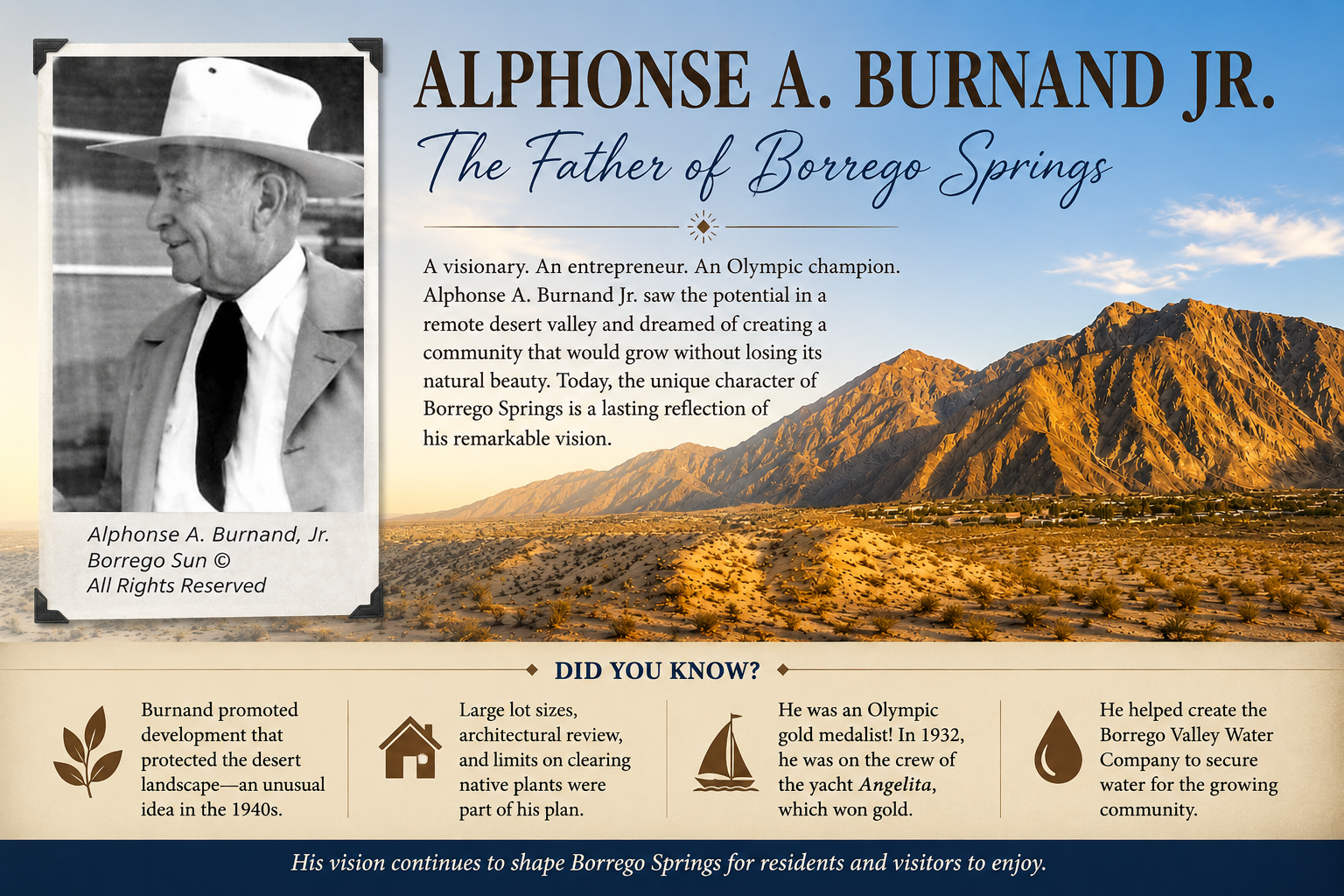
When visitors arrive in Borrego Springs, they often notice something different. The open desert views, spacious properties, and connection to the surrounding landscape create an atmosphere unlike many other desert communities. Much of that experience can be traced back to one man: Alphonse A. Burnand Jr., known as the "Father of Borrego Springs."
Born in Colorado in 1896, Burnand was the son of a miner. His family later moved to Santa Monica, where he grew up before attending the University of California, Davis, and studying agriculture. After graduation, he entered California's grape-growing industry and eventually owned vineyards in the Delano area of the Central Valley.
Around 1933, Burnand made his first trip to the Borrego Valley while searching for locations where crops could be harvested earlier than in other growing regions. The desert climate offered an opportunity to bring produce to market ahead of competitors. While exploring the valley for agricultural purposes, Burnand began to see potential far beyond farming.
In 1936, he purchased an interest in Coyote Canyon Ranch and later acquired the de Anza Ranch. Although growing grapes in the desert proved challenging because of heat, wind, and winter cold, Burnand became convinced that the valley could support something unique: a carefully planned desert community.
Over the following years, he acquired land through purchases, exchanges, tax sales, and agreements with homesteaders. His holdings eventually grew to approximately 17,000 acres.
In 1945, Burnand announced plans for a resort community in Borrego Valley. Newspaper reports at the time described his goal as creating a San Diego County rival to Palm Springs. To move the project forward, he assembled investors and helped establish several organizations, including the Borrego Valley Land and Development Company, the Borrego Springs Company, and the Borrego Valley Water Company.
What made Burnand's vision unusual was his emphasis on preserving the natural beauty of the desert. During a period when many developments focused primarily on growth, Burnand supported planning standards designed to protect the landscape. Large lot sizes helped maintain privacy and open space. Restrictions were placed on development, and an architectural review process was established. Developers were discouraged from clearing native vegetation simply to prepare building sites.
Many of the qualities that residents and visitors appreciate today can be traced to those early planning decisions. Open views, spacious neighborhoods, and a community that blends into the surrounding desert reflect principles established during Borrego Springs' formative years.
In January 1955, a group of investors associated with the development announced a four-point plan for Borrego's future. The goals included orderly development, support for agriculture, conservation of water resources, attracting homeowners and resort facilities, and ensuring that future growth would enhance the natural beauty of the valley. More than seventy years later, those goals still sound familiar to many residents.
Burnand's accomplishments extended beyond Borrego Springs. In 1932, he was a member of the crew aboard the yacht Angelita, which won a gold medal in the 8-Metre sailing competition during the Los Angeles Olympic Games.
Burnand lived long enough to see the community he envisioned become a reality. He passed away in 1981 at the age of 85.
Today, visitors enjoying Borrego Springs' desert scenery, wide-open spaces, and distinctive character are experiencing part of the legacy left by Alphonse A. Burnand Jr. His vision helped shape a community that continues to value both growth and preservation, making Borrego Springs one of California's most unique desert destinations.
Learn more about the Borrego Dream:
www.borregomodern.com/the-dream
Learn More About Borrego Springs