Jake Hinton • October 29, 2022

The 1948 Uranium Discovery in Anza-Borrego

Share

Unearthing Anza-Borrego's Geological Significance


Anza-Borrego State Park, a sprawling desert landscape in Southern California, is a treasure trove of geological wonders, cultural history, and ecological diversity. While the park is renowned for its stunning vistas, unique flora and fauna, and rich indigenous history, there’s another layer to its story that often goes unnoticed: its geological significance. In 1948, a discovery of uranium deposits in the park’s Badlands area added a new chapter to Anza-Borrego’s multifaceted narrative. This blog explores the intriguing story behind this discovery, its cultural implications, and the ethical questions it raises.


The Man Behind the Discovery: Fred Hinds


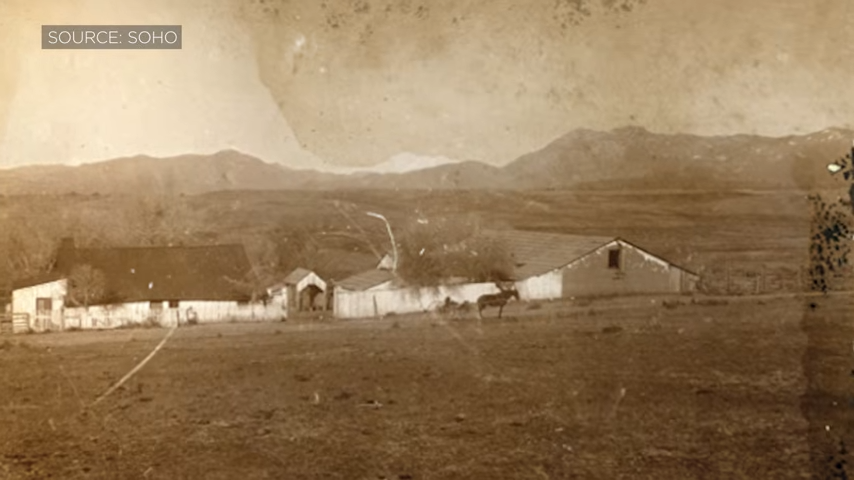
Fred Hinds, an itinerant sign painter and prospector, made headlines in 1948 when he discovered deposits of uranium-bearing ore in the Badlands area of Borrego Valley. Interestingly, Hinds was initially on the hunt for the legendary Peg-Leg Smith mine, a treasure that has eluded prospectors for generations.


The Ore: Carnotite’s Radioactive Reveal


The ore that Hinds discovered was identified as carnotite, a uranium ore that also contains vanadium and potassium. Carnotite ores were sometimes mined for radium in the early 20th century. When tested with a Geiger counter, the ore showed a reading of 20, considered fair for uranium-bearing ores.


What is Carnotite?


Carnotite is a uranium-vanadium oxide mineral that also contains small amounts of potassium. It is often bright yellow and can be found in sedimentary rocks. Carnotite is one of the ores that can be processed to extract uranium, vanadium, and sometimes radium.


Historical Context: Mining for Radium


In the early 20th century, carnotite ores were sometimes mined for radium, a radioactive element used for various industrial and medical applications. The discovery of carnotite in Anza-Borrego thus added a historical layer to the park, linking it to early practices in the mining and use of radioactive elements.


The Geiger Counter Reading: What Does It Mean?


A Geiger counter reading of 20 may not indicate a massive deposit, but it is considered fair for uranium-bearing ores. This reading was significant enough to warrant further exploration and studies. Geiger counters measure ionizing radiation and are commonly used to detect the presence of radioactive materials.


The Location: Anza-Borrego’s Badlands


The exact location of the deposit was kept under wraps, but it was said to be in an area known as the Badlands, near the source of San Felipe Creek. The Badlands are a geological wonder within Anza-Borrego State Park, known for their rugged terrain and unique rock formations.


The Atomic Energy Commission’s Interest


The discovery piqued the interest of the Atomic Energy Commission, leading to further tests to assess the viability and extent of the uranium field. This sparked debates about the potential for mining, touching on issues of sustainability, ethics, and environmental impact.


Cultural and Historical Layers


The discovery added another layer to the rich tapestry of Anza-Borrego State Park, a place already known for its geological wonders and cultural significance, including its historical relevance to the indigenous Kumeyaay people.


The Ethical Debate: To Mine or Not to Mine


While the reserves were not described as massive, the discovery ignited debates about whether to mine these deposits. The discussions extended beyond the boundaries of the park, touching on broader issues of sustainability, ethics, and the long-term impact on the landscape.


Final Thoughts


The 1948 discovery of uranium in Anza-Borrego State Park is a chapter that invites us to ponder the complex interplay between geology, culture, and ethics. It serves as a reminder that our natural landscapes are not just scenic vistas but are also filled with hidden stories and ethical dilemmas, waiting to be discovered and understood.


Learn More About Borrego Springs
By Andrea McKenna July 9, 2026
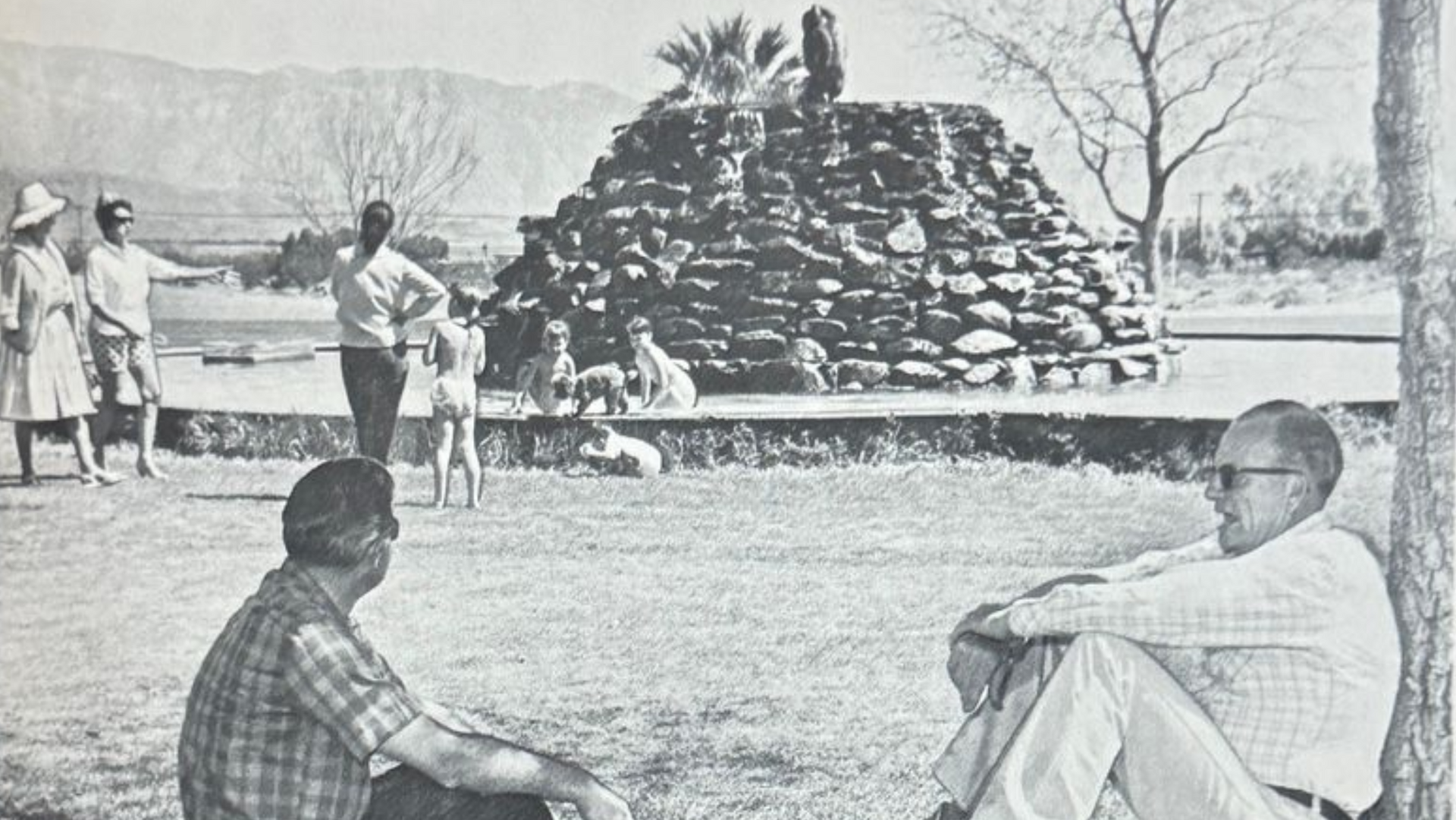
A 1966 Borrego Sun photo offers a glimpse of Christmas Circle during one of Borrego Valley's busy wildflower seasons. Published in the April 2, 1966 edition, the image shows visitors relaxing on the lawn near the iconic fountain after spending time exploring the desert in bloom. The original caption reads: SIESTA — One can get pretty hot and tired, looking at the wildflowers in Borrego Valley. Christmas Circle, with its inviting fountain, trees and green grass, is a nice place to take a break. This is the way it has been during the last few weekends. The photograph captures a quiet moment in Borrego Springs history, preserving the way visitors experienced Christmas Circle nearly 60 years ago. Images like this continue to document the community's past through the pages of the Borrego Sun archives.
By Andrea McKenna July 8, 2026
When the future of the Community Concert Association was uncertain, Bill Wright inspired a path forward through growth, volunteers and community support. As the Borrego Springs Community Concert Association announces its new season, it is worth remembering the people who helped keep this tradition alive. Founded in 1975, the all-volunteer nonprofit brings high-quality, eclectic music to Borrego Springs. Each season includes five public concerts and four free educational concerts for local students. Children are bused to the Borrego Springs Performing Arts Center to experience professional live music, and musicians also visit local schools for interactive programs that introduce students to music up close. That tradition almost came to an end. When the Association had fallen on hard times (2015) and was preparing to disband, Bill Wright stepped forward. By reaching out to his many business associates, Bill raised enough money to help save the organization and keep professional musicians coming to the Borrego stage. Among his written correspondence with the board, Bill Wright repeatedly advocated for “growth, not reduction,” encouraged members to “recruit new volunteers” and “develop sponsorship opportunities,” and closed one letter with a promise that captured his commitment: “We will do more than our share to keep the great music series going.”
By Andrea McKenna July 5, 2026
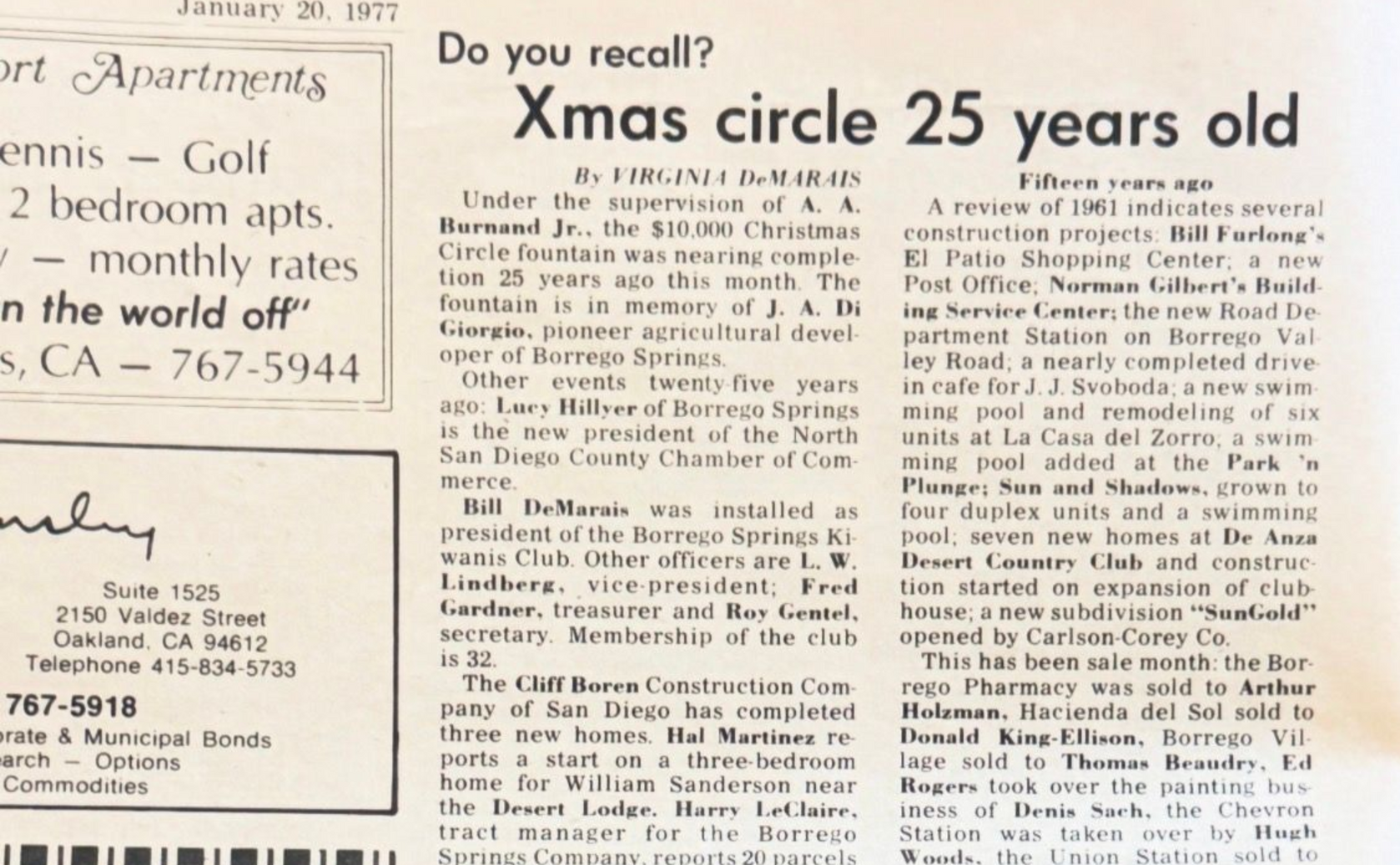
January 20, 1977 Xmas circle 25 years old By VIRGINIA DeMARAIS Under the supervision of A. A. Burnand Jr., the $10,000 Christmas Circle fountain was nearing completion 25 years ago this month. The fountain is in memory of J. A. Di Giorgio, pioneer agricultural developer of Borrego Springs. Other events twenty-five years ago: Lucy Hillyer of Borrego Springs is the new president of the North San Diego County Chamber of Commerce. Bill DeMarais was installed as president of the Borrego Springs Kiwanis Club. Other officers are L. W. Lindherr, vice-president; Fred Gardner, treasurer and Roy Gentel, secretary. Membership of the club is 32. The Cliff Boren Construction Company of San Diego has completed three new homes. Hal Martinez reports a start on a three-bedroom home for William Sanderson near the Desert Lodge. Harry LeClaire, tract manager for the Borrego Springs Company, reports 20 parcels of land sold during the holidays, totaling $50,000. Work has started on straightening Banner Summit Grade, reports Hugh Woods, vice-president of the Highway 78 Association. The Borrego Springs Square Dance Club is meeting at Hoberg’s Desert Resort. Wick Hauser is caller and teacher, Dick Wear – manager. Girl Scout Troop 441 of Borrego Springs serenaded the valley with Christmas carols, under the supervision of Mrs. Ralph Bell, Girl Scout leader, and Mrs. Charles Broeske, assistant. Mrs. Lola LeBard has started construction of a house and trailer court at Sunny Acres on Split Mountain Road. Borrego starts the new year with 18 telephones in the valley. Cover girl for the recently published Redbook Magazine is Dolores Smith Dalzell, daughter of the Borrego mail carrier, George C. Smith. Chamber of Commerce president Hugh Woods reports discussions at meeting of possibility of a bank by Perry Burnand, and suggestions and ideas on promoting television reception in the valley. Birdies are not eagles! Our typewriter slipped when we said W. D. Johnston got an eagle 3 on the par 4 18th hole at De Anza in the last edition. It was, of course, an eagle 2. A review of 1961 A review of 1961 indicates several construction projects: Bill Furlong’s El Patio Shopping Center; a new Post Office; Norman Gilbert’s Building Service Center; the new Road Department Station on Borrego Valley Road; a nearly completed drive-in cafe for J. J. Svoboda; a new swimming pool and remodeling of six units at La Casa del Zorro; a swimming pool added at the Park ’n Plunge; Sun and Shadows, grown to four duplex units and a swimming pool; seven new homes at De Anza Desert Country Club and construction started on expansion of clubhouse; a new subdivision “SunGold” opened by Carlson-Corey Co. This has been sale month: the Borrego Pharmacy was sold to Arthur Holzman, Hacienda del Sol sold to Donald King-Ellison, Borrego Village sold to Thomas Beaudry, Ed Rogers took over the painting business of Denis Such, the Chevron Station was taken over by Hugh Woods, the Union Station sold to Jack Barling. New openings were the Carlson-Corey Realty Company, the Marga-Reta Remembrance Shop, the Bottle Shop, the Bantam Market, and the Lazy V. Cafe. Service seminar Eleven local men recently were given certificates for attending a special electronic ignition service seminar sponsored by J & R Auto Supply in Borrego Springs. The seminar was designed to familiarize them with the new automotive electronic ignition systems, according to John A. Bowley of J & R. Besides Bowley, participants included Ted Townsend of Borrego Automotive; Joe Romas and John Guelke of Anza-Borrego Desert State Park; Billy Lawrence and Thomas Heiser of Borrego Springs Fire Department; John Petrich, Union 76 station; Paul Dellostrillo, Earl Cartier and Dale Cartier of Cartier Mobile Service; Angus Smith of De Anza Country Club, and Henry Barling Jr., Borrego Springs Dump Truck Service. Ewe goes to L.A.  The body of the Bighorn sheep ewe that was found in possession of a man on Montezuma Grade was donated to the Los Angeles County Museum and will become part of a diorama there. Salton Sea steady The Salton Sea water level (-229.3 feet) has remained at that level from Sept. 30 to early December, according to Craig Engel, manager of the State Parks Department Salton Sea Area. Engel said this indicates that “perhaps the water monitoring, higher water rates and fines imposed by the Irrigation District are working.”





By Andrea McKenna July 4, 2026
San Diego History Center Opens America 250 Exhibit Celebrating the Nation's 250th Anniversary
By Andrea McKenna July 4, 2026
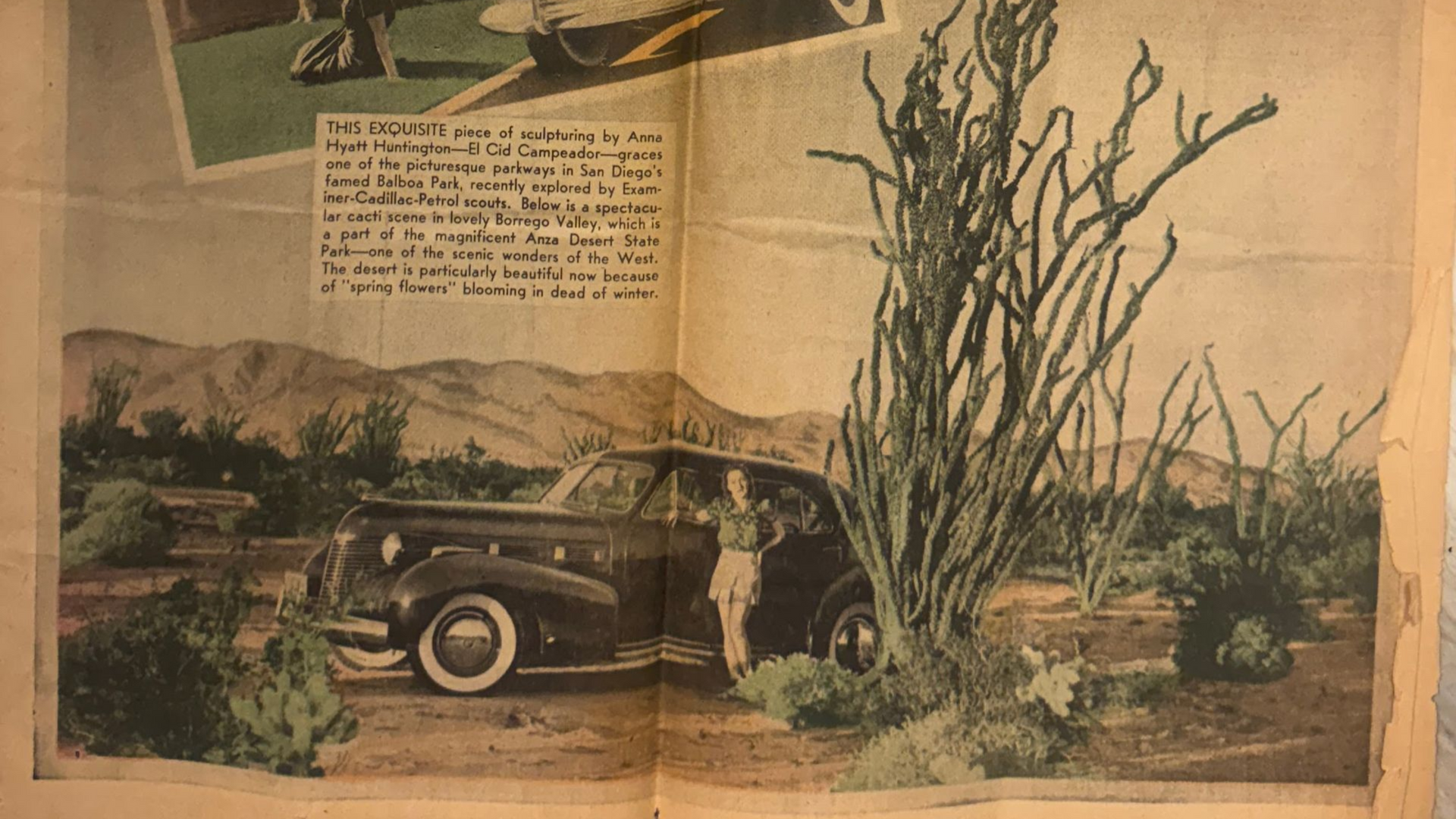
A December 1939 travel magazine captured Borrego Valley as one of Southern California's emerging desert destinations. One of the many historic items preserved with the Borrego Sun collection is a rare issue of Motor and Outing Magazine , published by the Los Angeles Examiner on Sunday, December 3, 1939 . The "Motor and Outing Magazine" was a popular recurring Sunday supplement distributed in the Los Angeles Examiner during the mid-20th century. It primarily featured regional travel guides, automotive lifestyle stories, and outdoor recreational content showcasing destinations and weekend trips across Southern California. Anza-Borrego Desert State Park was officially established by the State of California in 1933 . This particular page shows how Borrego Valley was presented to Southern California travelers in 1939. The accompanying caption describes the valley as “a spectacular cactus scene” and notes that it was part of Anza Desert State Park, highlighting the desert’s seasonal beauty with “spring flowers” blooming in winter. Nearly 90 years later, the image offers a rare glimpse of Borrego as an early desert destination promoted to motorists exploring Southern California by car. The photographs in the feature are credited to John H. C. Stingle , who documented several scenic locations throughout San Diego County for the publication. Historic items like this help tell the story of how Borrego Springs was introduced to visitors long before it became the community we know today. They provide a unique glimpse into early tourism, desert travel, and the publications that showcased the region's beauty nearly 90 years ago. ---- These documents are part of the Borrego Sun materials acquired by Ram Media Foundation . Separately, The Borrego Sun archives are being preserved and digitized by the San Diego History Center , ensuring that decades of Borrego Springs history will be preserved for future generations. To support the future of local media and preserve the past, please contact Andrea at andrea@rammediafoundation.org .


By Andrea McKenna June 23, 2026
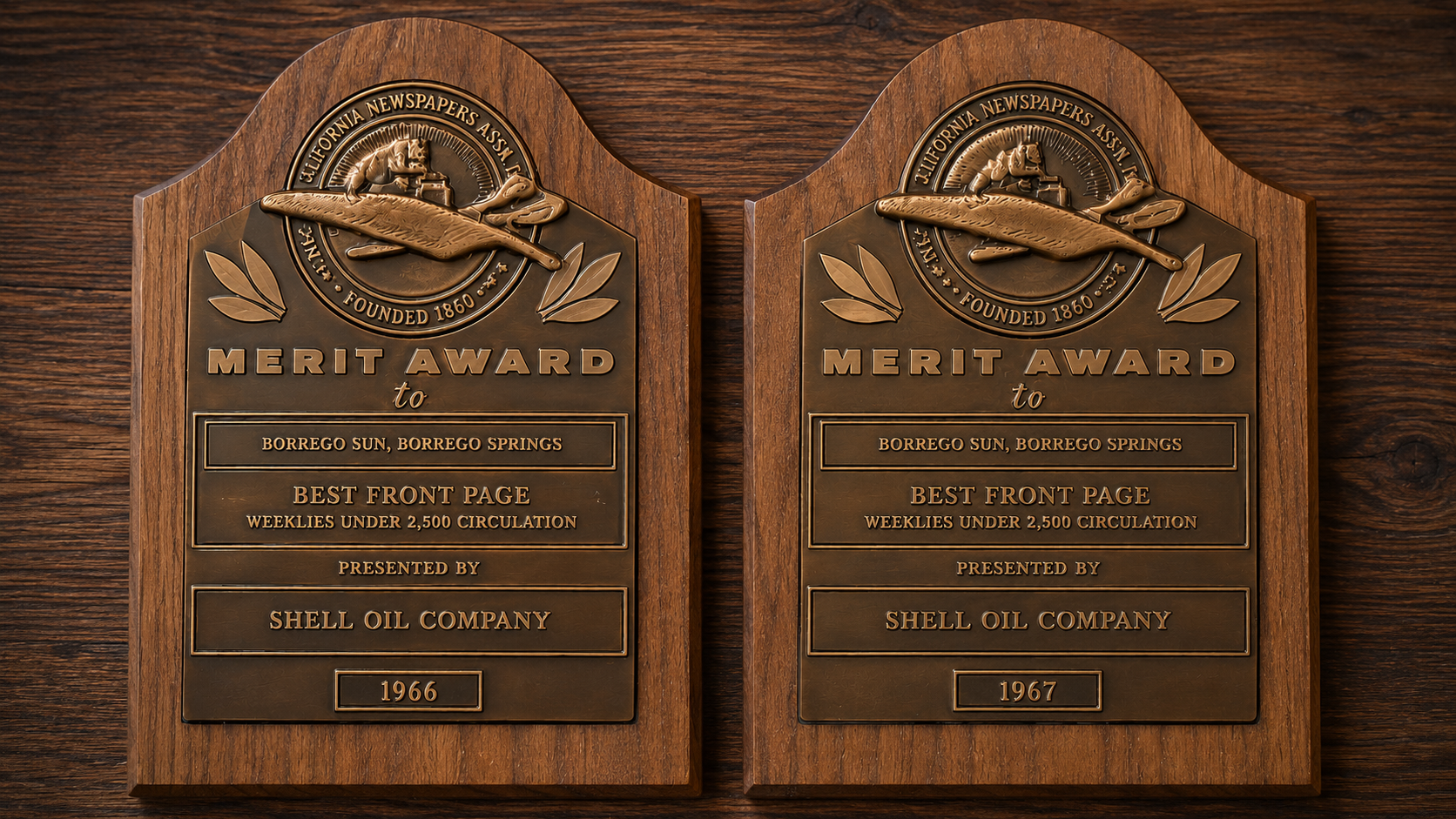
California Newspaper Publishers Association Merit Awards presented to the Borrego Sun for Best Front Page in 1966 and 1967.
By Sunbelt Publications June 9, 2026
A Sunbelt Spotlight with Diana Lindsay  For 17 years, Marshal South and his family lived on Ghost Mountain, a remote, waterless mountaintop in Blair Valley, now part of Anza-Borrego Desert State Park. Their life of isolation, creativity, and survival became one of the desert’s most talked-about stories. Life on Ghost Mountain From 1930 to 1947, the South family lived in a handmade home on Ghost Mountain. Marshal South wrote about their primitive lifestyle in monthly articles for Desert Magazine, drawing thousands of readers into the family’s unusual desert experiment. A Writer, Poet, and Desert Storyteller South wrote poems, novels, essays, short stories, and more than 100 pieces for Desert Magazine. His writing celebrated the silence, beauty, natural history, and healthful qualities of the desert. The Story Behind the Legend Diana Lindsay, editor of Marshal South and the Ghost Mountain Chronicles, shares the history behind the South family’s life, the questions surrounding their years on Ghost Mountain, and why the story continues to fascinate readers today. About Diana Lindsay Diana Lindsay is an award-winning author, historian, editor, and president of Sunbelt Publications. Her work has helped preserve and share the history of Anza-Borrego and the remarkable story of Marshal South. .
Charles Robert Starrett – The Durango Kid of Borrego Springs

By Jake Hinton May 28, 2026
Charles Robert Starrett was an American actor and singer, best known for his role as “The Durango Kid” in over 100 Western films. Born on March 28th, 1903 in Athol, Massachusetts, Starrett began his acting career in the silent era before transitioning to sound films. He passed away on March 22nd, 1986, in Borrego Springs, California.

By Jake Hinton May 5, 2026
Explore Alta Jones DuVall’s life, personal journey, and the historical context of Borrego Valley.
Show More

Share This Post