Department of Water Resources • September 8, 2026
Some Like It Hot: DWR Scientists Endure Extreme Heat
Share
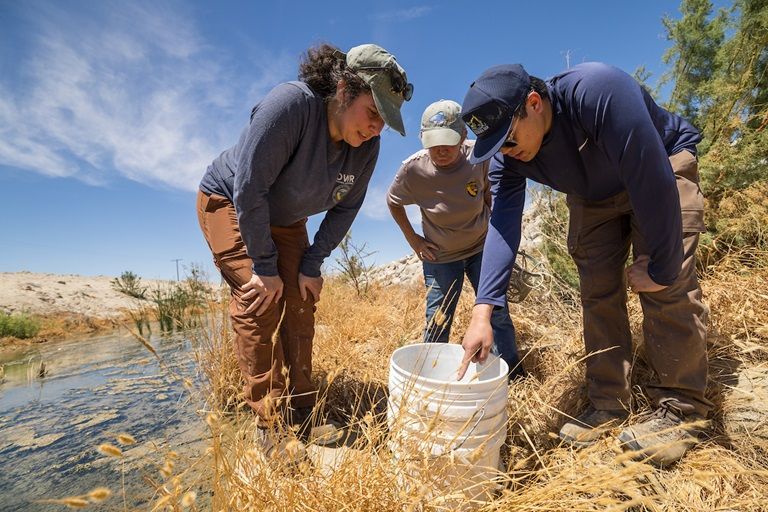
Specially-trained California Department of Water Resources staff members Vanessa Velasco (left) and Nicholas Burgos (right) support California Department of Fish and Wildlife staff member Sharon Keeney to set and collect traps for pupfish during a survey conducted by CDFW at a drain north of the Salton Sea in Riverside County
Summer temperatures at the Salton Sea in southeastern California frequently exceed 110° F, making any time spent outdoors hazardous, let alone doing anything strenuous. Even so, DWR scientists Vanessa Velasco and Nicholas Burgos routinely brave the heat as they study one of the region’s most fascinating creatures, the desert pupfish.
“The Salton Sea basin gets brutally hot at this time of year, but this is the peak of the breeding season for the pupfish and that’s when our research surveys are crucial,” said Burgos. “It’s a pretty harsh environment for most creatures, which is why their ability to survive here is so remarkable.”
The Salton Sea’s only endemic fish species, the desert pupfish can tolerate an extreme range of environmental conditions: salinity levels ranging from fresh water up to almost double ocean water salinity; water temperatures as high as 108° F and as low as 40° F; and low levels of dissolved oxygen.
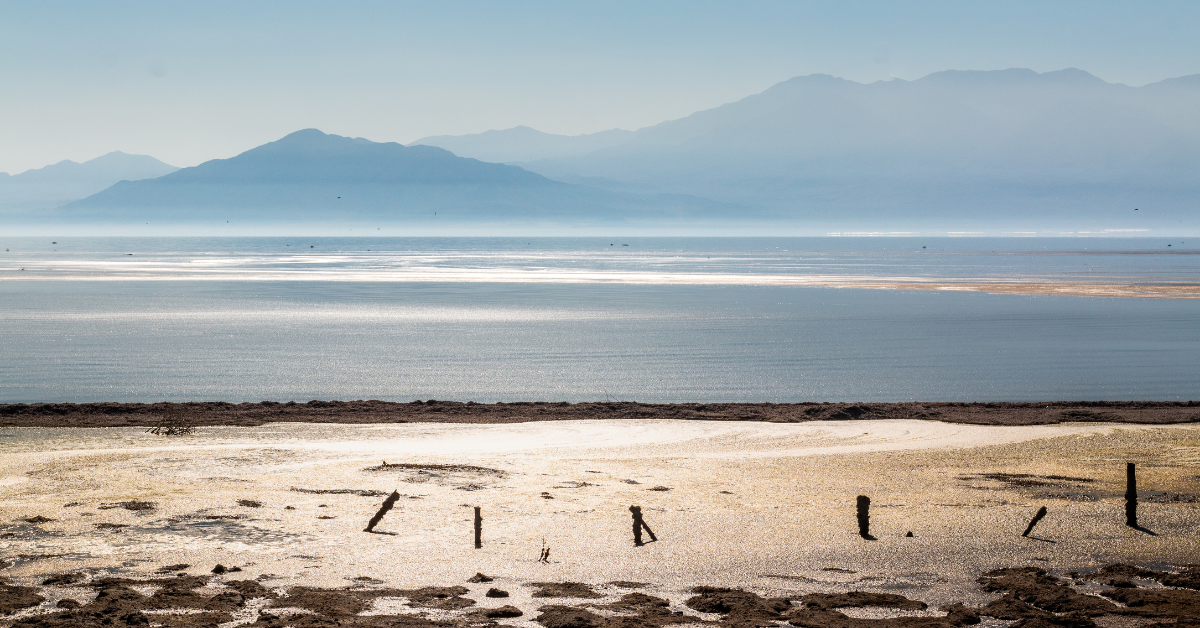
Once abundant in the Salton Sea basin’s shoreline pools and creeks, the desert pupfish now occupies only a fraction of its historic range. Since the Colorado River breached an irrigation canal in 1905, the resulting “accidental” lake periodically shrank and expanded, but since the early 2000s it has been steadily evaporating, losing between one and two feet of surface elevation each year. By the 1980s, the desert pupfish habitat had become so restricted the species was listed as endangered and would have completely disappeared if not for the intervention of concerned scientists and citizens.
Burgos and Velasco received training to conduct the pupfish surveys from California Department of Fish and Wildlife fishery biologist Sharon Keeney as part of DWR’s Species Conservation Habitat (SCH) project, an aquatic habitat restoration project that will restore approximately 9,500 acres of shallow and deep-water habitat at the southern end of the Salton Sea.
“Historically, pupfish populations have been found in the sea itself and in drains at the north and south ends of the lake, plus various tributaries and artificial habitats such as former marinas,” said Keeney. “An important part of the training is learning what locations are particularly favorable for pupfish. Some of the drains are quite turbid with high velocity flows and little vegetation, and those are poor conditions for pupfish which like slow velocity or stagnant water, especially for spawning.”
Keeney emphasizes that although desert pupfish are very tolerant of extreme conditions, they do not tolerate handling well, especially juveniles, and can easily die if not handled properly. “During the training, I stress the need to minimize exposing the fish to the air, especially in hot weather, and we only use nets and buckets, and never touch the fish directly with our hands,” said Keeney.
The release of water into the first two ponds of the SCH in May 2025 increased habitat for desert pupfish by roughly 2,010 acres. DWR’s surveys will show how well the fish are taking advantage of this expansion, and project managers are already seeing encouraging signs.
“We’re looking at filling the rest of the ponds this year and next, which will bring us to about 9,500 acres,” said Salton Sea Restoration Office Section Manager Vivien Maisonneuve. “As soon as we open some water, the pupfish will come. We are very happy to see that they start colonizing the new ponds very quickly.”
Keeney has also helped establish a desert pupfish population at the Living Desert Zoo in Palm Desert where one of the new ponds is named after her. Desert pupfish relocations become necessary when a pond or drain dries up, often due to tamarisk overgrowth. It’s a task Keeney introduced Burgos to during a recent survey.
“In the heat, it’s hard enough just doing the surveys,” Keeney recalled, “but doing the rescue as well was very tough; 9-to-5 and no shade at all. But I know Nick found it rewarding and we felt we had really accomplished something that day.”
For Burgos and Velasco, the pupfish survey training program is the first step toward obtaining a Scientific Collection Permit required by CDFW for research, educational, or management purposes that involve handling protected wildlife. “It’s kind of a big deal to be certified to be a permit-holder for an endangered species,” said Burgos. “The hope is that as the Salton Sea Management Program does more restoration projects, we will be able to provide this kind of service throughout the Salton Sea. Desert pupfish may be tough and resilient, but they’re still going to need our help.”
For a photo-illustrated version of this article, click here.
News Provided By
Learn More About Salton City & Salton Sea
>> Salton Sea Tales: A Potentially True Adventure is a speculative eco-thriller novel by Gabriel Wisdom