By Tammy Murga / Environment Reporter • July 6, 2026

Endangered ram dies after getting caught in concertina wire at US-Mexico border

Share
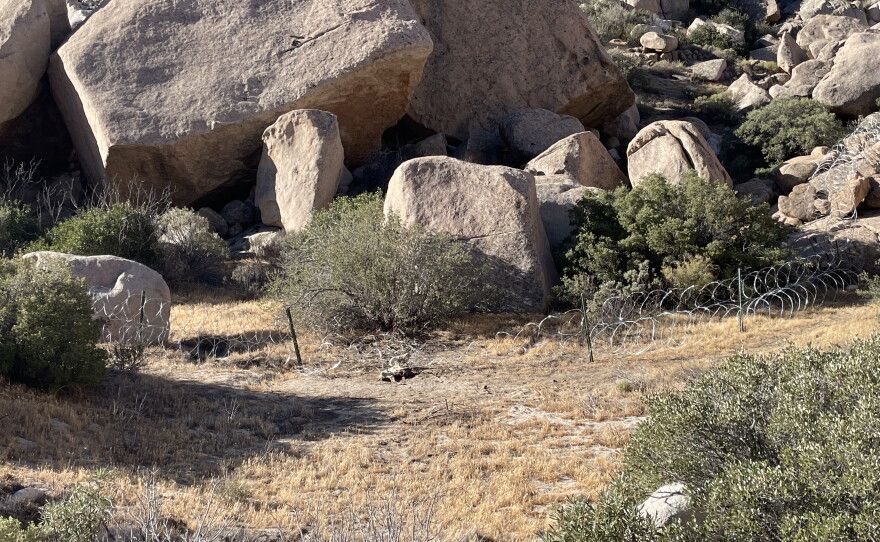
Photo courtesy Christina Aiello /Wildlands Network

Originally published on www.kpbs.org


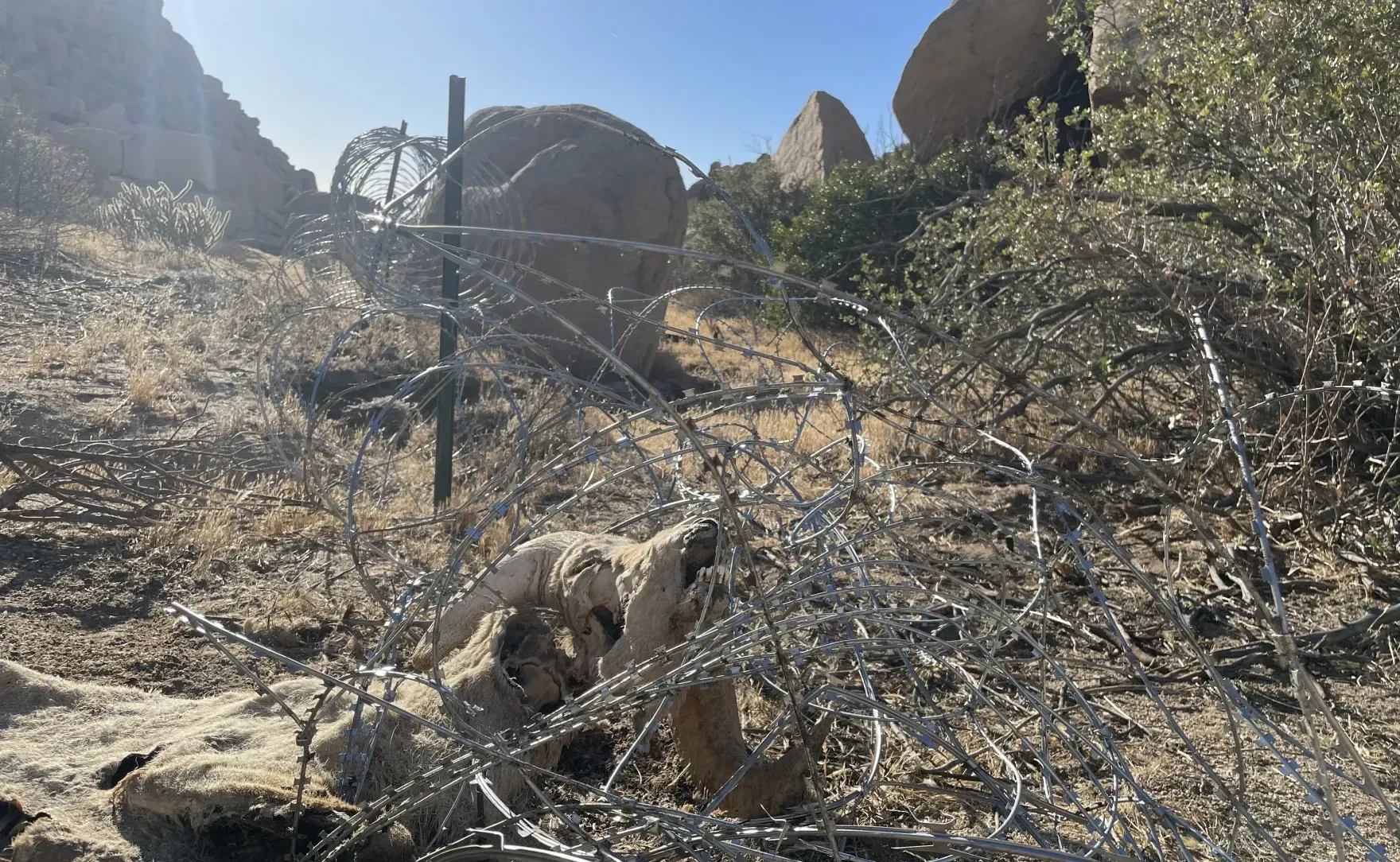
On Wednesday, June 3, 2026, Wildlife biologist Christina Aiello found an endangered Peninsular bighorn sheep that had died after becoming entangled in concertina wire at the border in the Jacumba Wilderness. U.S. Customs and Border Protection is closing gaps in the California-Mexico border with concertina wire.


The Peninsular bighorn sheep’s heavy, curved horns and front legs were trapped in the bladed, large coils.

Christina Aiello, a wildlife biologist at the Wildlands Network, found the ram last week in the Jacumba Wilderness, decomposing.


“It was pretty gruesome to see how fully wrapped up in this wire he was,” she said Tuesday.

Advertisement


This was the first death-by-border-wire Aiello had seen. Residents in Jacumba and Boulevard said they have also observed more wildlife wandering near their homes, some of them with lacerations, since the federal government began sealing gaps in the California-Mexico border.


Aiello said she wasn’t surprised by the ram’s death. For months, she and several other scientists and conservationists had been warning U.S. Customs and Border Protection officials about the consequences of wire fencing in natural areas.


Late last year, CBP began installing concertina wire in the Jacumba Wilderness where the animal was found. The addition of the coil fencing is part of the federal government’s larger plan to close the last remaining openings in the border wall, including in San Diego and Imperial counties, with “30-foot-high six-inch-squared diameter steel bollards” and a secondary barrier wherever possible, as well as surveillance cameras and LED lighting.


Aiello has asked CBP to remove the wire and to build animal passages on the steel U.S.-Mexico border wall that are large enough for bighorn sheep to cross. Those requests have been denied.


Conservationists have argued that without these measures in place, several species, including the endangered bighorn sheep, will be forced to travel far outside their home range in search of food and water. They said if the fencing remains in place, more protected species may die.

Advertisement


“If they have completed the razor wire fence, if they're doing construction on the border, you then have risks of that entanglement problem,” said Aiello. “If they leave that razor wire up, you have risks of death or interactions with construction vehicles.”

CBP declined to comment. A spokesperson deferred questions to the Joint Task Force – Southern Border, which did not respond.


In an emailed statement, the California Department of Fish and Wildlife (CDFW) confirmed the ram had died after getting caught in the large coils.


“CDFW has been clear with the federal government that border wall construction poses serious risks to protected wildlife, including bighorn sheep,” the statement added. “This is another tragic reminder of those concerns.”
Christina Aiello / Wildlands Network


On Wednesday, June 3, 2026, wildlife biologist Christina Aiello found an endangered Peninsular bighorn sheep that had died after becoming entangled in concertina wire at the border in the Jacumba Wilderness. U.S. Customs and Border Protection is closing gaps in the California-Mexico border with concertina wire.

Aiello was surprised to find the ram caught by the wire on a flat section of the Jacumba Wilderness, rather than high up in the remote area’s boulders.


“My thought here is that it actually might have just been grazing next to the fence, not even trying to jump over it,” she said. “Something as simple as just walking by with your head down and you're not paying attention, and a horn gets caught can create a very hazardous situation as the animal panics and starts to react.”

“If something so kind of mundane as walking next to the fence could lead to entrapment, I do think that the longer that fence is up, you know, the greater the risk,” Aiello added.


In Boulevard, resident Karen Parker said she has noticed more mountain lions in her community. She recently found one with noticeable lacerations on its back legs.


“Big cats have lost their habitat (since the expansion of the border wall)," she said. “(Mountain lions) have always been out here, but not like this and not this many. I put water out for them and that’s all we can do.”


On Monday, Jacumba resident Tanya Wilkins Aiau reported the death of what she believes was a wild horse that had been struck by a vehicle on Old Highway 80 near Jacumba to San Diego County Public Works officials. She said she believes the new border wall construction is pushing the horses toward busy highways.


“Because of all of the disruption, they don’t have their regular spots anymore,” she said, adding that local residents have reported two other wild horse deaths in recent months.


Aiello said she is working with state agencies and nonprofit organizations on both sides of the border to monitor wildlife movement using cameras and GPS trackers. They are also working on securing funding to install permanent water sources for animals who may lose their resources because of the border wall’s expansion.


Learn More About Borrego Springs
By Andrea McKenna July 23, 2026
San Diego broadcaster and local Ram Media Foundation founder returns to the convention where his Comic-Con journey began. Gabriel B. Wisdom, founder of Ram Media Foundation and creator of KRAM 90.5 FM Borrego Springs, will speak at San Diego Comic-Con on Friday, July 24. Founded in 1970, San Diego Comic-Con has grown into one of the world’s largest pop culture conventions, drawing more than 130,000 attendees for panels, exhibits and appearances by creators, artists, filmmakers and celebrities from around the globe. Wisdom will join Radio Hall of Fame inductee (Shotgun) Tom Kelly for "A Conversation with San Diego Celebrities Gabriel Wisdom and (Shotgun) Tom Kelly," from noon to 1 p.m. at the Marriott Marquis San Diego Marina. Beginning at KPRI-FM San Diego in the late 1960s, Wisdom went on to work at KGB-FM San Diego and KMET-FM Los Angeles during the formative years of FM rock radio in the 1970s. Today, he leads Ram Media Foundation and, among other roles, serves as a portfolio manager with AMM Investment Management.
By Gabriel Wisdom July 23, 2026
By Gabriel Wisdom I stepped out onto the stage at the San Diego ComicCon dressed as Thor. The wings on my helmet were slightly crooked, and the cape was too heavy for the San Diego summer weather, but none of that mattered. I can still feel the weight of the hammer in my hand, a ridiculous, glorious mirrored prop a friend of mine had built in his garage. The room was buzzing and in 1976, ComicCon was young and alive. The training wheels had come off and we had 3000 paid attendees – real fandom, but nothing like today’s 130,000 who attend each year. Behind me stood Stan Lee and his Marvel artist John Buscema, both of them watching the crowd like proud parents at a very strange school play. “Ladies and gentlemen!” I called out, raising the hammer. “I am THOR, God of Thunder, Lord of the Savage Lighting, and host for tonight’s masquerade ball!” The crowd cheered, and for a moment everything felt perfectly under control. Then I glanced at the judges seated in the front row. Gene Roddenberry, hands folded like he was observing a social experiment. There was Ray Bradbury, eyes burning with Fahrenheit 451 curiosity. And to Roddenberry’s right…a special surprise guest I’d brought along at the last minute, Timothy Leary, smiling like he’d just dropped in to see what condition his condition was in. I felt my stomach drop recalling earlier how ComicCon co-founder Shel Dorf had pulled me aside, his face tight with concern. “You brought him ?” he asked heatedly. “Do you have any idea what this could do to us? The most dangerous man in America , isn’t that what Nixon called him? I had shrugged, maybe a little too casually. “Leary and I are doing a radio show together with rock stars and other guests talking about science fiction; stuff like that, only this is science-faction. He’s crazy smart, and funny. Great fun.” Shel didn’t see it that way, but it was too late because there in the front row, the notorious “pied piper of LSD,” Doctor Timothy Leary was sitting between two of the most respected creative minds in speculative fiction. The first contestant came out dressed as a passable Spider-Man. “Have no fear, Spidey is here,” I boomed, voice steady, but my eyes kept drifting back to the front row. Leary leaned over to Roddenberry saying something that made them both laugh. Bradbury looked less amused. He crossed his arms, studying Leary like he was a story problem he hadn’t solved yet. Stan Lee was standing by the side of the stage, arms folded. “You’ve stirred the pot, kid,” he murmured. “I may have left the gas on and blown up the kitchen,” I replied. “Even better,” Stan grinned. Murmurs started spreading through the convention ballroom about Timothy Leary. A number of older people stood and left for the exits, shaking their heads. A dozen others followed shuffling past the rows of seated attendees. The energy had clearly shifted. I tightened my grip on the hammer and began swinging. “Alright!” I bellowed, “The mighty Thor shall supply the cure!” “True believers!” Stan Lee shouted. “What is a masquerade without a little chaos? The crowd laughed. The tension cracked. I looked down at Roddenberry who met my eyes and gave an encouraging nod. “The great Gene Roddenberry,” I declared to a round of applause. Then I asked, “In the Star Trek universe, what happens when unexpected elements enter the system?” Roddenberry stood slightly but not all the way. “We adapt,” he said. “Or we evolve.” Bradbury chuckled despite himself. Leary raised both hands. “Yes, we evolve. Sometimes you have to go out of your mind to come to your senses,” he laughed. The room erupted with another round of applause, some cheers, some boos, but it was alive again. Electric. I seized it. “Okay, let’s evolve this masquerade! Every contestant, you are now challenged to make it stranger, make it bigger, and make it believable!”  What followed was chaos, yes -- but the right kind. Comic-Con was still half counterculture experiment, half gathering of true believers and those who thought stories mattered more than the world seemed willing to admit. © 2026 Stan Lee, Gene Rodenberry, and Me ™ by Gabriel Wisdom

By Kevin Trevellyan July 23, 2026
Originally published on www.kpbs.org Several groups are formally pushing back on San Diego Gas & Electric’s request to raise customer rates by 8.6% in 2028, citing affordability concerns. Under the proposal , an average electric bill would jump about $14 over 2027 estimates, while a natural gas bill would rise about $8. Edward Lopez, executive director of the San Diego-based Utility Consumers’ Action Network, thinks that’s too high. He cited a California Public Utilities Commission report that found SDG&E’s average residential electric rates have already risen 98% over the last decade. “Coming on the heels of the ever-increasing requests, at some point, isn’t enough enough?” Lopez said. “We all feel the pain of these rates. They’re getting out of hand.” About 20% of SDG&E residential customers are at least a month behind on their power bills, according to same report. The Utility Consumers’ Action Network and several other ratepayer advocacy groups filed formal protests against SDG&E’s rate request with the California Public Utilities Commission on Monday. It’s part of a complicated four-year regulatory process, called a general rate case , to determine how much money the utility can collect from customers starting in 2028. Now, organizations “intervening” in the regulatory proceedings on behalf of SDG&E customers are hiring experts to dig into the utility’s thousands of pages of application materials in order to answer some top-line questions. “What is the utility doing? What are they proposing to do more of? Is it reasonable? What are the costs associated with that? Are those costs reasonable?” Lopez said. SDG&E wants to collect about $3.8 billion from customers in 2028, a roughly 8% bump over next year’s estimated revenue requirement. The utility says inflation, rising medical benefit costs and wildfire-related expenses are driving the increase. For SDG&E and other privately-owned utilities in California, shareholder revenue is partially based on the return from infrastructure projects. Malinda Dickenson, executive director of the San Diego-based Protect our Communities Foundation, contends SDG&E could lower its requested rates by prioritizing local power generation. The foundation’s protest filing calls for greater consideration of small-scale solar generation and storage in order to reduce costs tied to hardening grid infrastructure against wildfire risk. “You're not going to need these transmission upgrades and new transmission lines to bring power from faraway places to urban centers where the power’s used,” Dickenson said. “So what Protect our Communities will be doing in this proceeding is presenting alternatives to SDG&E’s heavy capital expenditures.” SDG&E has until July 30 to respond to intervening groups’ protests. In a statement, the utility acknowledged affordability is top of mind for customers. “Our proposal reflects a focused, disciplined plan to keep energy safe and reliable while managing costs responsibly on behalf of the customers and communities we serve,” spokesperson Anthony Wagner said. “We support the transparent regulatory process that allows customers, community members and other stakeholders to provide input as the [California Public Utilities Commission] reviews our request.” The commission’s five voting members will ultimately decide whether to grant or adjust SDGE’s rate request.
Show More

Share This Post