Jake Hinton • April 12, 2024

Informational Panels at the ABDNHA Visitor Plaza

Share
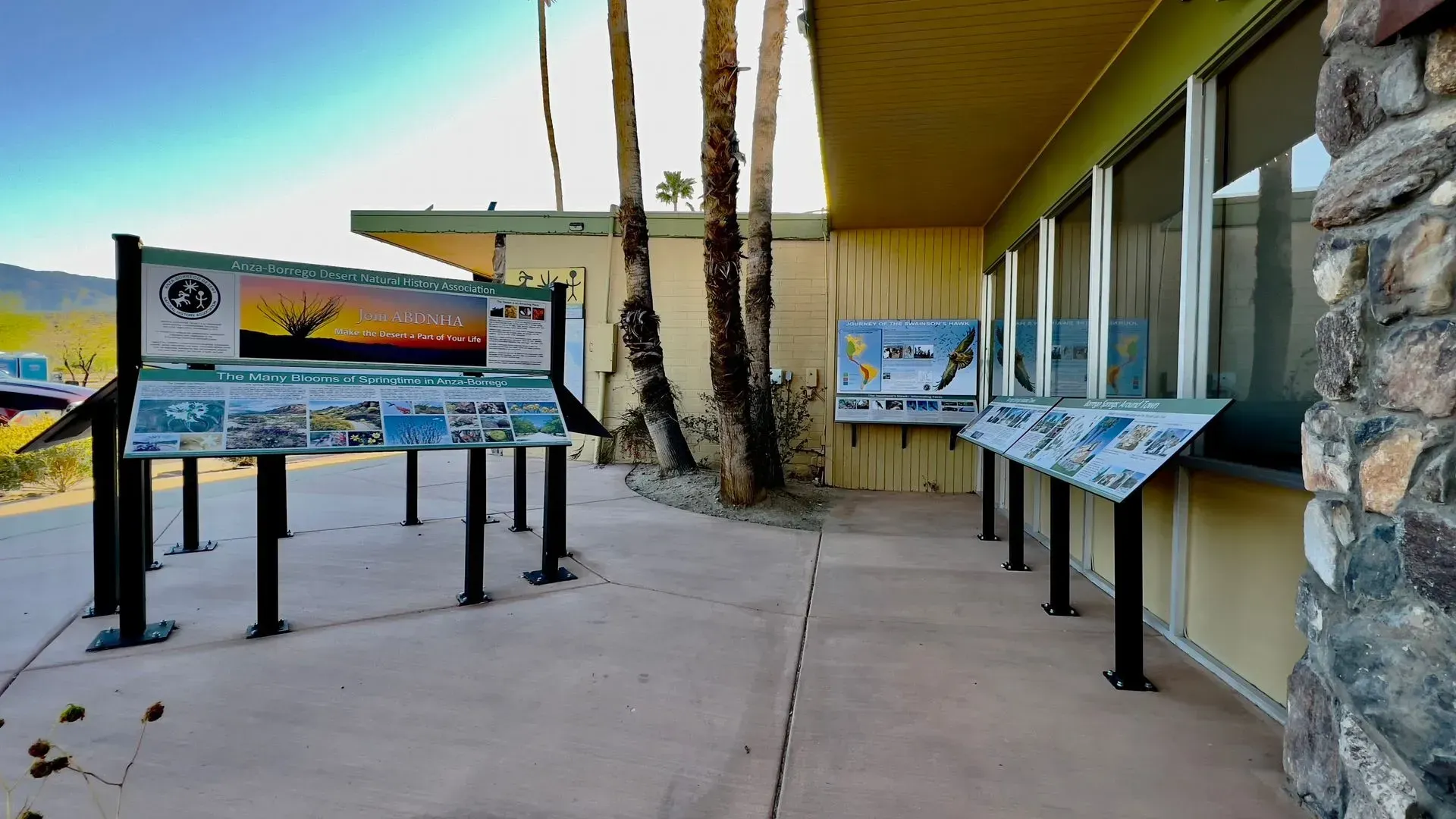
Informative Panels at ABDNHA Visitor Plaza


The Anza-Borrego Desert Natural History Association (ABDNHA) Visitor Plaza features a series of educational panels designed to provide visitors with detailed insights into the region. Located next to Carlee’s on Palm Canyon Drive, these displays offer valuable information about the desert landscape, local activities, and notable attractions.


Located at 652 Palm Canyon Drive, Borrego Springs, CA.


The four-sided kiosk and accompanying panels display striking photography from local contributors, along with clear, concise descriptions. These panels cover a variety of topics, offering guidance on key places to visit and things to do in Borrego Springs.


What You Can Learn from the Panels at ABDNHA Visitor Plaza


The informational panels at the Anza-Borrego Desert Natural History Association (ABDNHA) Visitor Plaza offer a wealth of knowledge about the Borrego Springs area and its natural environment.


Here are some of the key things visitors can learn:


  • Local Attractions: Discover nearby points of interest, including the iconic Ricardo Breceda Sculptures and the stunning vistas of Font's Point.


  • Borrego Badlands: Learn about the geological history of the Badlands, including the colorful sand and silt deposits that originated from Grand Canyon outflows millions of years ago.


  • Hikes Close to Town: Information on popular hiking trails, including a full panel dedicated to the Borrego Palm Canyon Trail.


  • Birdwatching: Explore birding opportunities in the area, including the annual Borrego Valley Hawk Watch.


  • Desert Blooms: Discover the seasonal blooms of Anza-Borrego, such as the cactus bloom, ocotillo bloom, Palo Verde bloom, desert lilies, and the famous spring wildflower bloom.


  • Creative Photography Ideas: Tips and ideas for capturing the unique beauty of the desert landscape through photography.


  • Things to Do in Town: Get recommendations for walking tours and other activities in and around Borrego Springs.


Maps and guidebooks are also available inside the ABDNHA Desert Nature Center for those looking to explore further.


A Lasting Resource for Visitors


This project was made possible through a grant from the office of 5th District Supervisor Jim Desmond, ensuring that the materials used in the construction of the panels are built to last. With a 10-year warranty against fading, these displays will continue to educate and inspire visitors for years to come.


Whether you're a local resident or a first-time visitor, the panels at the ABDNHA Visitor Plaza provide a quick and insightful way to learn more about Borrego Springs and its unique desert environment. Stop by, explore the panels, and discover something new about this fascinating region.


>>> You Need to See this Display! Borrego Sun


Learn More About Borrego Springs
By Andrea McKenna July 27, 2026
Photo by Kamala Venkatesh
By Marine Science Institute July 20, 2026
Marine Science Institute has named Lisa Biasillo its new Executive Director, succeeding longtime leader Marilou Seiff.
By Andrea McKenna July 13, 2026
Chase the Perseids in Borrego Springs: Summer’s Best Getaway Is Under the Stars If you've been waiting for a reason to visit Borrego Springs, t he Perseid meteor shower is a pretty great excuse. If you live nearby, consider this your reminder to book a staycation, get out of the house, and look up. Summer is one of the best values of the year. You'll find lower hotel rates, fewer crowds, and a slower pace , making it the perfect time to experience one of nature's most spectacular events. The Perseid meteor shower is active from July 17 through August 24 and is expected to peak the nights of August 12–13 . With little moonlight during the peak and Borrego Springs' internationally recognized dark skies, conditions are ideal for viewing. Under clear skies, you may see 50 to 100 meteors per hour , including brilliant fireballs that leave glowing trails across the sky. Borrego Springs is California's first International Dark Sky Community , making it one of the best places in Southern California to experience the Perseids. No telescope is needed. Just bring a chair or blanket, find a safe location away from lights, let your eyes adjust for about 30 minutes, and enjoy the show. The best viewing is generally after midnight through the hours before dawn, although meteors can appear throughout the night. During the day, take advantage of summer savings with a stay at La Casa del Zorro , a Stay & Play package at Rams Hill , or seasonal rates at The Palms at Indian Head . Sleep in, relax by the pool, enjoy lunch or dinner in one of Borrego's air-conditioned restaurants, and check BorregoEvents.com for local happenings. Browse the locally owned shops that remain open year-round, visit art galleries, enjoy some night photography, or take a stroll down Palm Canyon Drive and browse homes for sale in the windows of Coldwell Banker and other local real estate offices. Summer offers a quieter, more relaxed way to experience Borrego Springs. Whether you're planning a weekend getaway or just escaping for a night, there's no better time to discover why Borrego Springs is known for its dark skies, hospitality, and desert beauty. Come for the summer savings. Stay for the Perseids. Leave with memories—and maybe a few shooting stars.
By Andrea McKenna July 1, 2026
A Hollywood fun fact courtesy of longtime Park Ranger Fred Jee.
By Andrea McKenna July 1, 2026
Don't Miss These Summer Night Sky Events
June 21, 2026
Prepared with information from ABDNHA's Dark Sky resources, Michael Poirier, Astrophotographer, and the Sky Calendar from Michigan State University. Learn more about Borrego Springs dark skies at: https://abdnha.org/darksky/sky / Note: You can subscribe to the Sky Calendar from Abrams Planetarium, Michigan State University, 755 Science Rd, East Lansing, MI 48824. Borrego Springs offers some of the darkest skies in Southern California, making summer an excellent time to observe the Milky Way, planets, meteor showers, and other celestial events. Here's what to look for in June and July 2026. Early June Sunrise: 5:38 a.m. Sunset: 7:50 p.m. PST Day Length: 14 hours 12 minutes June Highlights June 1 (Monday) Venus and Jupiter appear within 8° of each other in the west-northwestern sky after sunset. June 3–16 Milky Way viewing conditions are excellent, with dark, moonless skies after nightfall. The Milky Way rises at 10:57 p.m. on June 7 and as early as 10:30 p.m. on June 14. It remains visible for up to 4 hours and 29 minutes. June 6–13 Grand Canyon Star Party, Arizona. Learn more at www.grandcanyon.org . June 11 (Thursday) Venus, Jupiter, and Mercury span their shortest angle in the evening sky, just 13.2° apart. June 15 (Monday) New Moon — one of the darkest nights of the month for stargazing and astrophotography. June 15 (Monday) Mercury reaches greatest elongation, 24.5° from the Sun, making it the best evening appearance of the year shortly after sunset. June 21 (Sunday) June Solstice marks the beginning of summer in the Northern Hemisphere. It is the longest day of the year with 14 hours and 20 minutes of daylight. June 22–July 2 June Bootids Meteor Shower. June 29 (Monday) Full Moon rises at 8:17 p.m. and sets at 5:04 a.m. June 30 (Tuesday) Asteroid Day. Early July Sunrise: 5:41 a.m. Sunset: 7:59 p.m. Day Length: 14 hours 18 minutes July Highlights July 5 (Sunday) The Milky Way rises at 9:38 p.m. and remains visible for 3 hours and 58 minutes. July 12 (Sunday) The Milky Way rises at 9:34 p.m. and remains visible for 3 hours and 35 minutes. July 14 (Tuesday) New Moon — ideal conditions for stargazing and astrophotography. July 15 (Wednesday) Mercury reaches greatest elongation, 24.5° from the Sun. July 28–29 (Tuesday–Wednesday) Delta Aquariids Meteor Shower peaks. July 29 (Wednesday) Full Moon rises at 8:17 p.m. and sets at 5:04 a.m. The Planets and the Milky Way in June Evening Planets Venus and Jupiter dominate the western sky after sunset throughout June. Around June 8–9, the two planets appear in conjunction, creating a striking close encounter in the west-northwestern sky. Venus, often called the "Evening Star," shines brilliantly as it moves from Taurus toward Gemini and climbs higher in the evening sky each night. Jupiter remains nearby and is also easily visible. Mercury becomes visible low in the western sky during the second half of June. June 15 offers the best viewing opportunity, as Mercury reaches its greatest elongation and highest apparent position above the horizon. Morning Planets Saturn and Mars are visible before sunrise. Mars remains low in the east-northeast, while Saturn rises higher from the east to east-southeast. Early June provides a chance to see the two planets relatively close together. Summer Milky Way Summer is the prime season for viewing the bright central core of the Milky Way. From June through August, the galaxy's core rises in the southeastern sky and becomes one of the most spectacular sights available to dark-sky observers. June Bootids Meteor Shower The June Bootids occur annually from June 22 through July 2 and peak around June 27. Most years produce only one or two meteors per hour. However, this shower has occasionally surprised observers with dramatic outbursts. In 1998, rates briefly reached approximately 100 meteors per hour. The shower originates from debris left by Comet Pons-Winnecke, which orbits the Sun every 6.3 years. June Bootids are known for their unusually slow speed, entering Earth's atmosphere at approximately 14 kilometers per second. Asteroid Day – June 30 Asteroid Day is a United Nations-sanctioned global awareness campaign held annually on June 30. The event educates the public about asteroid impacts, planetary defense, and ongoing research into near-Earth objects. The date commemorates the Tunguska Event of June 30, 1908, when a massive airburst explosion flattened approximately 830 square miles of Siberian forest. The blast is estimated to have released energy equivalent to between 3 and 50 megatons of TNT, making it the largest recorded impact event in modern history. For more information, visit www.un.org. Delta Aquariids Meteor Shower The Delta Aquariids meteor shower peaks on the night of July 28 and the morning of July 29. This annual shower can produce up to 20 meteors per hour under ideal conditions and is associated with debris from Comets Marsden and Kracht. The shower runs from July 12 through August 23 each year. Unfortunately, the 2026 peak coincides with a Full Moon, which will wash out many fainter meteors. Patient observers may still catch some of the brighter meteors throughout the night. The meteors appear to radiate from the constellation Aquarius but can be seen anywhere in the sky. Learn More About Borrego Springs' Dark Skies Borrego Springs is California's first International Dark Sky Community and one of the best places in Southern California to experience the Milky Way, meteor showers, planets, and other celestial events. To learn where to observe, dark sky etiquette, upcoming programs, and more about stargazing in Borrego Springs, visit the Anza-Borrego Desert Natural History Association's Dark Sky resources: https://abdnha.org/darksky/sky/
Show More
Subscribe for Free Updates!

Share This Post