About the Author: Karen Pearlman
Karen Pearlman is a longtime San Diego journalist and associate editor at East County Magazine, where she covers local news, government, community issues and feature stories.
Karen Pearlman • August 13, 2026
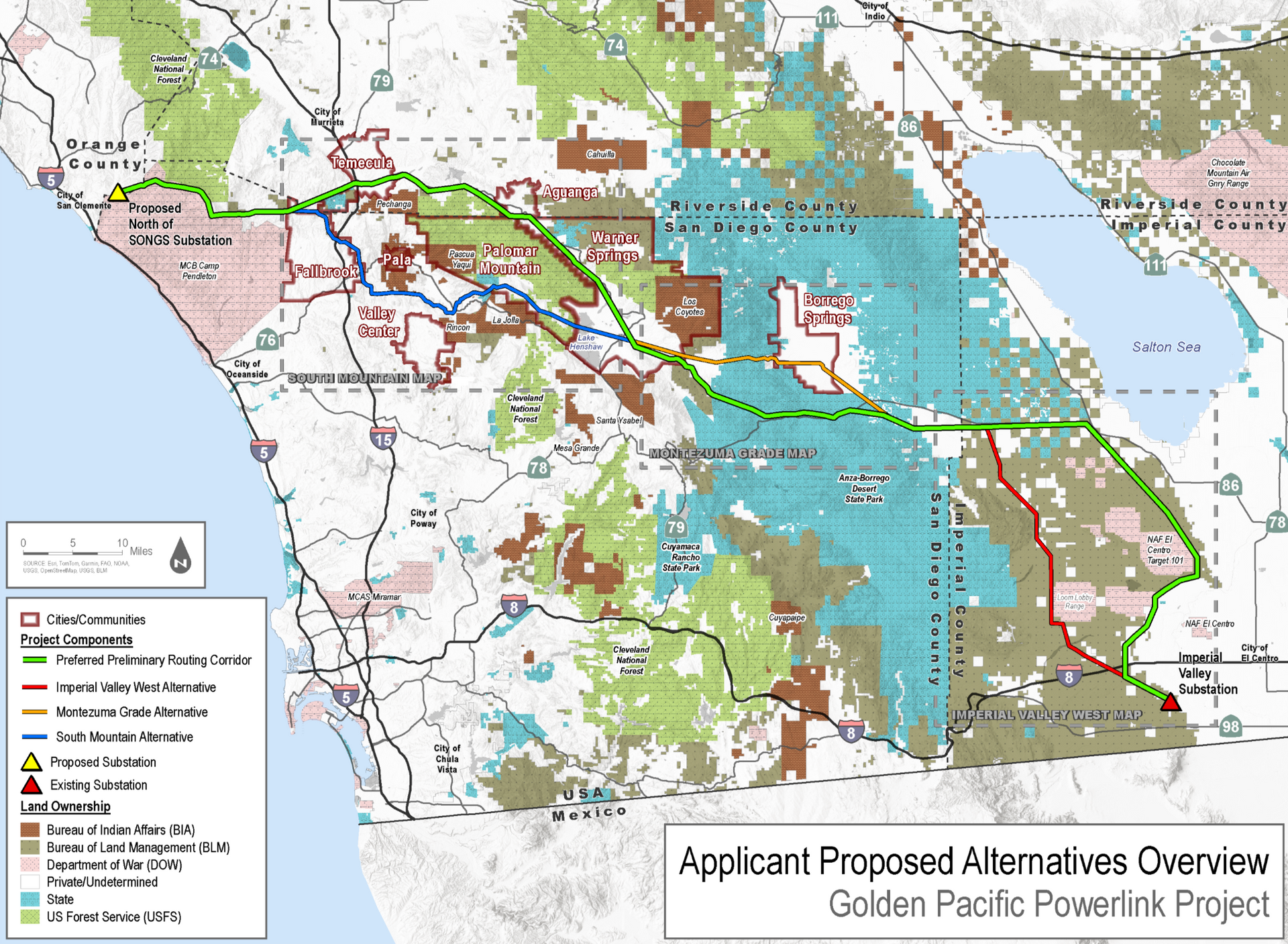
The San Diego County Board of Supervisors is accepting online comments on the Golden Pacific Powerlink through Aug. 18.
Submit a comment here:
https://sdcounty.granicusideas.com/.../6a7a375d7d79655936
By Karen Pearlman, East County Magazine
Aug. 12, 2026 (San Diego County) – The San Diego County Board of Supervisors will open the floor up at its Aug. 18 meeting for a presentation from two environmental groups opposing San Diego Gas & Electric‘s proposed Golden Pacific Powerlink.
The Golden Pacific Powerlink is the planned 500-kilovolt transmission line with structures 150 to 200 feet tall that would cut through Anza-Borrego Desert State Park and more than 100 miles of other terrain across San Diego and Riverside counties.
The $1.624 billion Golden Pacific Powerlink would be among the largest transmission lines in the utility’s system — meant to carry electricity about 135 to 145 miles from SDG&E’s Imperial Valley Substation to a new substation near the decommissioned San Onofre Nuclear Generating Station, at the San Diego–Orange County line.
District 5 Supervisor Jim Desmond and District 2 Supervisor Joel Anderson placed the item on the agenda, which can be found here.
The proposed route runs almost entirely through Desmond’s district, which spans the desert and North County backcountry from Borrego Springs to Fallbrook, while Anderson’s area includes Julian, Ramona and other East County communities like Jacumba that have faced a wave of large-scale energy projects in recent years.
The presentation will be collaboratively given by the Anza-Borrego Foundation and the Chaparral Lands Conservancy, the two groups leading the opposition.
The meeting comes as SDG&E ramps up its own outreach, with in-person open houses scheduled for later this month and public comment on the project’s preliminary route open through early November.
It also comes as many locals say the region is being asked, once again, to absorb infrastructure that mostly benefits the rest of the state — a pattern residents and local officials point to in the debate over large-scale solar, wind and transmission projects that have been approved in rural pockets of the county.
SDG&E says the project is needed to meet growing statewide demand.
The California Independent System Operator (CAISO), which runs the state’s grid, projects California will need to roughly double its current electricity capacity — about 160 gigawatts today — by 2045, partly to import power from Nevada and Arizona and keep the grid from being overloaded as demand grows.
CAISO’s Board of Governors approved the need for the line — formally called the Imperial Valley to North of SONGS 500 kV project — as part of its 2022-23 Transmission Plan in May, 2023. It was one of 45 transmission projects included in that plan, and the single largest and most expensive.
CAISO originally selected Horizon West Transmission to build, own and operate the line in May 2024; SDG&E took over the transmission-line portion of the project in August 2025, with Horizon West retaining the substation component near San Onofre.
A new line was needed rather than upgrading existing infrastructure, CAISO leaders have told reporters.
CAISO’s website says that the operator routinely evaluates alternatives like line reconductoring and upgrades. However, large-scale system modeling often shows that building new high-voltage infrastructure — such as a 500-kilovolt line — is the most cost-effective and reliable way to relieve major regional congestion and manage long-term load growth, the website shares.
The preliminary route runs from the Imperial Valley Substation north to State Route 78, then through Anza-Borrego Desert State Park along that corridor, before continuing on State Route 79 through Warner Springs, Lake Henshaw, Palomar Mountain, Pala, Pauma, Rincon and Valley Center, on toward Temecula, and finally to the new substation near the Orange County line.
SDG&E has released only a preliminary route corridor map, not detailed engineering plans, and says alternative routes are still being studied. Part of the corridor would cross private land that could require eminent domain acquisition.
The towers would stand about 15 to 20 stories high and be spaced every 1,500 feet, with a cleared right-of-way of up to 250 feet at each tower. (By comparison, the only line currently inside the park is a modest 69-kilovolt line on wooden poles, largely invisible against the landscape.)
CAISO’s transmission plan report projected that San Diego County ratepayers would cover about 9 percent of costs; SDG&E spokespersons have shared that the transmission-line-specific cost estimate is still being developed.
Anza-Borrego Desert State Park is California’s largest state park, spanning more than 600,000 acres of desert, canyons and badlands in eastern San Diego County.
It is known for its dark skies allowing clear views of the stars at night, myriad hiking trails, and sensitive and endangered species habitat.
Those in opposition say a 500-kilovolt line through the park would fragment wildlife corridors, threaten protected species, raise wildfire risk and permanently alter scenic views in a protected landscape.
The Anza-Borrego Foundation, the park’s official nonprofit partner since 1967, and the Chaparral Lands Conservancy, founded in 2009 to protect shrubland ecosystems, have led the pushback and are expected to detail those concerns in their Aug. 18 presentation to the Board.
This isn’t the first time SDG&E has proposed running a 500-kilovolt line through Anza-Borrego. In 2006, the utility proposed the Sunrise Powerlink, whose original route would have run roughly 25 miles through the park’s wilderness.
That route was rejected. Following a multi-year state and federal environmental review, the California Public Utilities Commission ruled in December 2008 that every route option through Anza-Borrego was “environmentally unacceptable and infeasible,” citing 52 significant, unmitigable environmental impacts that would have required de-designating roughly 50 acres of state wilderness.
The commission instead approved a route that ran west from Imperial Valley and turned north after 36 miles, running parallel to Interstate 8 and an existing transmission corridor — bypassing the park entirely. That version of Sunrise Powerlink was built and went into service in 2012, at a cost of about $2 billion.
Opponents argue Golden Pacific’s preliminary route revives much of the corridor the CPUC rejected in 2008. The Anza-Borrego Foundation says the roughly 22 miles of the new preliminary route that cross the park closely track the same corridor the commission found infeasible 18 years ago, including the Grapevine Canyon area, the Tamarisk Grove area and the Angelina Spring Cultural Preserve.
SDG&E’s project manager, Gerard Ellison, has acknowledged the parallel, saying there were “lessons learned from Sunrise” regarding mitigation and the use of existing rights-of-way.
Asked directly why the new route again runs through the park, given the backlash that forced Sunrise’s reroute, SDG&E’s project director said the Imperial Valley starting point is different this time, and that the utility is weighing cost, community impact and environmental impact together.
Beyond the published tentative route, which skirts Palomar Mountain via Highway 79, SDG&E has disclosed it will submit two additional alternative routes to the CPUC for study: one cutting directly through the mountain, the other following Highway 76.
The Save Palomar Mountain Task Force contends that both alternatives carry serious wildfire and life-safety risk.
Some of the anxiety ahead of the Aug. 18 meeting is being driven by claims not yet confirmed by SDG&E.
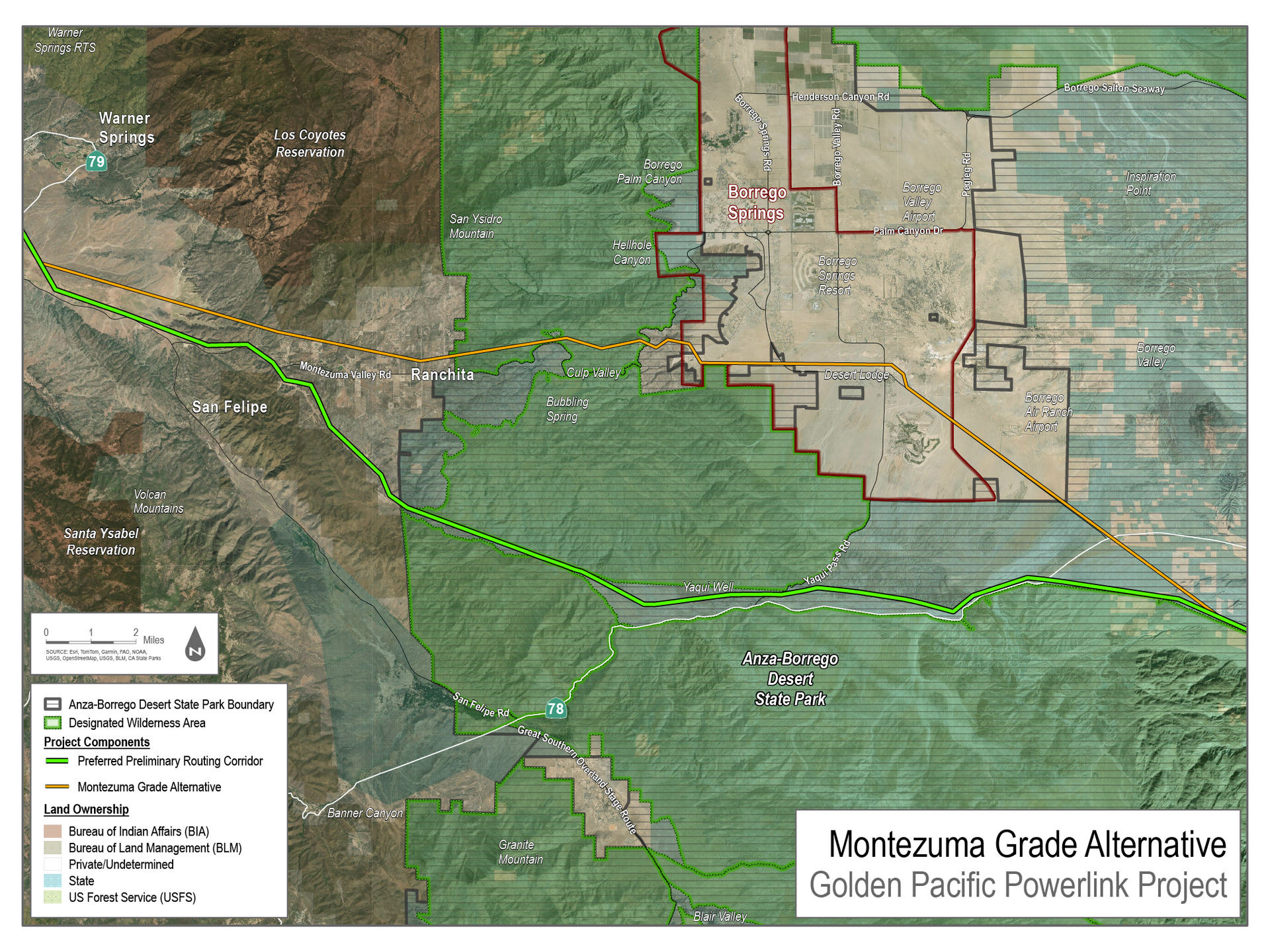
In an Aug. 11 post to the Borrego Springs 92004 Facebook group, resident Maris Brancheau said SDG&E has floated a “Montezuma Grade alternative” that would run the line on large towers through both the state park and the town of Borrego Springs itself, rather than skirting the community as the original preliminary route does.
“This isn’t a viable alternative — this is a threat that if we don’t accept the line in the park, they will come thru the town, too,” Brancheau wrote, adding that a route bypassing the park and the town via Highway 86 to Interstate 10 has not been offered as an alternative.
(SDG&E’s published project materials do not currently show a route through the town of Borrego Springs.)
The Golden Pacific fight is unfolding against a broader backdrop: several rural East County communities have spent the past several years absorbing large renewable energy and transmission projects tied to statewide climate goals — with mixed results for the people living closest to them.
In Jacumba Hot Springs, the county approved the 604-acre Jacumba Valley Ranch Energy Park solar and battery storage project after years of resident opposition. The Board of Supervisors ultimately required the developer to increase community benefit payments from $1.6 million to $4 million and expand buffer distances between homes and panels from 300 to 400 feet.
Residents said the project — expected to power roughly 57,000 homes for San Diego Community Power — would not directly supply their own electricity, while they would continue to experience SDG&E’s wildfire-related power shutoffs.
Neighbors later sued to block the project, arguing the county understated its long-term impacts; the solar farm was ultimately built and is now operational.
Nearby, in Boulevard, residents are fighting a proposed 588-acre solar and battery project called Starlight Solar, and a separate wind turbine project on the Campo Indian Reservation has drawn its own lawsuits from backcountry residents.
Community members from Campo, Jacumba, Boulevard and other communities have told reporters they feel they’re being asked to shoulder the visual, environmental and quality-of-life impact of the state’s clean-energy buildout while other communities get most of the benefit.
The pattern of large infrastructure built in rural, lower-income and often unincorporated East County communities to serve regional or statewide needs is the proverbial connector to Jacumba’s solar farm, Boulevard’s pending projects, and the Golden Pacific Powerlink’s proposed route.
The final say
SDG&E’s current map remains a proposal; the CPUC — not SDG&E — will ultimately determine the project’s route evaluate alternatives, and run the formal environmental review under the California Environmental Quality Act.
SDG&E released its preliminary route corridor map in April of this year, and held virtual open houses on May 12 and 14 that drew hundreds of attendees.
Stakeholder feedback remains open through early November, ahead of a formal CPUC application SDG&E has said it expects to file in fall or winter 2026. That step would trigger a multi-year state and federal environmental review.
State and federal permitting is expected to run through 2029, with construction targeted to begin that year and the line slated to go into service in 2032.
Beyond the Aug. 18 Supervisors meeting, SDG&E will be holding a series of in-person open houses for residents along the proposed corridor, where project staff and subject-matter experts will be available at stations to answer questions and gather feedback through maps and surveys.
There is an open house set for 4 to 7 p.m., Aug. 25 at the Fallbrook Community Center; one 4 to 7 p.m., Aug. 26 at Temecula Embassy Suites; one 4 to 7 p.m., Oct. 13 at the El Centro Community Center; and one from 4 to 7 p.m., Oct. 14 at Borrego Springs Resort.
An online open house with the same project information will also be available starting Aug. 25 at goldenpacificpowerlink.com.
Residents can also submit comments directly to SDG&E at GoldenPacific@sdge.com. The Anza-Borrego Foundation offers a downloadable letter template on its website to help structure comments around route and environmental concerns. The group can also be reached by phone at (844) 765-6388.
SDG&E has said that placing Golden Pacific in a corridor geographically distinct from existing 500-kilovolt lines like Sunrise Powerlink would improve grid resiliency, since the broader grid could stay operational if one corridor has to be shut down for safety reasons. It also says Sunrise Powerlink hasn’t caused any major wildfires during operation, though several small construction-related fires occurred during its 2011 build phase. (Nationally, the Western Fire Chiefs Association has found electrical power networks caused about 19 percent of wildfires between 2016 and 2020.)
SDG&E says the project has been refined through community input, stakeholder engagement, preliminary engineering and field investigations, and that the upcoming open houses will let residents review the latest project information and the route alternatives identified for study under CEQA.
Some residents in Imperial Valley and San Diego’s backcountry have proposed that SDG&E and the CPUC instead consider expanding rooftop solar or upgrading existing transmission lines rather than building a new corridor through the park.
Congressional hopeful Desmond has been outspoken on the project. In mid-June, he issued a lengthy public statement, later published as an op-ed in East County Magazine, laying out his opposition.
“I am going to fight it,” Desmond wrote, calling the project “a Sacramento project” and arguing the CPUC is not required to listen to the county or to residents of Borrego Springs, Valley Center, Pauma Valley or Warner Springs.
“The communities that take the impact have no vote in the decision. That is not how this should work,” he wrote.
Desmond has also emphasized the cost to local ratepayers: a multi-billion project with San Diego County covering just under 10 percent of the cost, even though the power would largely serve other regions of the state.
His office says it plans to attend upcoming public meetings and file formal comments at each stage of the review process.
The Board of Supervisors meeting starts at 9 a.m., Aug. 18 at the County Administration Center, 1600 Pacific Highway in downtown San Diego. The meeting will be shown live on the county website.
About the Author: Karen Pearlman
Karen Pearlman is a longtime San Diego journalist and associate editor at East County Magazine, where she covers local news, government, community issues and feature stories.



Thanks to Our Community Sponsors
Have a suggestion, question or comment? Let us know.
Andrea McKenna, RAM Media Foundation, Executive Director
PO Box 2436
Borrego Springs, Ca. 92004
Would you like to become a supporter of RAM Media Foundation? Reach out today!
- Privacy