Jake Hinton • January 16, 2026

The Return of Amazing Jupiter By Dennis Mammana

Share

Week of January 18-24, 2026

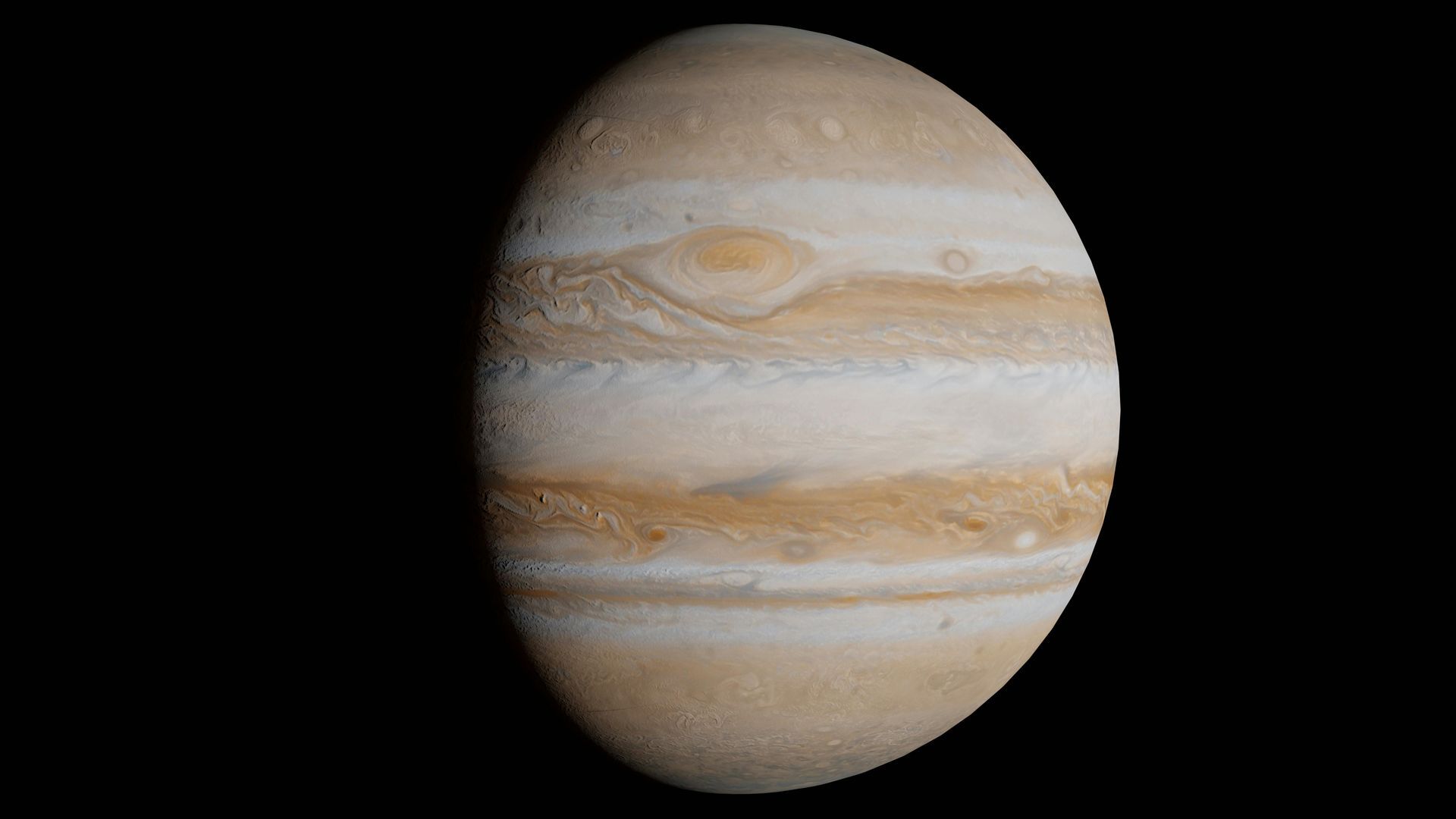
The giant planet Jupiter is back in our evening sky this week. Fresh from its opposition with the sun on Jan. 10, it now lies as close to the Earth as it ever comes, and shines at its most brilliant. I guarantee that if you go outdoors after dark and look low in the east-northeastern sky, you won't miss it!

Seeing Jupiter from one's backyard is pretty cool, but knowing something about it makes it even more special, so I thought I'd let you in on a few amazing Jovian facts that you may not know.


First, Jupiter is the largest of all planets and would completely dwarf the Earth. In fact, you would need 11 Earths side by side just to span its diameter. And, if you were to open up Jupiter like a gumball machine and pour Earths inside, you would need more than a thousand. Now that's a big planet!

As massive as Jupiter is, it's not a solid world. It's the largest of the four gas giant planets (Jupiter, Saturn, Uranus and Neptune) and, as its moniker suggests, it's made mostly of gases such as hydrogen and helium. In other words, it is almost entirely atmosphere with no surface on which a hypothetical astronaut could land.


Anyone foolish enough to try would simply plunge deeper into its ever-thickening atmosphere until being destroyed by its enormous weight and heat. You'd never even make it deep enough to find Jupiter's ocean of liquid hydrogen, or its core of weird metallic hydrogen. If you're ever invited to join a Jovian landing party, I think you should respectfully decline!


If you have a small telescope and aim it toward Jupiter, you can frequently see a few of its parallel cloud bands. These "stripes" are upper atmospheric weather systems that are stretched into parallel cloud bands by Jupiter's 10-hour rotation. This is so fast that if you view Jupiter early in the evening and then return to check it out around midnight, the planet will have turned halfway around, and you'd then be seeing the opposite side of the planet!


You might also spot a reddish smudge in the atmosphere of Jupiter. Since its discovery centuries ago, the Great Red Spot is no longer great nor red. Appearing now as more of a salmon color, this swirling anti-cyclonic storm was once three times the size of the Earth, but in recent decades has shrunk considerably. Today, it's "only" slightly larger than our planet!


A small backyard telescope will also reveal Jupiter's largest moons that drift in orbit around the planet from night to night. Discovered by Galileo Galilei in January of 1610, Io, Europa, Ganymede and Callisto are just four of the 95-plus moons now known to be orbiting the giant planet.


Armed with these remarkable bits of knowledge, I hope you'll never again think of Jupiter as just another bright light in our sky. And if you can't view Jupiter through your own telescope, contact your local amateur astronomy club, observatory or science museum to learn when they'll be hosting a "star party" so you can get a close-up look at this truly amazing world.


Jupiter's diameter is approximately 11 times wider than Earth's.


Visit Dennis Mammana at dennismammana.com. To read features by other Creators Syndicate writers and cartoonists, visit the Creators Syndicate website at www.creators.com.


Learn More About Borrego Springs

By Supervisor Jim Desmond August 30, 2026
Supervisor Jim Desmond outlines County preparations and steps residents can take now.
By FOX 5 San Diego August 30, 2026
Here's how the community is getting by amid the heat wave.
By H. Myers, Paramedic August 29, 2026
Simple steps to prepare for an emergency.
By Borrego Springs High School August 29, 2026

Wednesday, September 16
By Andrea McKenna August 29, 2026
Borrego Springs highlighted as a retirement destination.

By Cassie N. Saunders, County of San Diego Communications Office August 28, 2026
A new BenefitsCal feature called Truv now helps CalFresh, CalWORKs, Medi-Cal and County General Relief applicants save time, reduce paperwork and avoid mailing costs. The tool launched July 20, 2026, and verifies income and employment electronically during the e-application process. How Truv Works When applying through BenefitsCal, customers can securely sign in to their employer, payroll provider or financial institution. Truv uses secure, encrypted channels, and no information is shared outside the County of San Diego. If the employer participates in Truv, the system automatically pulls available income and employment information. Applicants can then review and confirm the information before submitting their application. “With Truv, it is easy for customers to opt in while applying through the online application tool BenefitsCal app,” said Alberto Banuelos, Interim Director of County Self Sufficiency Services. “It is a win-win, helping our customers save time and money and staff manage higher workloads.” Why It Matters Using Truv means customers don’t need to search for documents, manually enter income details or pay postage to mail paperwork. It also reduces the chance of manually entered errors. Application processing timelines vary: CalFresh reviews can take up to 30 days. Medi-Cal reviews can take up to 45 days. When income information is verified upfront, processing time can be shortened, helping eligible households get connected to critical resources faster. Self-Sufficiency Services supports more than 1.2 million San Diego County residents by providing access to essential public safety net programs. With customer-focused tools, multilingual help and community partnerships, Self‑Sufficiency Services works to make applying for benefits easier, faster and more accessible. Our mission is simple: to help people stay healthy, safe and on a path toward long‑term self‑sufficiency. Cassie N. Saunders is a communications specialist with the County of San Diego Communications Office. Contact
By Andrea McKenna August 27, 2026
Saturday, November 7
By St Barnabas Communications August 27, 2026
Borrego Springs-made short film screens Oct. 11 St. Barnabas Episcopal Church will present the award-winning short film George & Rosa on Sunday, Oct. 11, from 1–2 p.m. as part of its “Who Is My Neighbor?” film and discussion series. Written, produced and directed by Borrego Springs resident Matt Bosson, the 24-minute drama follows George and Rosa, two people living on the margins who form an unexpected bond despite speaking different languages. The story explores loneliness, companionship and human dignity. George & Rosa was produced entirely in Borrego Springs, with local talent involved in the production and the Anza-Borrego desert serving as its backdrop. The film won Best Medium Short in the Reale Film Festival’s June 2026 Monthly Awards. Bosson worked for many years in television video playback on productions including 24, House MD and Grey’s Anatomy before relocating to Borrego Springs, where he teaches English and continues his filmmaking and music work. His previous short BAD was also filmed and premiered in Borrego Springs. The screening will be held at St. Barnabas Episcopal Church, 2680 Country Club Road, followed by a community discussion as part of the ongoing “Who Is My Neighbor?” series. 


By Tammy Murga / Environment Reporter August 27, 2026
Dozens of residents from Fallbrook and surrounding communities attend an open house at the Fallbrook Community Center on Aug. 26, 2026. SDG&E hosted the event for its proposed Golden Pacific Powerlink. Two other open houses are planned in October. Originally published by KPBS.org on August 20, 2026.
Show More
Subscribe for Free Updates!

Share This Post