Borrego Springs Local • December 19, 2023

Borrego Springs’ SAR Aurora Phenomenon

Share
A picture of a person standing in the desert at night
By Dennis Mammana July 18, 2026
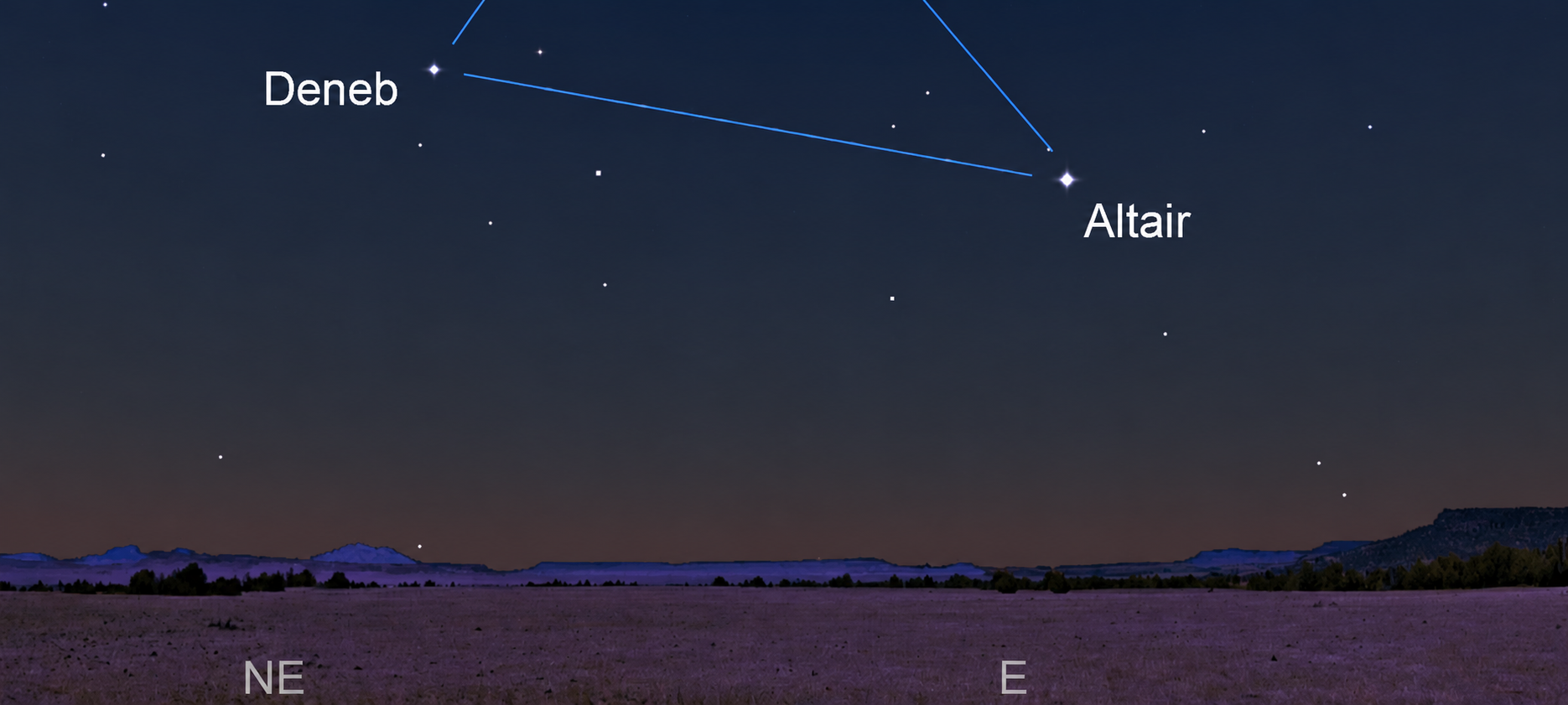
By Dennis Mammana Week of July 19-25, 2026 We can spend our time under the stars trying to find constellation figures from mythological times, but we'll always have limited success. If we really want to see pictures among the stars, I'm afraid we need to create our own. You may remember from previous articles that constellations are simply areas of the sky, and do not resemble their namesakes. Corvus looks nothing like a crow. Trying to find a bear in Ursa Major? Fuhgetaboutit! And Scorpius, the scorpion ... well, OK, there will always be one exception. No, if you want to see pictures among the stars, you must invent your own. And that's where asterisms come in. An asterism is a group of stars that we connect in our imaginations to look like something. Some of the easiest of these to create are geometrical figures. If you ever took a geometry class, you may recall that a point is the simplest of these — a figure with no length, width or depth. In the sky, every star forms a point; connect any three of these, and you'll create a triangle. One in particular, though, is different. It's larger and brighter, and we can find it midway up in our eastern sky after dark. It's called the Summer Triangle. It's not a constellation but rather an asterism made of three stars from three separate constellations, but that doesn't mean that early storytellers overlooked this prominent star grouping. For example, an ancient Chinese love tale tells that the star Deneb represents a magpie bridge over the Milky Way, which allows the separated lovers Altair and Vega to be reunited on only one summer night each year.  The brightest of the stellar trio — and highest in the sky this week — is Vega, the most prominent star in the constellation of Lyra, the harp. It lies 150 trillion miles from us (about 25 lightyears); in other words, the light arriving tonight from Vega began its journey toward our eyes in 2001. The southeasternmost of the three stars is Altair, the brightest in the constellation of Aquila, the eagle. Its name comes from the Arabic Al Nasr al Tair, meaning in English "the flying eagle." Altair lies about 96 trillion miles (17 lightyears) from us. Not only is Altair one of the nearest stars, it's also one of the most rapidly spinning, completing one rotation in just 6.5 hours! Finally, farthest to the northeast lies Deneb, marking the tail of the great swan Cygnus, more easily recognized as the Northern Cross. It's not certain, but we think that Deneb could lie as far away as 2,600 lightyears from Earth. If it's truly that distant, this star could be one of the most brilliant in our entire galaxy, with a luminosity equivalent to 200,000 suns, and would generate more light in one day than our sun has produced since the days of Marco Polo at the end of the 13th century! With the overwhelmingly bright moonlight this week and next, the brightest stars are about all we'll be able to see, but you can still head outdoors to check out the brightest of the summer — the Summer Triangle. Visit Dennis Mammana at dennismammana.com. To read features by other Creators Syndicate writers and cartoonists, visit the Creators Syndicate website at www.creators.com . Learn More About Borrego Springs
By Andrea McKenna July 12, 2026
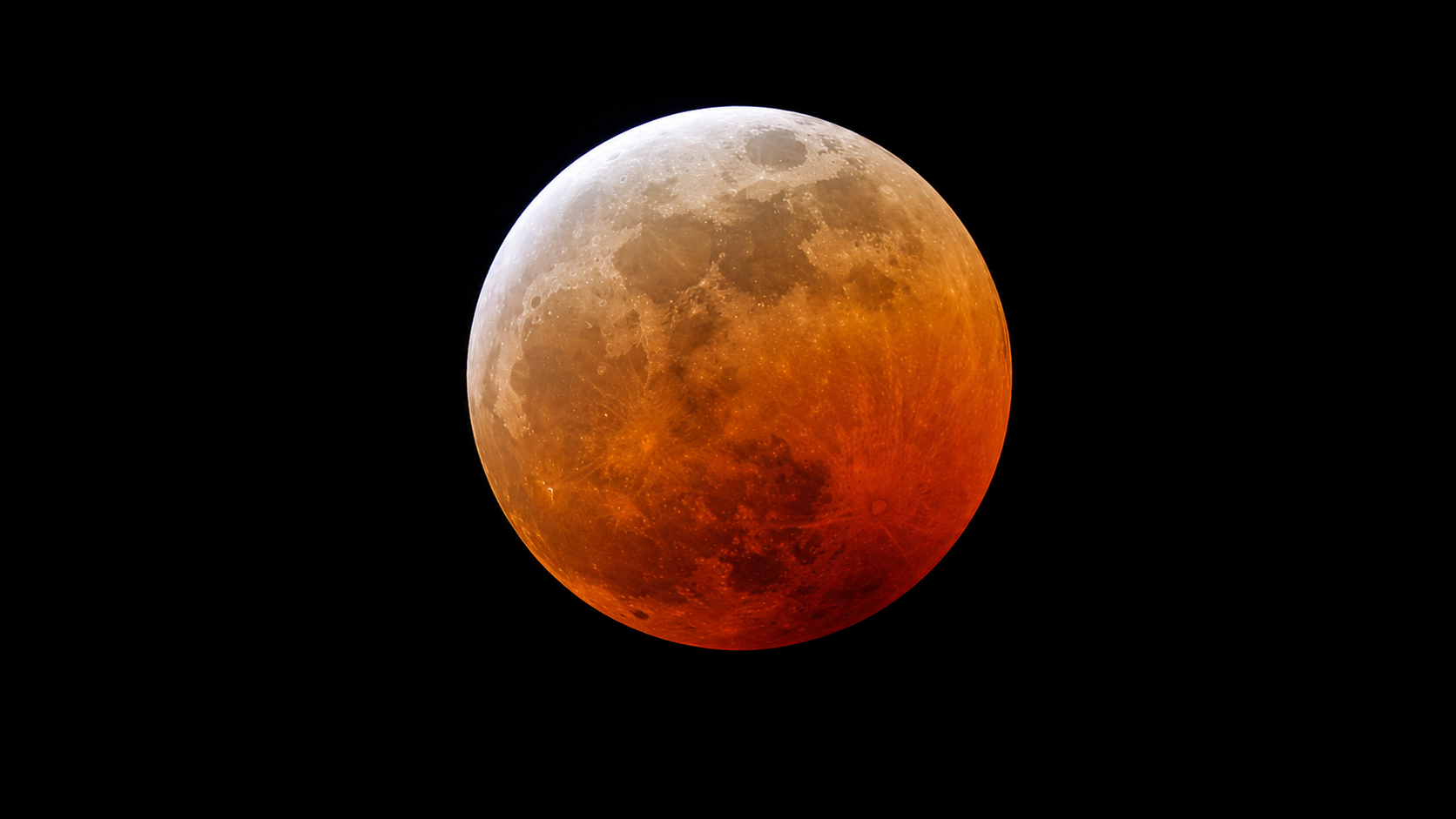
Reserve Your Spot for the Lunar Eclipse Spectacular
By Andrea McKenna July 12, 2026
Participants experienced Borrego Springs' dark skies through guided telescope viewing and expert commentary.
By Andrea McKenna July 7, 2026
Make a Night Sky Tour Part of Your July Getaway
By Dennis Mammana July 5, 2026
By Dennis Mammana Week of July 5-11, 2026 There's a constellation in our night sky right now that is somewhat unknown to stargazers. Despite being huge — it's the 11th-largest in all the heavens — it has no stars brighter than the North Star, so you won't find it easily without a pretty dark sky. Its name is Ophiuchus (oh-fee-YOU-kuhs), and if you'd like to find it this month, you'll need to get away from the city lights and gaze midway up in the southeast shortly after dark. Ophiuchus (the serpent-bearer) represents Aesculapiu, the ancient Greco-Roman god of medicine, healing and physicians, and its brightest star is named Rasalhague, which is Arabic for "Head of the Snake Charmer." Draped from one side of Ophiuchus to the other lies Serpens — the only two-part constellation in the heavens — with its head on one side (Serpens Caput) and its tail on the other (Serpens Cauda). I admit that it requires quite an imagination to find these star groupings, but once you do, you'll know them forever. In fact, you may even recognize this shape, especially if you've ever searched online for the name of a physician. Quite often, you'll find the image of two serpents wrapped around a vertical staff that appears topped by a round knob and is flanked by wings. It's known as the "caduceus," and since 1902, when the U.S. Army adopted it as the insignia of its Medical Corps, it has been the familiar emblem of the American medical profession. Many medical associations — including the World Health Organization — use what some consider to be the "correct" and traditional symbol of medicine: the staff of Asclepius, with a single serpent encircling a staff. Either way, people have long associated the serpent with medicine. Once you find its stars, you'll see that Ophiuchus lies along some of the thickest star clouds of the Milky Way. If you've managed to get yourself to a rural location with a non-light-polluted sky, you'll have little trouble finding the hazy band of the Milky Way passing near this constellation, along with the bright reddish-orange star Antares (the heart of Scorpius, the scorpion) just to its lower right. Be sure to take binoculars with you so you can scan this celestial region. Here you'll find countless "faint fuzzies" (as amateur astronomers affectionately call deep-sky objects). Many of these are star clusters — collections of dozens, hundreds or even thousands of stars held together by gravitation — and interstellar nebulae, where stars and planetary systems are constantly forming. Now, while you're gazing at the stars of Ophiuchus, here's a little tidbit to wrap your head around: This constellation is not one of the official signs of the zodiac, but it should be. Why, you ask? Because the sun spends three times as many days in front of the stars of Ophiuchus as it does in Scorpius. So why, then, is this constellation missing from the official zodiacal signs in horoscope tables? Your guess is as good as mine. Just remember, if you were born between Nov. 29 and Dec. 17, you're not a "Scorpio" or "Sagittarius," as you might have thought. You're actually an Ophiuchan! Make of that what you will... Visit Dennis Mammana at dennismammana.com. To read features by other Creators Syndicate writers and cartoonists, visit the Creators Syndicate website at www.creators.com . Learn More About Borrego Springs
By Andrea McKenna July 1, 2026
Don't Miss These Summer Night Sky Events
Show More

Capturing the Unseen: Borrego Springs’ Desert Aurora

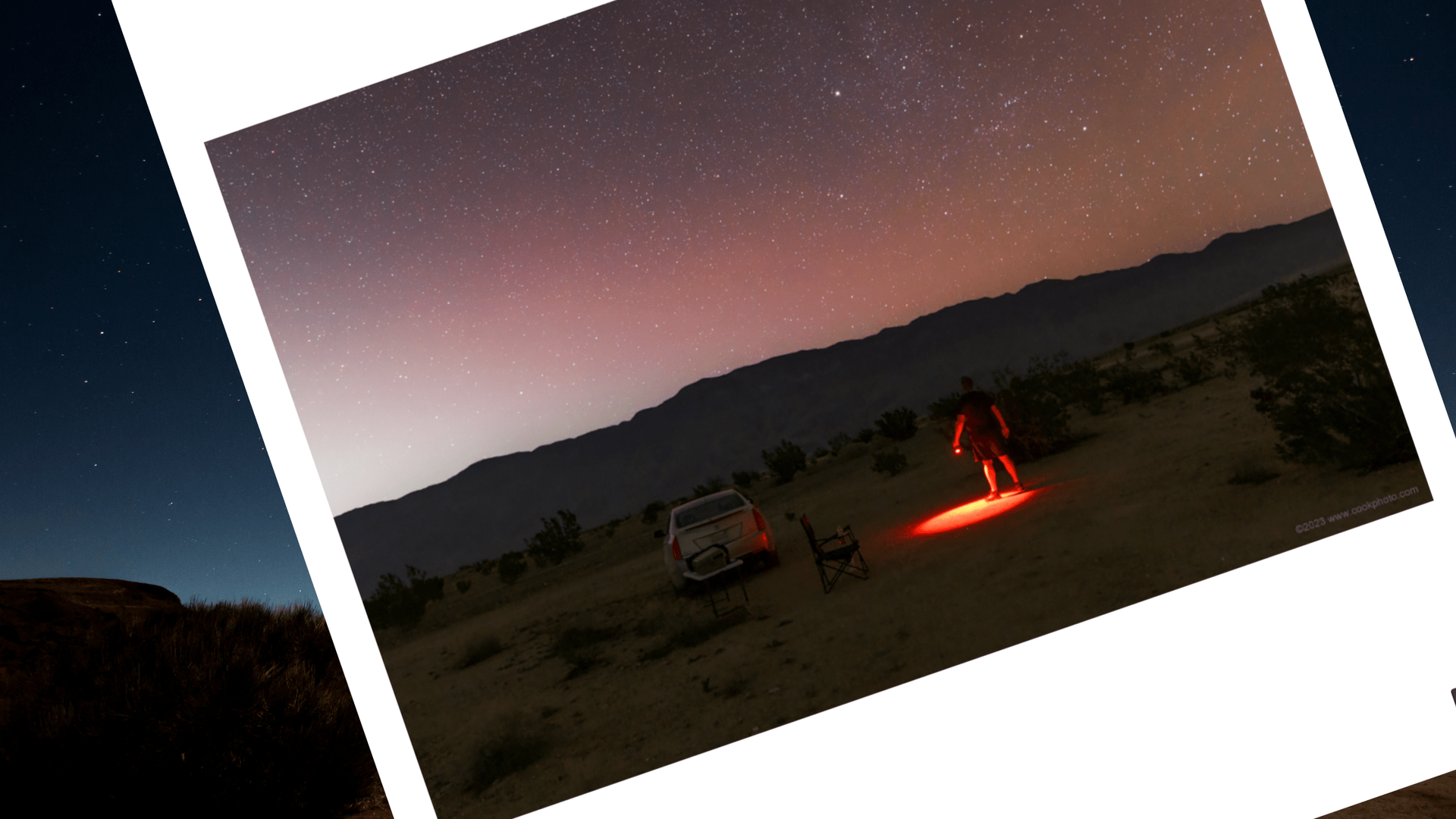
While the Northern Lights often steal the celestial spotlight, a recent phenomenon captured by photographer Chris Cook reveals that the heavens have more than one color palette at their disposal. On the evening of November 5, 2023, Cook witnessed a stunning display in the form of a Stable Auroral Red (SAR) arc, painting the skies above Borrego Springs, California, with hues of nocturnal red.


A Serendipitous Spectacle Above the Santa Rosa Mountains

Cook’s experience in Anza-Borrego Desert State Park, east of San Diego, was serendipitous. His trained eye and equipment—specifically, a Canon EOS 6D paired with a Tamron 15-30mm f/2.8 lens—were primed for moments just like this. The 20-second exposure at ISO3200 allowed him to capture the elusive SAR arc, a phenomenon usually invisible to the naked eye but nonetheless spectacular when revealed by today’s camera technology.


“Last night I was camped out in Anza-Borrego Desert State Park east of San Diego and ended up capturing a faint red aurora SAR! The arc of red was faintly visible in NNE sky above the Santa Rosa Mountains. While I’m used to capturing the northern lights from more northern regions, this was my first capture of an aurora from the desert at 33°N!! Canon EOS 6D, Tamron 15-30mm f/2.8 lens, ISO3200, 20 second exposure.”

– Photographer Chris Cook via Spaceweather.com


The Science of the SAR Arc

SAR arcs are a lesser-known cousin of the aurora borealis, occurring at lower latitudes. These shimmering red curtains of light become visible during geomagnetic storms, and while they don’t typically impact technology like their more famous relatives, their beauty is undeniable. The SAR arc observed by Cook is part of a long history, first identified in 1956, yet it remains a visual enigma to many.


The Ring Current: Earth’s Invisible Paintbrush

The red glow of a SAR arc originates from the Earth’s ring current system—a flow of electrons within the magnetosphere that, when energized during a geomagnetic storm, releases heat energy. This energy heats oxygen atoms in the Earth’s atmosphere, resulting in the SAR arc’s distinctive red light. This process was vividly demonstrated during the strong geomagnetic storm on November 5, when social media was awash with images of these red arcs, including those captured by Cook.


Borrego Springs: A Photographer’s Haven

The deserts around Borrego Springs offer a stark, serene backdrop that contrasts beautifully with the night sky’s vibrant displays. It’s a reminder that wonders await where you least expect them, even at 33°N latitude. For Cook, this marked the first capture of an aurora from the desert, adding a new chapter to his portfolio of celestial photography, which can be admired on his website and Instagram.


Embracing the Night Sky’s Mysteries

This event underscores the importance of preserving dark skies and the wonders they hold. For enthusiasts and casual observers alike, it’s a call to look up and embrace the mysteries that unfold above us. Borrego Springs’ rare SAR aurora is a testament to the ever-surprising nature of our universe, inviting us all to explore the night and its secrets.



Share This Post