Jake Hinton • December 5, 2024

Holiday’s Home at The House of Borrego Springs

Share

Celebrate the season with a touch of mid-century modern charm!


The House of Borrego Springs West Gallery invites you to "Holiday’s Home," a festive showcase of holiday décor, art, and all things mid-century modern.


Dates: December 7 – January 5


Location: El Patio, 624 Palm Canyon Drive, Borrego Springs, CA 92004


Explore a collection that blends nostalgia and style, perfect for getting into the holiday spirit. From vintage-inspired holiday decor to captivating art, it’s a must-visit this season.


For details, contact 760-443-3300 or email houseofborregosprs@sbcglobal.net.

Don’t miss this unique celebration of holiday cheer and mid-century elegance!

Learn More About Borrego Springs
By Matt Bosson, BSFI July 20, 2026
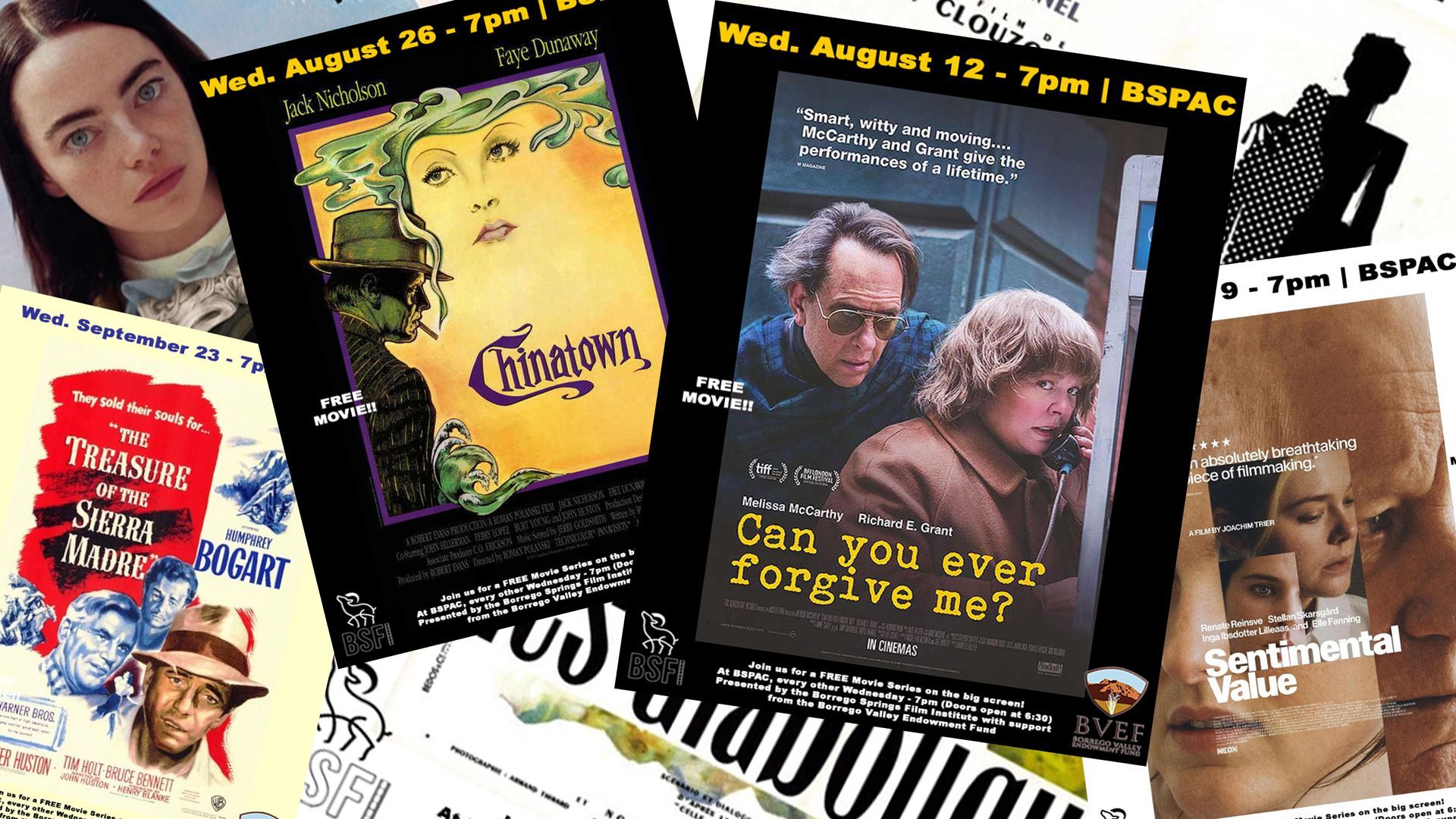
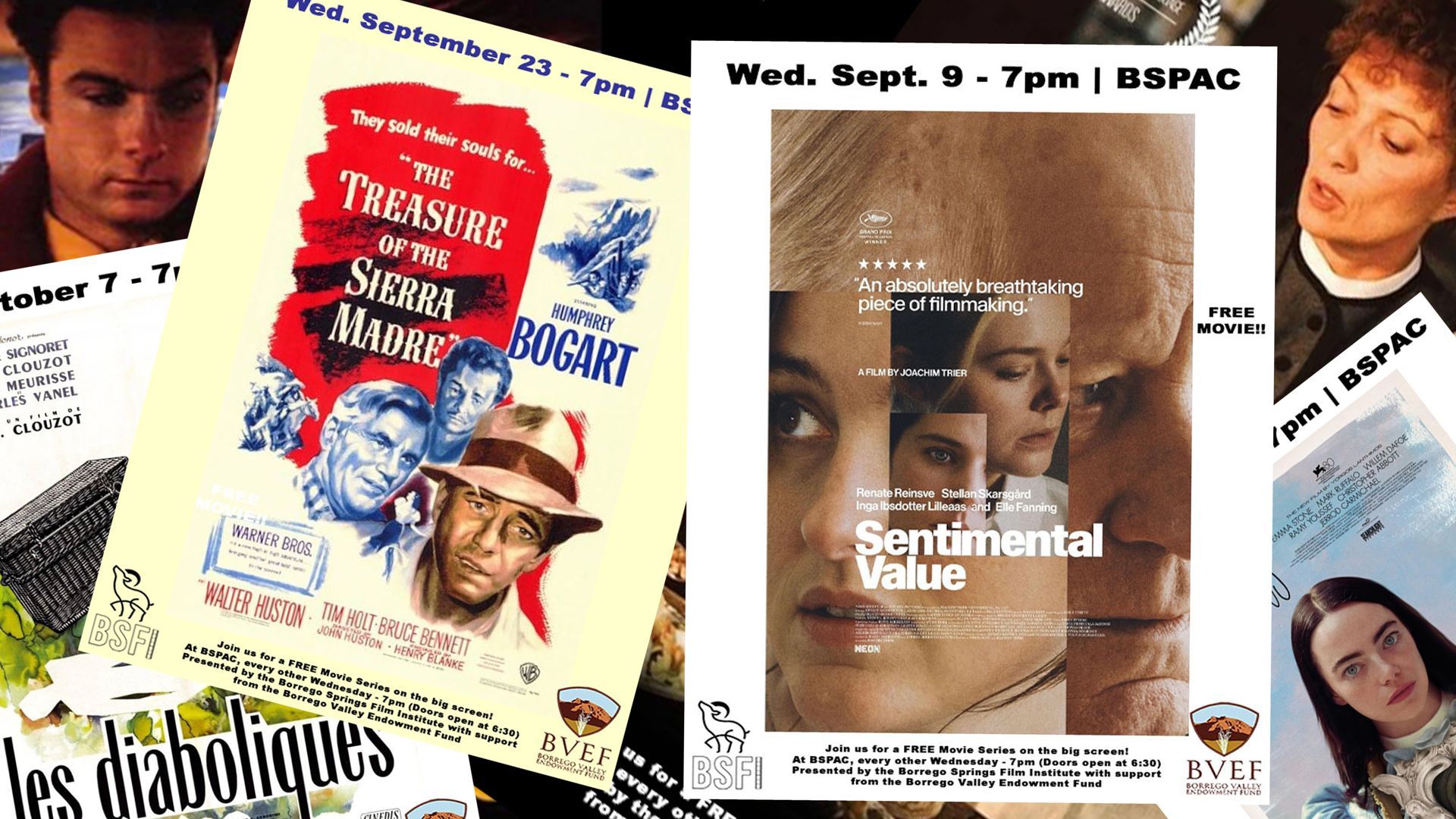
On Wednesday, July 29, at 7pm BSFI presents: A Simple Plan – 1998 – Rated R – 2h 1m A Simple Plan is a gripping neo-noir crime thriller that represents a striking departure from Sam Raimi's reputation as a master of horror and stylized genre filmmaking. Directed by Raimi and written by Scott B. Smith, adapting his own 1993 novel, the film stars Bill Paxton, Billy Bob Thornton, and Bridget Fonda, and is set in rural Minnesota. The story follows brothers Hank (Paxton) and Jacob Mitchell (Thornton), who, along with Jacob's friend Lou (Brent Briscoe), stumble upon a crashed plane in the woods containing $4.4 million in cash. The four — including Hank's wife Sarah (Fonda) — go to great lengths to keep the money secret, but begin to doubt each other's trust, resulting in lies, deceit, and murder. Roger Ebert, who ranked the film fourth on his list of the best films of 1998, praised how rarely a film is "this skillful at drawing us, step by step, into the consequences of criminal action," and Gene Siskel called it "an exceedingly well-directed genre picture" in which Raimi "does an excellent job of presaging the lethal violence that follows." A Simple Plan premiered at the 1998 Toronto International Film Festival to critical acclaim, before a limited US release in 1998. It underperformed at the box office, grossing $16.3 million, but was widely praised by critics. On the awards front, the film earned two Academy Award nominations: one for Best Supporting Actor for Thornton and one for Best Adapted Screenplay for Smith. After Paxton's death in 2017, critic Matt Zoller Seitz declared his performance as Hank the finest of Paxton's career — a fitting testament to a film that, despite its modest box office, has only grown in reputation as one of the most emotionally devastating thrillers of its era. This season’s BSFI movie screenings are being generously underwritten by the Borrego Valley Endowment Fund (BVEF). A Simple Plan — Free BSFI Movie Screening When: Wednesday, July 29 at 7 p.m. Doors open at 6:30 p.m. Where: Borrego Springs Performing Arts Center, 590 Palm Canyon Drive, Borrego Springs Rating/Runtime: Rated R | 2 hours, 1 minute
By East County News Service July 18, 2026
East County News Services Looking for an affordable summer outing? San Diego residents can visit select Balboa Park museums free every Tuesday through the park's popular Free Museum Tuesdays program. Each Tuesday features a different participating museum, but on the first Tuesday of every month , residents receive free admission to both the Fleet Science Center and the San Diego Natural History Museum (The Nat) . Visitors simply need to bring a valid photo ID or other proof of San Diego County residency. The recently updated San Diego Natural History Museum offers five floors of exhibits, including displays on Southern California's unique wildlife, fossils and conservation. One featured exhibit showcases artwork created from plastic collected along shorelines, highlighting the impact of marine pollution. Just steps away, the Fleet Science Center has also undergone recent renovations and features hands-on science exhibits, interactive displays and activities designed for visitors of all ages. Parking can also help keep the day budget-friendly. Several free parking lots are available throughout Balboa Park, and the City of San Diego has temporarily paused parking enforcement in many areas through early next year, making it easier for visitors to enjoy the park without added expense. Free Museum Tuesdays rotate participating museums each week, giving residents the opportunity to explore many of Balboa Park's cultural attractions throughout the month. For the current schedule and additional information, visit balboapark.org .  ---------- Located about 90 miles southwest of Borrego Springs, Balboa Park makes for an easy day trip, offering San Diego County residents free admission to select museums every Tuesday through the Free Museum Tuesdays program.
By Matt Bosson BSFI July 15, 2026
Free Summer Movies Continue in Borrego Springs This July
By Andrea McKenna July 15, 2026
Leo Carrillo’s A Salute to Borrego Valley A Salute to Borrego Valley is a small 1960 booklet written by actor Leo Carrillo, best known as Pancho on The Cisco Kid. Carrillo was a longtime supporter of Borrego Springs, an honorary mayor and a familiar presence at local events. He also served as master of ceremonies at the 1949 dedication of the Borrego Springs Airport. The booklet notes that Carrillo wrote the verse years earlier while sharing a $1-a-day room with Will Rogers at the Summerset Hotel in New York City. In the poem, Carrillo contrasts crowded city life with the peace of Borrego Valley, celebrating its sagebrush, desert sand, open skies, mountains and wildlife.
By Andrea McKenna July 13, 2026
From the Borrego Sun archives Gale Gordon was best known for his longtime work with Lucille Ball on The Lucy Show and Here’s Lucy. He also appeared in I Love Lucy, Our Miss Brooks and Dennis the Menace. Gordon later made Borrego Springs his home, living on a Tub Canyon ranch and serving as honorary mayor. This 1969 article tells how a search for land purchased by his mother led him to the desert. ------- Originally published in the Borrego Sun on June 21, 1969. HE FOUND PEACE Lost Acreage Brought Gale Gordon To Desert It’s not difficult to find a reason for moving to Borrego Springs. But for actor Gale Gordon it was even less difficult. He came to Borrego 40 years ago to find 10 lost acres his mother, English actress Gloria Gordon, had purchased for speculation, but no one knew where they were. Gale, today the honorary mayor of Borrego Springs, couldn’t find them, according to a recent article in the Los Angeles Times, and in subsequent trips he fell in love with the desert. “When I bought Tub Canyon,” he told the Times writer, Cecil Smith, “I brought an expert surveyor down to check my property lines, and while he was here I sent him to look for Mother’s land. He couldn’t find it. “Just a few years ago, a man wrote me asking me if he could have an easement for a road over Mother’s 10 acres to his property. I told him I’d give him the easement if he’d show it to me. Now, at last, I know where it is.” In the Times article, Smith wrote: “Some people are frightened by the desert. The solitude disturbs them. Across the mountains at Palm Springs there is glitter and clamor and neon dazzle where tourists and movie stars gambol. “Though show folk own great tracts of Borrego (among them Bing Crosby, Jascha Heifetz, Chuck Connors, Eddie Albert and Margo), there is here quiet, muted peace.” Gale obviously agrees, in his words:  “When I get in my car to come here I can feel the tensions slacken, the muscles relax. By the time I’m here, I’m a different man and Hollywood seems light-years away. The desert is like the sea, an ever-changing thing that never changes. I guess I come here to find my soul."
By Brice Weaver July 12, 2026
By: Brice Weaver www.briceweaverphotography As I write this, I’m traveling home from Arles, France, after spending the past week participating in the Photo Folio Portfolio Reviews during Les Rencontres d’Arles, one of the world’s largest and most respected photography festivals.  For one week each summer, the historic city in southern France becomes a gathering place for photographers, curators, publishers, editors, gallery directors, and artists from around the world. Photography spills out of galleries and into churches, museums, former industrial buildings, courtyards, and public spaces. It feels less like a festival and more like a city-wide conversation. I traveled to Arles to present Evidence, a long-term photographic project exploring memory, environmental change, and the traces people leave behind in the landscape. The work brings together photographs made at California’s Salton Sea, in Patagonia, and throughout Southern California. Getting there was the culmination of months of preparation. Photographs were selected, removed, rearranged, printed, and reconsidered. Like many photographers, I spend most of my time working alone. Arles is the opposite of that experience. Suddenly, you’re surrounded by people from dozens of countries, all there because photography matters to them. The portfolio reviews took place over five days. Each meeting lasted just twenty minutes, but those twenty minutes moved quickly. Some conversations focused on environmental themes. Others centered on publishing, exhibitions, sequencing, or the future of the project. Some people responded strongly to Evidence as a complete body of work, while others became interested in one particular chapter and wanted to spend most of our time discussing it. What became clear very quickly was that there was no single way to read the project. Different people saw different things in the same photographs. At times the conversations confirmed ideas I already had. At other times they took the work in directions I hadn’t considered. By the end of the week, I had pages of notes and plenty to think about on the flight home. One thing I appreciated was that the discussions rarely stayed focused on photography alone. Conversations often expanded into larger subjects: environmental change, memory, history, the passage of time, and the complicated relationship between people and the places they inhabit. Between reviews, I spent as much time as possible exploring the festival. Arles is forever associated with Vincent van Gogh, who moved there in 1888 and produced some of the most important work of his career. More than a century later, artists are still making the journey. Walking through the city, it wasn’t difficult to understand why. The light is extraordinary, and creativity seems woven into everyday life. The exhibitions themselves were remarkable. One might be housed inside a centuries-old church, while another occupied a former warehouse or industrial building. In a single afternoon, it was possible to move from contemporary photography addressing climate change or migration to Roman artifacts that had survived for nearly two thousand years. At one museum, a cat slept quietly among the visitors and ancient stonework, completely unfazed by the steady stream of people passing through. The city was filled with photographers carrying portfolios through narrow streets between review sessions and exhibitions. Conversations started in galleries and continued in cafés. Everywhere I went, people were exchanging ideas, discussing projects, debating books, and sharing experiences. Coming from Borrego Springs, I couldn’t help noticing how often the subjects being discussed in France felt familiar. Landscape. Water. Environmental change. Human impact. Memory. The locations were different, but many of the questions were the same. That felt especially relevant given the origins of Evidence. Much of the project grew from places close to home, particularly the Salton Sea and the changing landscapes of Southern California. Seeing those photographs spark conversations with people from different countries and backgrounds was one of the most rewarding parts of the experience. As the week came to an end, photographers were still moving through the city with portfolios tucked under their arms, heading toward another exhibition, another review, or another conversation. A few hours later, I was on a train leaving Arles, carrying home a notebook full of ideas, new professional connections, and a renewed appreciation for the role photography can play in connecting people and places that might otherwise never meet. For a photographer from a small desert community, it was a week I won’t soon forget.
Show More

Share This Post