About the Writer: Karen Pearlman
Karen Pearlman is a longtime San Diego journalist and associate editor at East County Magazine, where she covers local news, government, community issues and feature stories.
Karen Pearlman • August 24, 2026
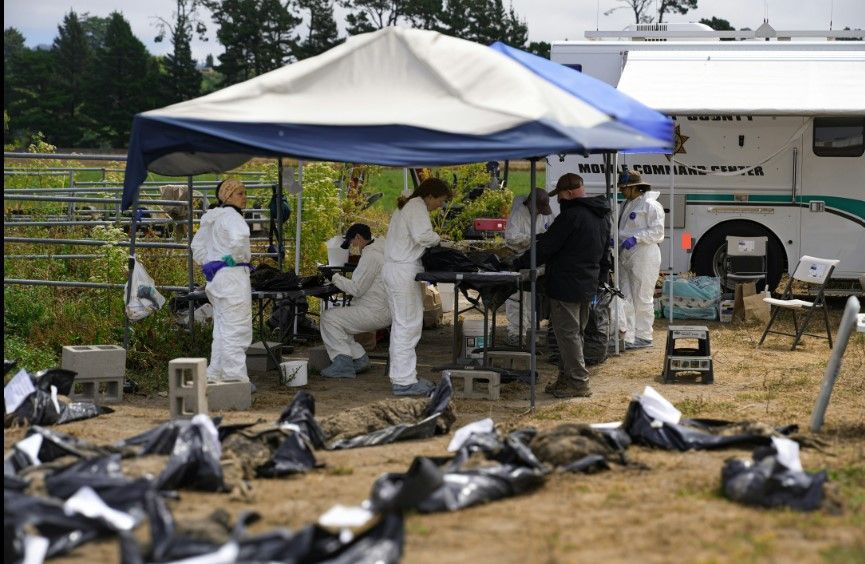
A scene from rescues effort and investigation in Northern California at Miranda’s Rescue. Photo courtesy Humboldt County Sheriff’s Office
By Karen Pearlman, East County Magazine
In light of recent high-profile cases exposing gaps in oversight, transparency and accountability for companion animals, some of California’s top animal welfare organizations are lobbying for the creation of a centralized Bureau of Companion Animal Welfare within the California Department of Food and Agriculture.
A coalition — which includes San Diego Humane Society, California Animal Welfare Association (CalAnimals, the state’s association for animal shelters and animal control agencies), San Francisco SPCA, Valley Humane Society, Animal Legal Defense Fund, the Humboldt County Sheriff’s Office, the ASPCA, Humane World for Animals, Best Friends Animal Society and Oakland Animal Services — will hold a collaborative press conference at 10 a.m., Monday, Aug. 24 at the California State Capitol in Sacramento. Lawmakers, shelter representatives and law enforcement members are expected to attend.
The state has animal protection laws covering the care, sale, transfer, sheltering, boarding and breeding of pets, but no single statewide entity ensures those laws function together. Advocates say the result is a fragmented system in which local agencies often operate with limited resources, inconsistent standards and no reliable mechanism for early intervention.
Two recent cases illustrate the problem, coalition members say.
At Villa Chardonnay, Horses with Wings, Inc. an organization in Julian that presented itself as a sanctuary, San Diego Humane Society executed a search warrant and assumed care of more than 700 animals, including nearly 450 cats plus 30 dogs, 175 horses and more than 70 farm animals, following years of many publicly shared concerns about inadequate conditions on the property.
Investigators found Villa Chardonnay-housed animals suffering from malnutrition, emaciation, untreated wounds, infections and substandard medical care. Many of the animals rescued from the Julian site required extensive treatment, while others were euthanized to end severe suffering.
“Villa Chardonnay showed us the enormous cost of waiting until a situation becomes catastrophic,” said Jace Huggins, vice president and chief of humane law enforcement at SDHS. “Rescuing 728 animals required an extraordinary mobilization of investigators, veterinarians, animal care teams and community partners. A statewide bureau would not replace local enforcement, but it could provide the licensing, inspections and complaint-response infrastructure needed to identify warning signs before hundreds of animals are in crisis.”
Further north, in Humboldt County, Miranda’s Rescue remains under active investigation, according to the Humboldt County Sheriff’s Office, amid allegations that dogs accepted by the organization were killed and falsely represented as adopted.
Humboldt County Sheriff’s Deputies said investigators recovered canine remains, skulls, bones and more than 600 dog collars from Miranda’s Rescue property, and that preliminary examinations indicated many of the recovered dogs died from gunshot wounds. Hundreds of additional dogs transferred to the rescue remain unaccounted for. The investigation is ongoing.
“The investigation into Miranda’s Rescue has highlighted the need for greater accountability and transparency for organizations entrusted with animals,” said Humboldt County Sheriff William F. Honsal.
“Law enforcement is designed to investigate suspected crimes after evidence comes to light; it is not a substitute for routine licensing, inspections and reliable reporting. A statewide Bureau will give California an earlier line of sight into how animals are received, cared for, transferred and adopted, while preserving the authority of local agencies.”
Supporters say a Bureau could license and register companion-animal businesses and organizations, conduct inspections, investigate complaints, support enforcement of existing laws, collect and publish statewide data, provide the public a clear reporting channel, and coordinate with local animal control, public health and other agencies.
Funding could come from a tiered, fee-supported licensing model that accounts for organization size, type and animal volume.
Darcy Smith, co-founder of Funky Chicken Rescue in Vacaville, said she supports stronger protections for animals but opposes adding another layer of bureaucracy.
California already has animal welfare laws, animal control agencies, code enforcement and law enforcement, she said — the focus, and the funding, should go toward strengthening those existing systems.
Smith has closely followed a separate case involving a Duck Sanctuary run by Howard Berkowitz, whose operation was raided in Valley Center on July 16 after moving into San Diego County following years of code enforcement contacts in Riverside County.
More than 800 animals, most of them birds, were seized, and Berkowitz was arrested on a Riverside County warrant. Smith said Riverside County code enforcement cited Berkowitz repeatedly over the years but that he continued relocating the operation rather than face impoundment of his animals. She said many animal control agencies are severely understaffed and underfunded, leaving officers unable to thoroughly investigate every complaint or conduct needed follow-ups.
“Rather than spending money creating another Bureau, I would much rather see those resources invested directly into local Animal Control — more officers, better training, stronger investigative resources, and the ability to follow up on every credible allegation of neglect and abuse,” Smith said. “Accountability and additional bureaucracy are not the same thing.”
Audrey Reynolds of Saving Horses Inc. said she raised concerns about conditions at Villa Chardonnay for years before the intervention took place, and that she and another advocate, Annette Ledda, came forward with evidence in 2024.
Reynolds said she supports creating a state-level agency the public can turn to when local government response falls short, while stressing that laws still need to be enforced locally first.
“Who can I go to in Sacramento?” Reynolds said. “It’s time for some type of change.”
Not everyone is ‘the bad guy’
Coalition leaders emphasized that the vast majority of California’s shelters, rescues, foster groups, veterinarians, boarding providers and breeders operate responsibly.
The recent cases, they said, illustrate what can happen in the absence of consistent licensing, inspections, reporting requirements and statewide accountability — and local agencies and nonprofits often shoulder that responsibility with limited coordination or shared data.
“California’s shelters and animal control agencies are being asked to operate within a statewide system that has no common foundation for licensing, inspections or information sharing,” said Jill Tucker, CEO of CalAnimals. “A Bureau would establish clear, consistent expectations, help organizations understand and meet those standards, and allow small problems to be corrected before they become costly tragedies.”
The coalition continues to call on the California Legislature and the next governor to establish the bureau, championing the ideas that doing so would give the state the tools, expertise and accountability needed to protect companion animals, consumers and communities.
About the Writer: Karen Pearlman
Karen Pearlman is a longtime San Diego journalist and associate editor at East County Magazine, where she covers local news, government, community issues and feature stories.



Thanks to Our Community Sponsors
Have a suggestion, question or comment? Let us know.
Andrea McKenna, RAM Media Foundation, Executive Director
PO Box 2436
Borrego Springs, Ca. 92004
Would you like to become a supporter of RAM Media Foundation? Reach out today!
- Privacy